The Quietest Table in the Mess
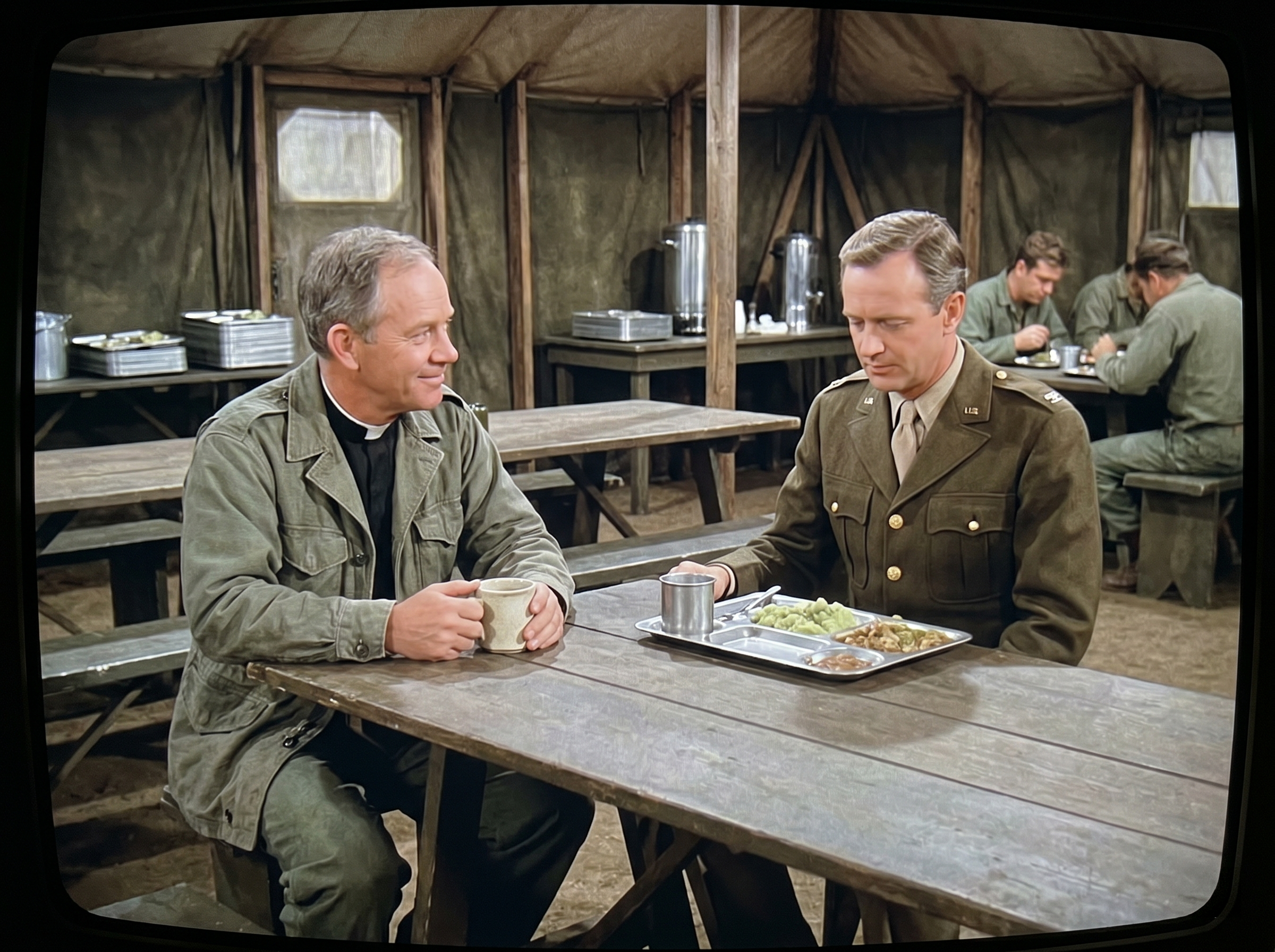
The hum of the 4077th’s mess tent was usually a cacophony of scraping trays, shouted complaints about the liver, and the distant, reassuring rumble of a generator. But today, the air felt heavy, pressed thin by a long, exhausting shift that had stretched into the early morning hours.
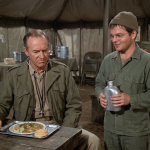
Father Mulcahy sat at a corner table, his fingers wrapped tight around a dented ceramic mug that had long since gone cold. Across from him, Major Charles Emerson Winchester III stared down at a tray of unrecognizable green mush with the grim detachment of a man surveying a crime scene.
Charles had been silent for an hour, his usual razor-sharp wit buried under a mountain of fatigue. He picked at his meal, his posture stiff, holding onto his dignity like a fragile shield.
“It’s not quite the coq au vin you’re accustomed to, Charles,” Mulcahy said, his voice barely a whisper, intended only for his companion. “But it is, technically, sustenance.”
Charles didn’t look up, though a small, involuntary twitch appeared at the corner of his eye. “Father, to call this ‘sustenance’ is to insult the very concept of biology. It is, perhaps, a primitive form of mortar, designed specifically to repair the cracks in our collective morale.”
He paused, his hand hovering over his tray. He looked tired—not just the sleep-deprived kind of tired, but the kind that reaches down into the marrow of a person.
“I received a letter this morning,” Charles suddenly confessed, his voice uncharacteristically brittle. He finally looked up at the Chaplain, his composure cracking just enough to let the raw, human exhaustion underneath shine through. “My mother writes that the symphony back home has started their new season without me. She says they’ve replaced my seat.”
The tent seemed to go silent. The weight of that small, personal loss hung in the air, sharper and more painful than any casualty report. It wasn’t just a chair in an orchestra; it was the life he had built, the identity he had fought to preserve, slipping further away into the fog of war.
Mulcahy set his mug down, his expression softening into that familiar, saintly patience that had seen them through a thousand dark nights. He didn’t offer a platitude. He didn’t quote scripture. He simply leaned forward, his elbows resting on the weathered wood of the table.
“Charles,” Mulcahy said gently, “I suspect the music hasn’t stopped. It’s just playing in a different key.”
Charles let out a short, cynical laugh, though it lacked its usual bite. “A different key? Father, I am currently composing a symphony of chaos, scored entirely for the instruments of scalpels and suction machines.”
“And yet,” Mulcahy continued, gesturing toward the mess tent, “you are here. You helped a soldier walk out of this camp on his own two feet today, a man who, by all accounts, shouldn’t have been able to stand. If that isn’t a masterpiece of sorts, I don’t know what is.”
Charles looked at his tray, then back at the kind, weathered face of the man who had comforted more broken souls than anyone else in Korea. The sharp lines around his mouth relaxed, just a fraction. The sarcasm, his primary defense mechanism, finally faltered.
“I suppose,” Charles murmured, his voice thick with a sudden, unbidden vulnerability, “that there is a certain… rhythm to the survival we practice here. It is not the music I intended to play. But it is, at the very least, a melody of sorts.”
He picked up his fork and, with a resigned sigh, took a small, hesitant bite of the green mush. He grimaced, but he didn’t complain. For a brief moment, the two men sat in the quiet, the vast distance between a Boston aristocrat and a small-town priest evaporating in the dim, yellow light of the tent.
They weren’t colleagues, or officers, or even just soldiers anymore. They were simply two tired men in a place that asked too much of them, finding a momentary sanctuary in the shared ritual of a meal.
As the morning light began to filter through the canvas, illuminating the dust motes dancing between them, the crushing weight of the war felt just a little bit lighter. The symphony hadn’t stopped; it had just changed, and for today, that was enough. They finished their food in comfortable silence, two friends at the end of the world, knowing that when the next whistle blew, they would stand up and face the music together.
—
In the heart of the 4077th, even the smallest moments of grace were the ones that kept us whole.