The Wood and the Wire
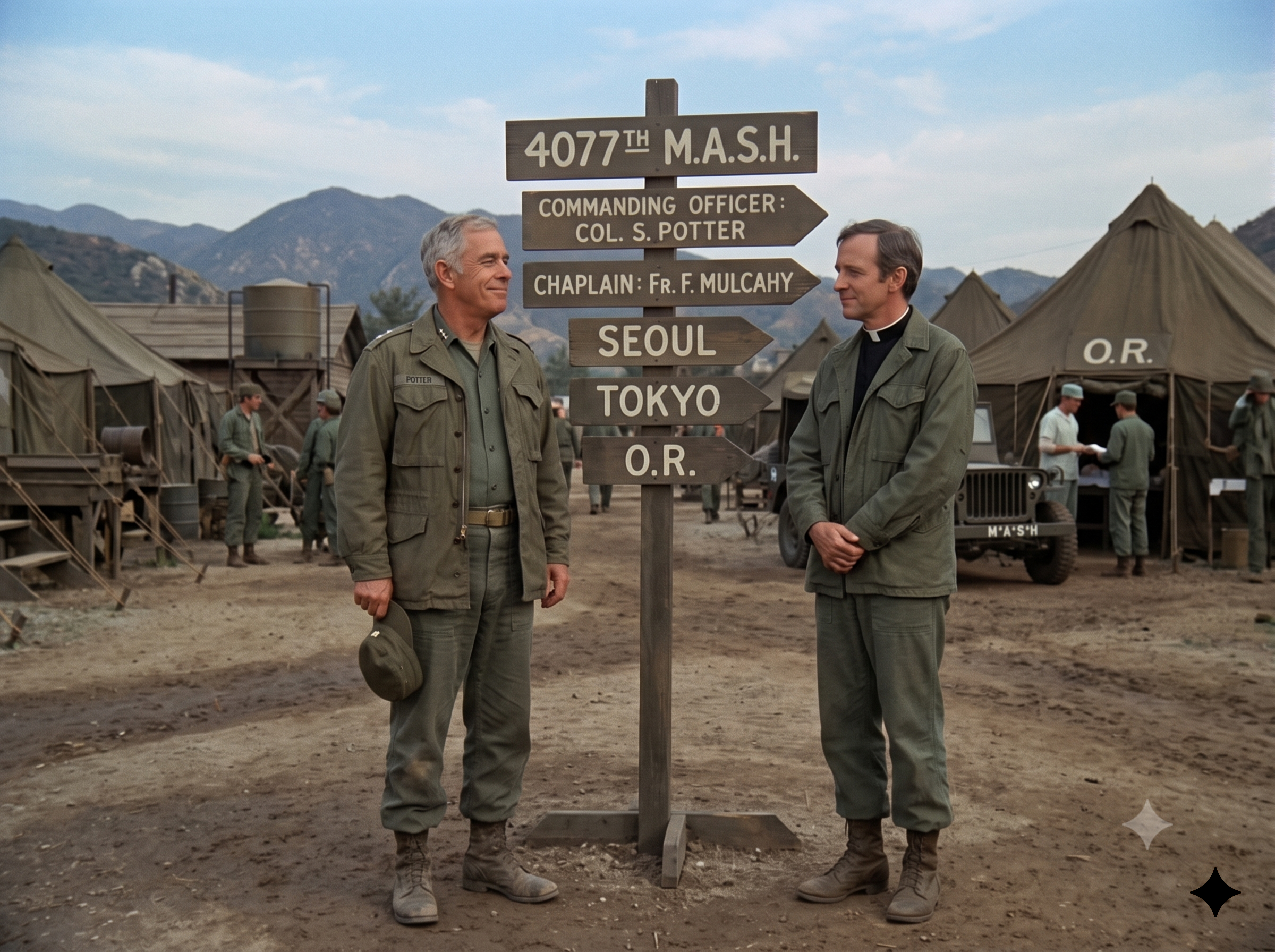
There were rare, fragile moments at the 4077th when the war simply forgot to make a sound.
The relentless hum of the generators would temporarily fade into the background, and the sky would settle into a soft, dusty blue. It was during one of these quiet reprieves that Colonel Sherman T. Potter found himself standing in the center of the compound. He stood on the dry dirt path, hands resting on his hips, his posture compact and stable.
Before him stood the famous wooden signpost, a chaotic tree of arrows pointing to places that felt more like myths than reality.
Potter wore his weathered fatigues, the fabric lived-in and comfortable after months of dust and starch. He looked up at the painted towns—Boston, Toledo, San Francisco, Hannibal. A look of gentle pride crossed his face, not for the war, but for the people who had nailed those pieces of scrap wood to the post.
From the shadow of the mess tent, Father Francis Mulcahy approached. The priest stepped lightly, his black shirt and white collar a stark contrast to the endless sea of olive drab.
Mulcahy stopped slightly to the side of the Colonel. His hands were clasped gently in front of him, fingers intertwined in a gesture that was half-prayer, half-patience.
“They never seem to get any closer, do they, Colonel?” Mulcahy asked softly.
Potter didn’t turn his head right away. He just smiled, the corners of his eyes crinkling beneath the brim of his hat. “No, Padre. I suppose they don’t. Sometimes I think if you stare at them long enough, the miles actually go up.”
Mulcahy offered a warm, quiet smile, though his eyes carried the heavy, unmistakable weight of the morning’s surgical shift. It had been a long three days. The kind of days that made a man forget what year it was, let alone what continent he was standing on.
“I was just thinking,” Mulcahy murmured, his voice barely above a whisper. “About the sheer distance. Not just the physical miles, Colonel. But the distance between who these young men were when they left home, and who they are when we send them back.”
Potter finally turned to look at the priest. He saw the hopeful warmth in Mulcahy’s face, but also the deep, quiet sadness that the Father tried so hard to hide from the rest of the camp.
“War changes the geography of a man’s soul, Father,” Potter said, his voice carrying a fatherly gravel. “You can’t walk through this kind of fire and not come out a little singed around the edges.”
The two men stood in silence, letting the dusty beige air settle around them. The canvas tents flapped weakly in a sudden, passing breeze.
Mulcahy looked down at his folded hands. “I try to give them comfort, Colonel. I read the scriptures, I hold their hands, I write letters to their mothers. But lately…”
The priest’s voice trailed off, cracking just a fraction of an inch.
“Lately what, Francis?” Potter asked, stepping a few inches closer, offering his sturdy presence.
“Lately, I wonder if a prayer is nothing more than a bandage made of air,” Mulcahy confessed, his eyes lifting back to the signpost. “The surgeons, they pull out the shrapnel. They stitch the skin. But me? I wonder if I am doing any good at all when the pain is this loud.”
Suddenly, the ground beneath their boots trembled.
A low, thunderous rumble echoed over the distant ridge, rattling the wooden arrows on the post. It wasn’t thunder. It was heavy artillery, miles away, but close enough to remind them that the silence was only an illusion.
The wooden arrow pointing to ‘Crabapple Cove’ shivered on its rusty nail.
Potter’s jaw tightened. Mulcahy closed his eyes, his knuckles turning white as he gripped his own hands tighter. The war was waking up again, and the heavy burden of duty was rushing back to crush the breath right out of them.
The rumble rolled through the valley and finally faded, leaving a heavy, ringing stillness in its wake.
Potter reached out and placed a steady, calloused hand on Mulcahy’s shoulder. The grip was firm, grounding the priest back to the dirt path of the compound.
“Francis, look at me,” Potter said gently.
Mulcahy opened his eyes, taking a slow, shaky breath. He turned to his commanding officer, looking every bit like a man who was carrying the spiritual weight of an entire army on his modest shoulders.
“You listen to an old cavalry man,” Potter said, his tone dry but brimming with deep affection. “I’ve seen a lot of wars. I’ve seen men stitch up bodies in France, and I’ve seen them do it in the Pacific. Hawkeye, B.J., Winchester… they can sew a boy’s leg back together. But they can’t sew up his spirit.”
Mulcahy offered a weak, self-deprecating smile. “Sometimes I feel like I’m just offering words to boys who are entirely deafened by artillery.”
“You are offering them their humanity,” Potter corrected firmly. “When those boys wake up in post-op, they are terrified. They don’t know where they are. They look around and see blood, and mud, and tents. But then they see you.”
Potter gestured toward the signpost with his chin.
“This piece of wood right here? It points to their homes,” Potter explained. “But you, Padre? You are a piece of home they can actually touch. When you sit with them, they aren’t just a serial number on a dog tag. They are a son, a brother, a human being.”
Mulcahy’s posture softened. The deep tension in his shoulders seemed to melt away under the Colonel’s wise, steady words.
“A bandage made of air,” Potter repeated with a soft chuckle. “Maybe so. But down here in the mud, air is exactly what we need to keep breathing.”
Just then, the screen door of the company clerk’s office slammed open.
Radar O’Reilly trotted out into the dusty compound, clutching a clipboard to his chest like a shield. He wore his oversized knit cap, his round glasses glinting in the muted sunlight. He skidded to a halt when he saw the Colonel and the Father.
“Uh, excuse me, Colonel, sir? Father?” Radar stammered, looking nervously between the two men.
“What is it, son?” Potter asked, his voice instantly shifting back to the patient tone of a camp commander.
“Sparky just called from I Corps, sir. He says they got a mix-up on the supply trucks. We aren’t getting the extra powdered eggs this week.” Radar paused, looking tragically grim. “We’re getting three hundred cans of creamed corn instead.”
Potter let out a long, heavy sigh, pulling off his hat to wipe his brow. “Lord, hear our prayer. The mess tent is going to smell like a Nebraska silo.”
Mulcahy couldn’t help it. A genuine, bright laugh escaped his lips. The quiet sadness that had clouded his eyes just moments before dissolved into the warm, ridiculous reality of the 4077th.
“I suppose I should start praying for the digestion of the camp, Colonel,” Mulcahy smiled, his hands finally relaxing at his sides.
“You do that, Padre. Make it a priority,” Potter said, putting his hat back on. “Thank you, Radar. Dismissed.”
Radar gave a crisp, slightly awkward salute, turned on his heel, and scurried off toward the mess tent to deliver the tragic news to the cooks.
The compound was quiet again, but the heavy, oppressive weight of the war felt just a little bit lighter. The absurdity of creamed corn had a funny way of bringing them all back down to earth.
Potter and Mulcahy turned their attention back to the wooden signpost. The arrows stood silent, pointing across the globe, silently holding the dreams of two hundred tired people.
“It’s a long way to anywhere, isn’t it?” Mulcahy said, his voice finally at peace.
“Sure is,” Potter nodded, looking at the arrow for Hannibal, Missouri. “But as long as we’re stuck in the middle of nowhere, I’m glad I’m stuck here with you people.”
Mulcahy smiled, feeling a deep, profound sense of gratitude for the gruff, big-hearted Colonel beside him. They were thousands of miles from the places they loved, but they had somehow managed to build a family right here in the dirt.
“Shall we go check on the patients, Colonel?” Mulcahy asked.
“Lead the way, Francis,” Potter replied.
They turned their backs to the signpost and walked slowly toward the post-op ward side by side, two good men walking into the darkness, carrying just enough light for everyone else.
Home was thousands of miles away, but as long as they had each other, they were already exactly where they needed to be.