The Quiet Weight of the Canvas Sky
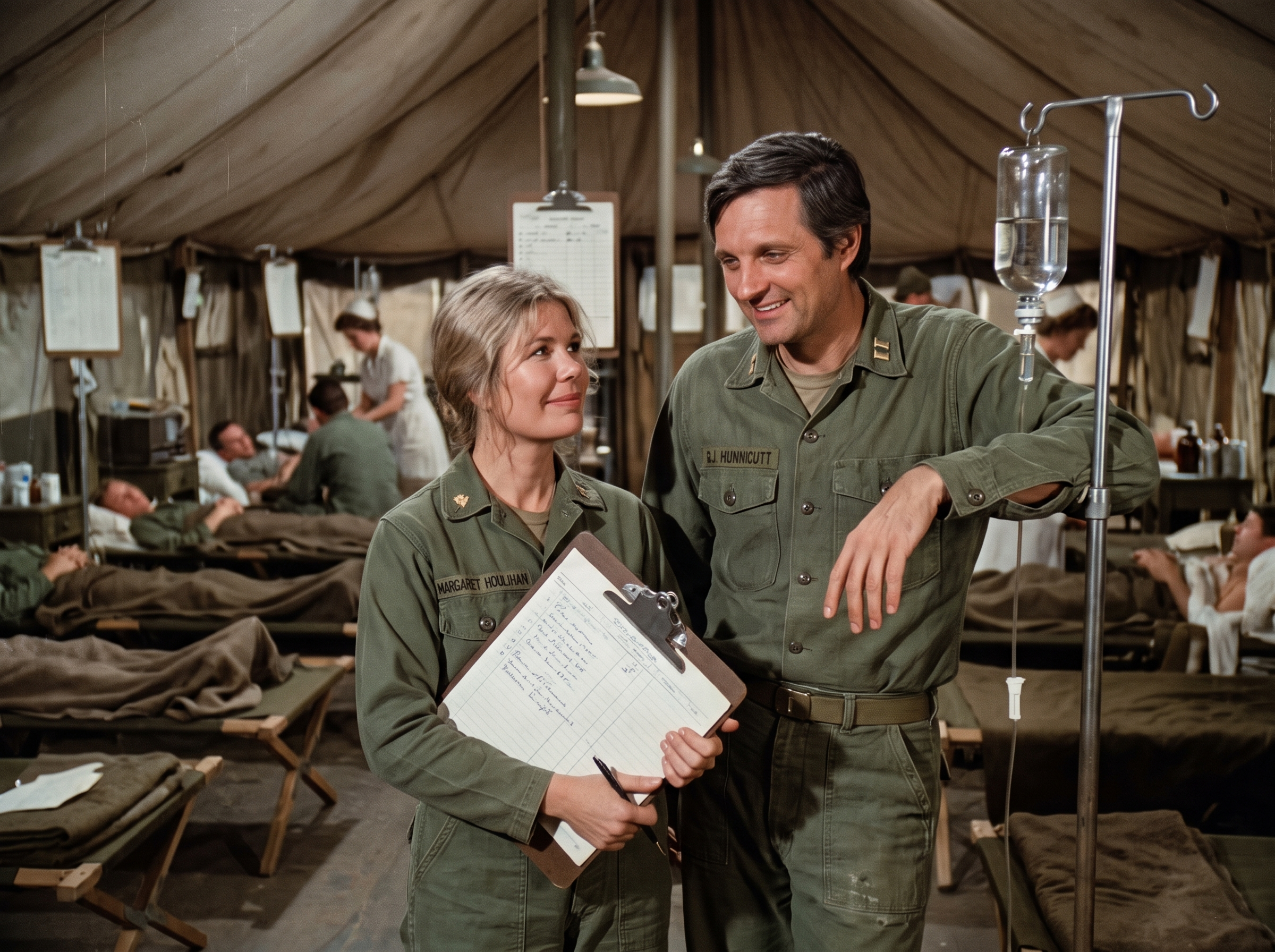
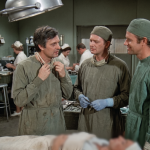
There was a very specific kind of silence that fell over the Post-Op ward after a thirty-six-hour marathon in the OR.
It wasn’t an empty silence.
It was heavy, thick with the rhythmic sound of a dozen sleeping chests rising and falling under muted white blankets.
Outside the canvas walls, the Korean wind was howling, and the camp was slowly waking up to another gray morning.
But inside the tent, time seemed to stand completely still.
Captain B.J. Hunnicutt was too tired to make the fifty-yard trek back to the Swamp.
His boots felt like they were cast in solid lead.
Instead of leaving, he had drifted to the back of the ward, leaning his entire exhausted weight against a metal IV stand.
He didn’t care that the metal was cold, or that he was practically sleeping on his feet.
Right now, that simple aluminum pole was the only thing keeping him tethered to the earth.
He closed his eyes for just a second, letting the ambient warmth of the heaters wash over his face.
Then, the soft, deliberate sound of boots on the wooden floorboards made him open them again.
It was Major Margaret Houlihan.
She was moving down the row of cots, doing her final rounds before turning the ward over to the day shift.
Even after thirty-six hours of blood, mud, and endless coffee, her posture was remarkably straight.
She held a medical clipboard against her chest like a wooden shield.
It was the armor she always wore, the professional distance that kept the horrors of the 4077th from swallowing her whole.
But as she stopped near B.J., the dim, pale green light of the ward caught her face.
The armor was cracking.
She looked down at the clipboard, her eyes scanning the vitals of a nineteen-year-old kid from Ohio who, just hours ago, had been slipping away from them on the operating table.
B.J. watched her silently, not wanting to break the fragile peace of the room.
He saw the way her knuckles were white as she gripped the edges of the board.
He saw the tiny, involuntary tremble in her lower lip.
Margaret took a slow, trembling breath, her eyes still locked on the paper.
“His pressure is stabilizing,” she whispered, her voice barely louder than the hum of the heaters.
She didn’t sound like Regular Army right now.
She sounded small, tired, and profoundly human.
She looked up from the chart, her eyes meeting B.J.’s across the narrow aisle between the canvas partitions.
In that single glance, all the rank, all the regulations, and all the defensive bluster simply vanished.
Her face was entirely unguarded, revealing a soft, quiet, and deeply vulnerable tenderness that she almost never let anyone see.
It was the look of a woman who had just realized she had helped pull off a miracle, and the sheer emotional weight of it was suddenly too much to carry alone.
Her eyes pooled with unshed tears, and for a terrifying second, she looked like she was going to completely fall apart.
She stood frozen, the clipboard trembling against her chest, trapped in the heavy silence and waiting for the ground to give way.
B.J. didn’t move from his spot against the IV stand.
He didn’t offer a quick joke or a sarcastic remark to deflect the tension.
Instead, he just looked at her, his posture relaxed and deeply grounded.
Slowly, an incredibly warm, deeply empathetic smile spread across his tired face.
It wasn’t a smile of pity, and it wasn’t a smile of triumph.
It was a smile of pure, unspoken understanding.
“You did good, Margaret,” he said softly, his voice a steady rumble in the quiet tent.
The simple, honest words seemed to break the spell.
Margaret let out a shaky breath, the tension leaving her shoulders all at once.
She didn’t look away.
She held his gaze, anchoring herself to the quiet strength in his eyes.
“We almost lost him, Beej,” she whispered, the nickname slipping out naturally.
“I know,” B.J. nodded, his smile never wavering. “But we didn’t.”
He shifted his weight slightly, leaning a little closer, though he kept his hands deep in his pockets.
“You were brilliant in there,” he added gently. “I’ve never seen anyone clamp an artery that fast. You didn’t even blink.”
Margaret looked down at the clipboard again, but this time, the gesture wasn’t defensive.
A small, proud smile tugged at the corners of her mouth.
The vulnerable tenderness in her eyes shifted into a quiet, profound gratitude.
“I had a good surgeon,” she replied, her voice regaining a fraction of its usual strength, though the softness remained.
She stepped closer to the IV pole, standing just a few feet away from him.
They stood there together in the muted gray and white light, two people separated by background, rank, and temperament, but united by the impossible reality they shared.
The war was waiting for them just outside the canvas flaps.
There would be more choppers, more wounded, more endless nights that tested the limits of their sanity.
But right now, in this tiny pocket of space and time, there was only peace.
Margaret looked at B.J., really looked at him, taking in the deep lines of exhaustion around his eyes and the relaxed, easy way he leaned against the cold metal.
“How do you do it?” she asked softly, the question genuine and searching.
“Do what?” B.J. asked, his eyes crinkling warmly.
“Keep that smile,” Margaret said. “Keep your balance. After everything we see in there… you always walk out looking like you know a secret the rest of us don’t.”
B.J. chuckled quietly, a warm, tired sound.
He looked down at his scuffed boots, then back up at her.
“It’s no secret, Margaret,” he said gently. “I just remember what I’m going back to. And I remember that every kid we patch up in here is going back to something, too.”
He tapped the IV pole lightly with his fingers.
“You just have to find your anchor,” he said. “Something to hold onto when the wind gets too strong.”
Margaret absorbed his words in silence.
She looked at the rows of sleeping soldiers, the quiet evidence of their long, brutal night.
Then she looked back at B.J., her expression filled with a deep, unspoken mutual respect.
In that moment, she realized that while she often relied on rules and regulations to keep her standing, B.J. relied on pure humanity.
And right now, his humanity was exactly what she needed.
She took a deep breath, the crisp, antiseptic air filling her lungs.
The moment of overwhelming vulnerability had passed, replaced by a quiet, steady resolve.
She gripped the clipboard a little more firmly, not as a shield, but as a badge of honor.
She was Major Margaret Houlihan, and she had done her job well.
“You should get some sleep, Captain,” she said, her tone professional again, but laced with an undeniable, lingering warmth.
“You too, Major,” B.J. replied, his smile widening just a fraction.
Margaret gave him one last, lingering look of gratitude.
She didn’t say thank you.
She didn’t have to.
She turned and walked quietly down the aisle, her boots making soft, even sounds on the floorboards, heading out to face whatever the morning would bring.
B.J. watched her go, leaning against his aluminum anchor for just one more minute, finding his own small measure of peace in the quiet breathing of the ward.
He closed his eyes again, smiling into the shadows, knowing that tomorrow they would do it all over again.
And knowing that, together, they would survive it.
In a place defined by mud and madness, sometimes the greatest medicine was simply the quiet presence of a friend who understood.