Bandages and Sarcasm: A Quiet Aftermath
You didn’t have to know the day of the week to understand the atmosphere at the 4077th; you just had to look at the tired eyes.
They were in that strange, silent eye-of-the-storm after a long, exhausting OR push. The adrenaline had faded, leaving only a bone-deep weariness and the dusty reality of the camp.
Behind them, the row of green tents stretched out like a silent testament to the number of lives that drifted through. The dusty ground was tracked with bootprints and the tires of trucks that never seemed to stop.
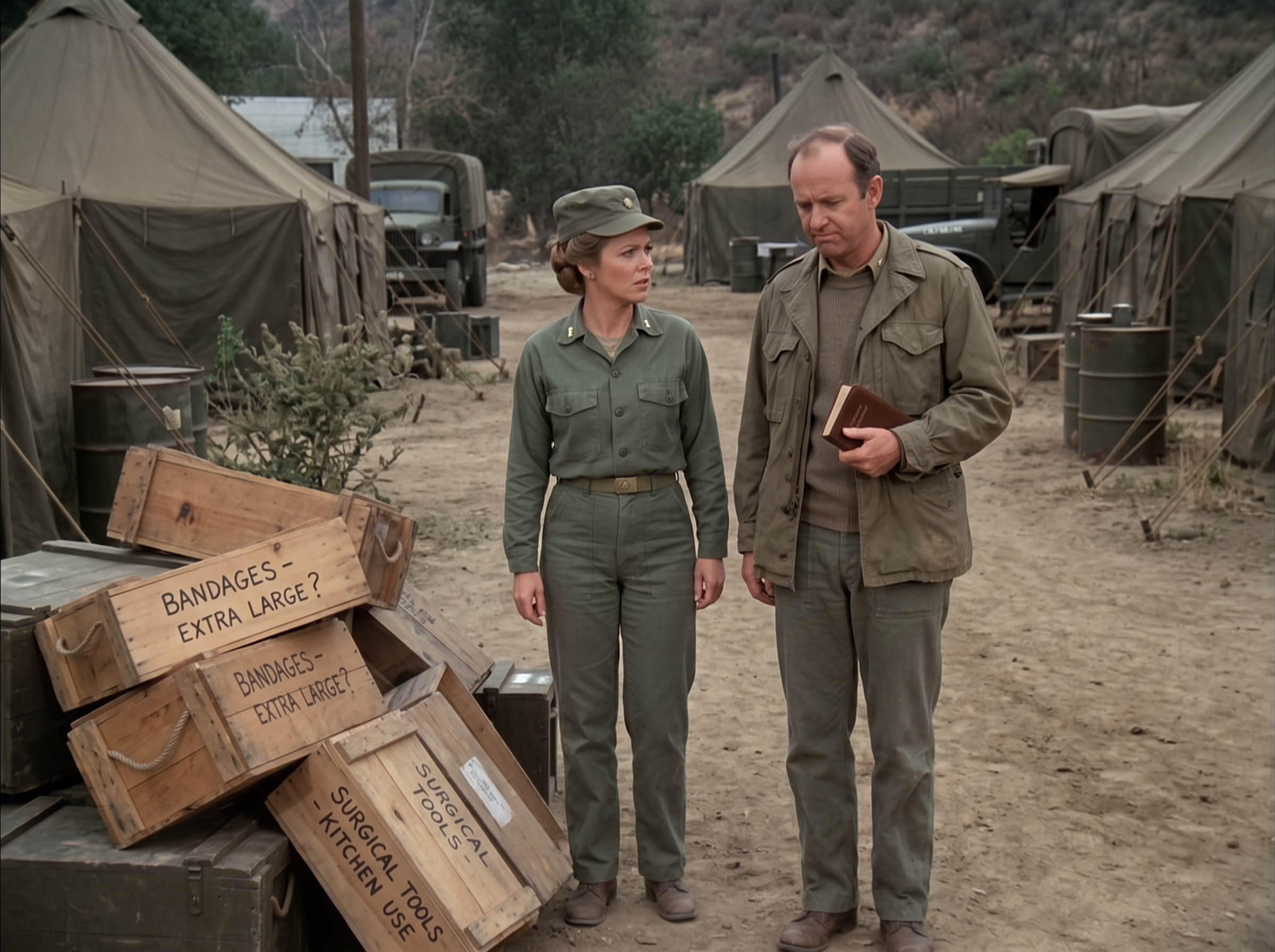
Margaret Houlihan, looking impossibly neat for someone who’d spent twelve hours in blood, stood centered in the path, her hands relaxed at her sides. Her uniform was perfect, her posture strong, but a distinct line of tension marked her face. She was surveying a new arrival.
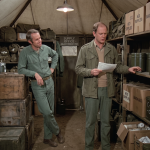
By “arrival,” it meant three fresh, unstained wooden crates that had just been unloaded. They looked out of place against the weathered barrels and old, dark trunks that littered the foreground, a reminder of the endless cycle of supplies and surgeries.
Charles Emerson Winchester III stood just to her side. He looked weary too, but his disgust with the camp remained evergreen. He was absently holding a small, brown-bound book, likely a distraction that had just failed him.
He raised an eyebrow, gesturing to the stack of fresh crates. The tension came not from a massive crisis, but from the cumulative absurdity of their situation.
“Well,” Winchester drawled, his voice thick with cultivated disdain and heavy fatigue. “It seems we are now perfectly equipped for… a very specialized kind of medical emergency.”
Margaret followed his gaze. One crate, labeled clearly in large, block letters, read: **BANDAGES – EXTRA LARGE?**
Another, just below it and slightly angled, echoed the doubt. **BANDAGES – EXTRA LARGE?** The question marks were bold and almost playful.
But it was the third crate, the one near his right foot, that had pushed the major past sarcasm and into genuine exasperation. It was titled with careful clarity: **SURGICAL TOOLS – KITCHEN USE**.
Winchester’s expression was a perfect portrait of defeat. He seemed to be asking the universe if there was anyone *actually* running this supply chain. “Must we now sterilize the ladles, Major? Should I consult Mrs. Beeton before the next resection?”
Winchester let out a theatrical sigh, gripping his small book tighter as if it could shield him from the incompetence surrounding them. “Kitchen use. It’s preposterous.”
Major Houlihan continued to stare at the crates. Her gaze didn’t soften; if anything, it intensified. Winchester had seen that look before. It was the look she got when she was about to make things happen through sheer force of will, but also when she was processing the quiet human failures that nobody talked about.
For a long moment, the only sound was the wind rustling the dry, brittle scrub brush near the crates. Margaret didn’t snap at him. She didn’t march off to file a complaint. She just *stared*.
Finally, her voice came, unusually quiet. “Extra large,” she repeated the words from the top crate.
“And questionable,” Charles added dryly. “The supply clerk in Seoul must be a comedian.”
“It’s not just the bandages, Major,” she replied, her gaze moving down past the ‘Kitchen Use’ label to the older, dirtier boxes and barrels piled around them. “Look at this mess. This camp. It’s a junk heap. No order. Just things piled upon things.”
She made a vague, sweeping gesture that took in the supply yard, the dusty trucks, and the endless green tents. It wasn’t about the misspelled labels anymore.
Winchester watched her profile. The strong jaw, the determined set of her shoulders. She was, he realized, near the breaking point of this quiet phase. Exhaustion makes everything sharper and harder to ignore.
“We have critical cases waiting on back-ordered plasma, and we receive…” he gestured again with the book, “…Bandages? Extra Large? And culinary scalpels. Major, I believe the proper response is despair, not inspection.”
He expected her to agree, perhaps even order him to find Hawkeye and Klinger and make *them* deal with the crates. But Margaret surprised him.
She knelt down in the dust. The action was slow and deliberate. With a practiced snap, she pulled the crowbar she must have been hiding up her sleeve (or perhaps just produced from sheer force of memory of where such tools *ought* to be). She positioned it under the lid of the ‘Extra Large’ crate.
Winchester stood over her, bemused. “And what, pray tell, are we doing, Major? Assessing the comedic timing of bandages?”
A single, crisp *CRACK* split the afternoon air. The lid gave way.
Margaret pulled a roll of white cotton out. It wasn’t ‘extra large.’ It was standard 4-inch cotton batting. Precisely what they needed for the surgical packs.
She held the roll up to Winchester, her tension breaking, not into a smile, but into a determined look of command. “Major, they aren’t ‘Extra Large?’ Bandages. These are exactly what we were screaming for three days ago. They mislabeled the entire shipment.”
She gestured to the other two boxes. “The kitchen tools… that crate probably holds the real surgical kits.”
He blinked. The sarcasm drained away, replaced by a momentary flash of understanding. This wasn’t about bureaucratic failure. This was about their lifeline, delivered sideways.
Margaret didn’t waste another second. “Get these inside, Major. Start the autoclave. We aren’t waiting for supply clerks. If they came, we’re using them.”
She got to her feet and looked at him, her expression hardening again, but with purpose this time. The brief moment of shared vulnerability over the camp’s clutter was over.
Winchester nodded. He tucked the small book—perhaps containing poems, perhaps Shakespeare, some artifact of another life—deep into the pocket of his jacket. With a sigh that now signaled work rather than complaint, he reached down to hoist the heavy, newly valuable crate.
“I will,” he muttered, though not with his usual contempt. He looked at her. “Efficient as always, Major.”
He began to lift the box, his elegant fingers gripping the rough wood.
Margaret picked up the roll of batting she had dropped. She walked past him, already moving toward the OR. For one last second, as she walked away, Winchester watched her. The lines of tension were still there, but she was in motion again.
He raised a sarcastic eyebrow to the other ‘Kitchen Use’ crate, as if to say, *Don’t get used to this, supply unit.* But as he walked toward the supply tent with his burden, Winchester glanced at the dusty ground and the cluttered yard. It was a junk heap. A beautiful, messy junk heap that kept pushing back against the impossible, day after day. And somehow, in that moment, he felt a strange, grudging affection for its stubborn survival.
They learned to find hope in the errors, order in the mess, and life wherever they could.