The Fine Print of the 4077th
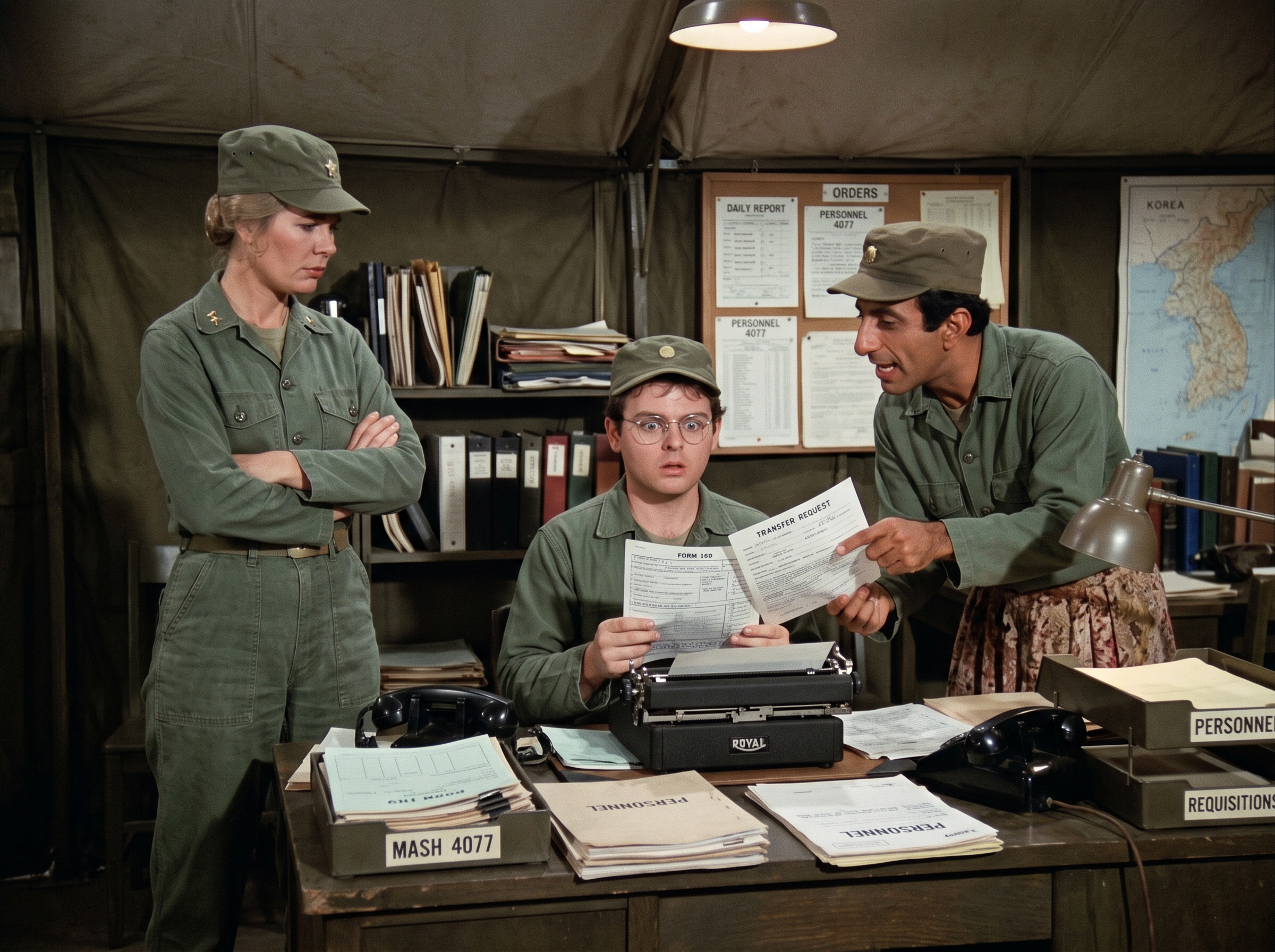
The war in Korea wasn’t just fought with scalpels, plasma, and midnight choppers. A good portion of it was fought with triplicate forms, carbon paper, and a heavy Royal typewriter.
Inside the company clerk’s office, the air was thick with the scent of hot canvas, stale coffee, and endless bureaucracy. It was a stifling Tuesday afternoon at the 4077th.
The camp was trapped in one of those rare, agonizing lulls between bug-outs and wounded transports. In the quiet, the sheer boredom and fatigue weighed on everyone like a wet wool blanket.
Radar O’Reilly sat behind his cluttered desk, surrounded by the paper barricades of his modest empire.
To his left, wire trays were neatly labeled “MASH 4077”, “PERSONNEL”, and “REQUISITIONS”. To his right, a heavy black rotary field phone sat silent, like a sleeping guard dog.
Radar was just trying to sort through the daily reports when the door swung open.
In strode Corporal Maxwell Klinger. He moved with the theatrical posture of a conquering hero returning to Rome.
Klinger was dressed in his standard olive drab fatigue shirt and a standard-issue cap, completely regulation from the waist up. From the waist down, however, he was sporting a remarkably vibrant, flowing floral skirt.
He didn’t walk; he practically glided across the plywood floor, his face lit up with expressive, comic pride.
“Read it and weep, O’Reilly!” Klinger declared, slapping a pristine piece of paper onto the desk. “The golden ticket. The grand exit. The magic words that will finally send Maxwell Klinger back to the neon lights of Toledo!”
Radar blinked, his wide, innocent eyes magnified behind his round glasses. He picked up the paper, holding it delicately as if it might explode.
It was clearly labeled “TRANSFER REQUEST” in bold, perfectly aligned letters.
Standing beside the desk, Major Margaret Houlihan let out a sharp, practiced sigh. She had been waiting for Radar to locate a missing requisition form for surgical soap.
Margaret stood with her arms tightly folded across her chest, her posture projecting capability and strict authority. Her uniform was crisp, her cap perfectly angled.
She wore a skeptical, controlled expression, clearly frustrated by the interruption but too stubborn to leave without her soap requisition.
“Another brilliant escape plan, Corporal?” Margaret asked dryly, her tone dripping with professional exhaustion. “What is it this time? Are you claiming to be the lost Duchess of Grand Rapids?”
“Better, Major,” Klinger said, leaning over the desk and pointing an eager finger at the document in Radar’s trembling hands. “It’s a forgotten clause. Section 4, Paragraph B of the Army Psychological Purity Act of 1942.”
Klinger tapped the paper emphatically. “It clearly states that any enlisted man caught wearing non-regulation civilian women’s garments exceeding three yards of fabric during a Tuesday inspection is legally required to be sent stateside for immediate evaluation. It’s a loophole big enough to drive a jeep through!”
Radar didn’t look up. He was staring at the second page, a supplementary document titled “FORM 104.”
His brow furrowed into a deep V. The nervous confusion on his young face was rapidly shifting into wide-eyed concern.
“Uh, Klinger…” Radar stammered, his voice cracking slightly. “Did you read the addendum on the back of Form 104?”
“I don’t read addendums, Radar. I read the writing on the wall, and it says ‘Goodbye Korea!'” Klinger beamed, adjusting his cap.
Margaret uncrossed her arms, leaning in just a fraction. She knew that tone in Radar’s voice. It was the tone he used right before the bottom dropped out of a situation.
“What does it say, Corporal O’Reilly?” Margaret asked, her voice losing its sharp edge, replaced by a sudden, careful curiosity.
Radar swallowed hard, clutching the beige paper. The warm, practical light of the desk lamp illuminated the sheer panic sweeping across his face.
“Well,” Radar started, his eyes darting frantically between Klinger’s proud smile and Margaret’s intense stare. “It says… oh boy. It says that under the revised 1951 wartime measures… this specific transfer request has been reclassified.”
Klinger’s smile froze. The theatrical pride wavered. “Reclassified to what, Radar?”
Radar looked up, terrified. “To immediate, permanent reassignment…”
“…to a frontline infantry battalion,” Radar finished, his voice dropping to a distressed whisper.
The silence in the clerk’s office was sudden and heavy. The faint hum of a jeep engine outside only made the quiet inside feel louder.
Klinger stopped pointing. He stood completely frozen, leaning over the typewriter. The proud, confident glow drained from his face, replaced by a look of sheer, unadulterated horror.
“Infantry?” Klinger choked out, the word barely escaping his throat. “Frontline infantry? But… but the skirt! The three yards of fabric! Toledo!”
“According to the fine print,” Radar said, his eyes scanning the olive-drab nightmare of military bureaucracy, “claiming this specific exemption during active wartime is now considered a confession of a desire for hazardous duty. They assume if you want out that bad, you must be crazy enough to volunteer for the front.”
Klinger sank back, looking like a man who had just watched his winning lottery ticket blow into a burning campfire. He smoothed his hands over the floral print of his skirt, completely defeated.
“Hazardous duty,” Klinger whispered. “They found a way to make me crazier than I was pretending to be.”
Margaret stepped forward. The rigid, skeptical frustration completely melted away from her face.
She looked at the broken corporal. She knew the desperate, exhausting lengths Klinger went to, day after day, just to keep a sliver of hope alive. They all did it in their own ways.
“Let me see that, O’Reilly,” Margaret said, her voice dropping into that quiet, capable register she used when a patient was waking up in post-op and needed grounding.
Radar handed her Form 104 and the Transfer Request. Margaret’s eyes scanned the beige paper. She saw the trap, the cruel, mechanical indifference of the Army’s legal department.
She looked from the paper to Klinger, who was staring blankly at the map of Korea on the wall, as if trying to find the exact spot where his life was going to end.
With a swift, fluid motion, Margaret ripped the Transfer Request right down the middle.
Klinger gasped, snapping out of his daze. “Major! What are you doing? That’s a federal document!”
“No, it isn’t,” Margaret said firmly, ripping the papers again into quarters. “It’s a typo. A clerical error.”
She tossed the torn pieces into the small metal trash can beside Radar’s desk.
“As far as I’m concerned, Corporal Klinger never submitted any such paperwork,” Margaret said, looking directly at Radar. “Isn’t that right, O’Reilly?”
Radar sat up a little straighter behind the Royal typewriter. The heavy anxiety lifted from his small shoulders. He understood exactly what the head nurse was doing.
“Yes, ma’am,” Radar said earnestly, a small, grateful smile touching his lips. “I haven’t seen a Transfer Request all week. In fact, my outgoing tray is completely empty.”
Margaret turned her attention back to Klinger. She didn’t offer a hug, and she didn’t offer a sweet smile. That wasn’t who she was. But the look in her eyes was fiercely protective.
“You’re a fool, Klinger,” Margaret said softly. “You spend half your life trying to trick the Army, and you forget that the Army wrote the book on tricks. You stay here. We need our people right here.”
The words hung in the air, carrying a heavy, unspoken weight. Our people.
It was an admission of what they all knew but rarely said out loud. The 4077th was a chaotic, muddy, exhausting nightmare, but it was their nightmare. They kept each other safe in it.
Klinger looked at the trash can, then back to Margaret. His shoulders relaxed. The panic completely faded, replaced by a quiet, profound relief.
He stood up straight, brushing imaginary dust off his fatigue shirt, recovering his dignity.
“You know, Major,” Klinger said, a faint hint of his usual theatrical spark returning to his voice. “I always said you had a magnificent sense of justice. Beneath that tough, regulation exterior beats the heart of a true humanitarian.”
Margaret’s professional mask slipped back into place immediately. She folded her arms again, raising an eyebrow.
“Don’t push it, Corporal,” she warned dryly. “And next time you want to play lawyer, try wearing a sensible suit. That floral print clashes with the olive drab.”
“Noted, Major,” Klinger said, offering a surprisingly sincere salute. He turned on his heel, the skirt swishing around his ankles, and walked out the door. He was still in Korea, but he was safe.
Margaret watched the door close, a tiny, almost invisible smile pulling at the corner of her mouth. She turned back to the desk.
Radar was already pulling a fresh sheet of paper from the tray, rolling it into the typewriter with a comforting, mechanical click.
“Your soap requisition, Major?” Radar asked brightly, his hands hovering over the keys.
“Three boxes, O’Reilly. And make it quick,” Margaret said, her voice brisk but warm. “We have a hospital to run.”
As Radar began to type, the rhythmic clatter filled the small office. Outside, the camp carried on, tired but enduring, held together by triplicate forms, shared exhaustion, and a quiet, unbroken loyalty.
They came to the 4077th looking for a way out, but what they found was a family that wouldn’t let them go it alone.