That Old Box by the Signpost
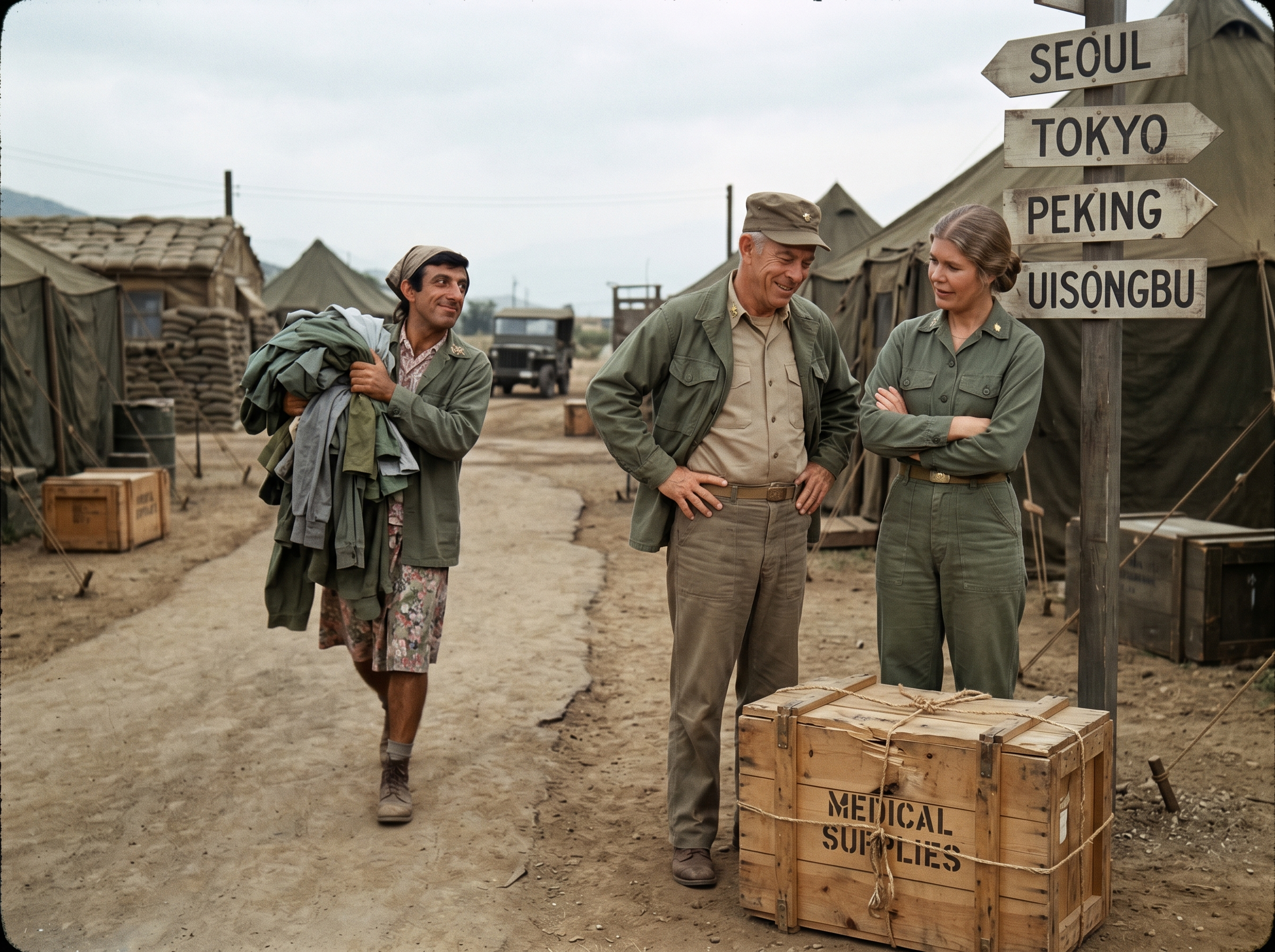
It was just another Tuesday at the 4077th. Which means it was Tuesday, but also the longest Tuesday in history.
The endless convoy of choppers had finally stopped, replaced by the heavy silence of a finished shift. Everyone was a walking husk of fatigue.
The dust was just starting to settle when this arrived, dropped off by a supply truck that didn’t even stop to chat. Just a crate and a cloud of exhaust.
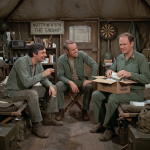
And so there they were, gathering like people watching a slow-motion car crash, staring down at the battered wooden crate.
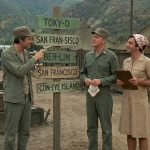
It sat on the hard-packed dirt right next to the iconic signpost, the one that pointed everywhere they wished they were—SEOUL, TOKYO, PEKING, UISONGBU—and nowhere they actually wanted to be.
“Medical Supplies” was stenciled on the side, almost mocking them in its bluntness.
Colonel Potter stood there, his hands resting on his hips, his posture a mix of fatherly authority and pure, simple exhaustion. He was staring at the crate like he could somehow command it to open and reveal something useful, like extra quinine or a single bag of non-government coffee.
“It’s just a crate, Margaret,” he said, his voice quiet. He didn’t have the energy for a full Potter-ism today.
Margaret Houlihan had her arms crossed, her eyes narrowed. She was always the professional, even in the middle of this mess. But today, the tension was different. It wasn’t about proper procedure; it was about hope.
“A simple crate that took three weeks to get here,” she said, her voice unusually small.
Down the path, Klinger was approaching, looking like a hallucination that hadn’t gotten the memo about the war. He was carrying a mountain of laundry, but that wasn’t what anyone was looking at. He was wearing the bandana, the blouse, and the short-skirt floral dress. Again.
He had that sneaky, knowing smile on his face. The expression that said he knew something you didn’t, or maybe he just liked the way the air felt on his legs.
He was looking over his shoulder, almost certainly keeping an eye out for Hawkeye or B.J., who were probably inside working their way through their ninth pitcher of orange juice and gin.
Potter and Margaret were so engrossed by the crate they didn’t even notice Klinger yet. He was like the comic relief that hadn’t been triggered yet.
Everyone just stared.
Because in this place, a sealed wooden box was never just a box.
It was a mystery, a distraction, and, most of all, a vessel. It carried the faint, fragile hope that maybe, just maybe, this one shipment wouldn’t be defective plasma or left-footed combat boots.
The mood was fragile. One sarcastic comment could trigger a breakdown; one misplaced step could end a friendship.
The signpost stood sentinel over them. It didn’t care about the supplies. It only pointed to a world they couldn’t reach, a reminder of the thousands of miles separating them from normal life.
The crate was just… there. Waiting.
Finally, Potter let out a slow, deflated breath that seemed to contain all the weariness of the last year. “Well,” he muttered, “it’s not going to open itself. And we’re all too tired to keep staring at it.”
He looked at Margaret, a rare moment of shared resignation between commander and head nurse. She nodded silently.
Potter sighed again, deeper this time. He just couldn’t take the suspense anymore.
He bent down, searching for some loose wire or nail to grab onto. His fingers brushed against a thick twine binding.
This was it.
The silence hung heavy, thicker than the dust. The only sound was the scratching of Potter’s calloused fingers as he clawed at the twine. Klinger, a spectacle of floral print and military issue, had paused his advance, his head tilted back with that strange, waiting smile, oblivious to the gravity his commanding officer was wrestling with.
Margaret, arms still tightly crossed, leaned in a fraction, her breath held. In her mind, she was praying for scalpels. New, un-rusted, sharp-as-a-wit scalpels. Not because she needed them this second, but because they represented the possibility of doing her job without the constant, grinding friction of using substandard tools. A sharp blade was a clean cut, a faster surgery, a better chance for some eighteen-year-old kid on a chopper.
Potter’s hands shook slightly. He found a stubborn knot and yanked. The dry rope resisted.
“Damn thing,” he muttered. He looked up at Margaret, a flash of his old grit returning. “Can you believe this, Margaret? Fighting a war for freedom and democracy, and I’m losing a battle with a piece of string from Uisongbu.”
Margaret didn’t laugh. She just watched his hands, the same hands she’d seen carefully stitch closed a dozen bellies that morning. Her voice was steady, professional. “Let’s just get it open, Colonel. Thinking about it is taking more energy than doing it.”
Her words were a simple command disguised as advice. Potter smiled. He appreciated her lack of sugarcoating. He took a fresh grip on the twine.
With a definitive *SNAP*, the dried rope broke. The noise felt disproportionately loud, like a gunshot in a library. A little puff of sawdust settled on the dirt.
For a heartbeat, no one moved. The box lid was loose. It was just sitting there, waiting to reveal its soul.
Klinger had frozen mid-step, his load of laundry a colorful burden. His expression hadn’t changed; he was still watching the road, waiting for his audience, but his body was perfectly still. He was, surprisingly, part of the tension, not a distraction from it.
Potter placed a hand on the lid. The wood felt rough and real. He pushed it aside.
The contents were wrapped in heavy butcher paper, and inside that, soft flannel. But beneath the layers, they saw the glint of glass and metal.
Potter reached in and pulled out a small, amber bottle. He held it up to the pale gray light, squinting. “Well, what do you know,” he said, a genuine smile finally breaking. It wasn’t the cynical grin of a tired surgeon; it was the lightened look of a man who’d just received good news. “Actual penicillin. Not the dusty, end-of-the-barrel stuff from last week. The real, clear mccoy.”
He handed the bottle to Margaret. She took it with both hands, reverently. “And surgical scissors,” she said, pointing inside the box. “Look at the edge on that metal. It’s new.” She ran a finger along the blunt side, a tenderness in the gesture that no one in the O.R. would ever see. For a moment, she wasn’t a Major; she was a nurse holding a lifeline.
The tension broke. It didn’t dissipate into wild cheering; that was too much energy. It was a slow, shared exhalation.
Klinger, realizing the big reveal had happened without him, sighed, readjusted the laundry mountain, and resumed his strange, flowery walk, looking forward now.
Potter dusted his hands on his trousers. “Guess this Tuesday wasn’t a complete washout,” he said, looking at the box and then at Margaret. The signpost, with its impossible distances, suddenly felt a little less cruel. The supplies were here, in this place, for these people.
They hadn’t won the war. They hadn’t even guaranteed they’d have enough gauze for tomorrow. But in a world where everything seemed broken or delayed, they had a clean bottle of penicillin.
It was a small victory, but here, those were the only kind that mattered. The kind you could hold in your hands.
Potter smiled at Margaret, a warm, fatherly look that needed no words. He looked tired again, but not weary. Margaret carefully re-wrapped the penicillin bottle.
Around them, the camp began to move again. A truck backfired in the distance. Someone shouted about laundry.
The signpost still pointed to Tokyo and Seoul and the rest of a world they only saw in dreams. But in the quiet dust of the 4077th, next to a battered old crate, three people had just found enough hope to last them until tomorrow. And in this place, that was more than enough.
Sometimes, the smallest comfort is everything.