The Weight of Three Thousand Miles
Some days, the war in Korea didn’t feel like it was fought with mortars, scalpels, or helicopters.
Some days, the most dangerous weapon in the entire peninsula was a standard-issue, triple-copy, government-printed piece of paper.
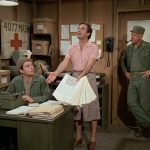
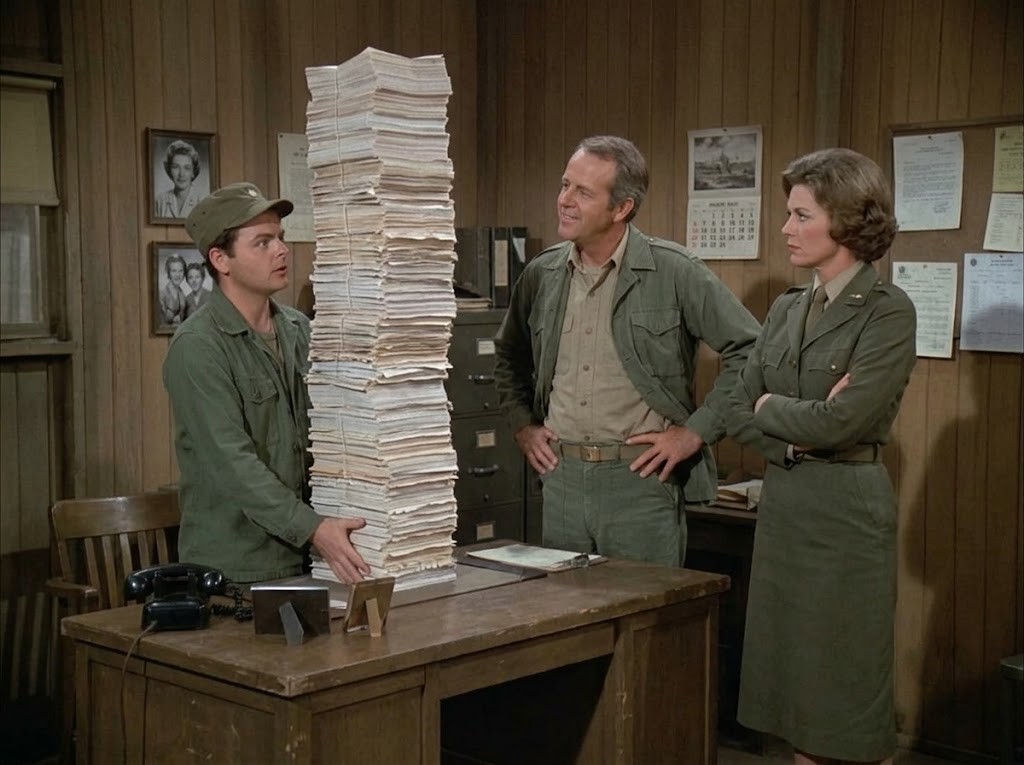
Corporal Radar O’Reilly stood in the center of the clerk’s office, his fingers trembling slightly as he stabilized a tower of paper that defied the very laws of gravity. It stretched from the top of the battered wooden desk all the way past his chin, a monolithic pillar of bureaucracy that smelled of stale ink, damp cardboard, and impending doom.
Colonel Sherman Potter stood beside him, hands planted firmly on his hips, a dry, knowing smirk playing beneath his mustache.
To Radar’s right, Major Margaret Houlihan stood with her arms tightly crossed, her expression a mix of military sternness and deep, exhausted skepticism.
“Go ahead, Son,” Colonel Potter said, his voice carrying that familiar, steady Midwestern gravel. “Tell me that’s just the weekly supply manifest for tongue depressors, and I’ll buy you a whole case of Grape Nehi.”
Radar swallowed hard, his eyes wide behind his thick lenses as he stared at the mountain of paper. “I wish I could, Colonel. But it’s Form 104-B. All of them. Every single one, quadruplicated, signed, stamped, and cross-referenced.”
Margaret took a step closer, her sharp eyes scanning the top layer of the stack. “Radar, Form 104-B was discontinued by the Pentagon three months ago. They replaced it with Form 108-C. Please tell me you didn’t just have the entire unit fill out obsolete medical-personnel census reports.”
Radar looked like he wanted the floor of the tent to open up and swallow him whole. “Well, Major, see, the clerk over at the 8063rd told me they were still using the 104-Bs because the 108-Cs were stuck at the docks in Incheon. So I thought if I got ahead of it, we wouldn’t get penalized by Supply Liaison…”
“And instead,” Potter interrupted, his smile fading into a look of grandfatherly fatigue, “you’ve managed to create a paper monument to human error that stands taller than Klinger in his Sunday best.”
The room fell quiet, save for the distant, rhythmic thumping of chopper blades echoey across the valley—a reminder of why they were all here in the first place. That sound always brought a sudden weight into the room, a sobering chill that made the stacks of paper seem both incredibly small and entirely unbearable.
Radar’s arms were beginning to shake from the effort of holding the stack steady. He knew what this meant: hours of re-typing, days of tracking down doctors who were already exhausted from twelve-hour shifts in O.R., and weeks of waiting for the real forms to arrive.
“Colonel,” Radar whispered, his voice cracking slightly with the raw fatigue that every person in the 4077th carried deep in their bones. “If the brass sees this, they’re going to audit the whole camp. They might hold up the rotation orders.”
Margaret’s posture softened just a fraction, her crossed arms dropping slightly as the true gravity of the mistake hit the room. In a place where a rotation order was the only beacon of hope a soldier had, any threat to it was a tragedy.
Potter took a slow breath, looking from the trembling corporal to the towering stack of useless paper, the silence in the office growing heavier by the second.
—
“Let’s not panic just yet,” Colonel Potter said quietly, breaking the tension that had gripped the room like a vice.
He reached out and placed a solid, steadying hand on Radar’s shoulder, easing the tension in the young corporal’s arms. “First rule of command, Radar: never let a piece of paper tell you how to run a war.”
Margaret let out a breath that was half-sigh, half-laugh, the rigid military facade cracking completely to reveal the tired, deeply protective woman underneath. “If I have to tell Hawkeye Pierce that he has to fill out another twenty pages of personal history because of a clerical mix-up, he might actually fly back to Maine on a motorized gurney.”
“He wouldn’t be the only one,” a voice called out from the doorway.
Captain B.J. Hunnicutt slid into the room, a half-eaten apple in one hand and a relaxed, easygoing smile on his face that instantly lowered the temperature in the office. He looked at the massive column of white sheets, raised an eyebrow, and whistled softly. “Say, Radar, did we finally get that shipment of sheet music for the camp choir, or are you just building a fortress to hide from Winchester’s cello practice?”
“It’s a bureaucratic disaster, Captain,” Margaret said, though the sharp edge was gone from her voice, replaced by a quiet camaraderie. “We’ve filled out the wrong forms for the entire personnel rotation registry.”
B.J. took a bite of his apple, his eyes twinkling with that gentle, grounded humor that kept the 4077th sane. “Well, look at the bright side. If we don’t send them in, the Army won’t know we’re here. If they don’t know we’re here, they can’t send us any more patients. I say we use them to insulate the Swamp before winter hits.”
Radar didn’t laugh; his eyes remained fixed on the middle of the stack, the guilt of adding to everyone’s burden weighing heavily on his shoulders. “It’s my fault. I should have checked with Seoul before I distributed them to the tents.”
Colonel Potter walked around the desk, his boots clicking softly against the floorboards. He looked at Radar, seeing not just an army clerk, but a kid from Iowa who had been forced to grow up much too fast in a country full of mud and misery.
“Listen to me, Radar,” Potter said, his voice dropping to that warm, fatherly register he reserved for moments when the uniform didn’t matter. “There isn’t a man or woman in this camp who hasn’t made a mistake when they were tired. Lord knows I’ve signed things that would make a mule laugh.”
“But the rotation orders, Colonel…” Radar mumbled.
“Are going to be just fine,” Margaret interrupted, stepping up to the desk and firmly grabbing the top half of the paper tower to relieve the pressure on Radar’s hands. “Because we are going to fix it. Corporal, you have the master list of names on your clipboard, don’t you?”
Radar nodded quickly, pulling the clipboard closer to his chest. “Yes, ma’am. Fully updated as of 0800 hours.”
“Good,” Margaret said, a rare, warm smile gracing her lips. “Then we don’t need the doctors to re-write a thing. You and I will spend the evening transferring the data to the correct 108-C forms once they arrive. I’ll even ensure Major Winchester lends us his fountain pen, whether he likes it or not.”
B.J. grinned, leaning against the doorframe. “And I’ll make sure Pierce keeps the distillery running so you two have some high-octane fuel to get through the night. Don’t worry, Radar. We’ve survived artillery, bad food, and Klinger’s fashion choices. We can handle a few reams of paper.”
Radar looked between the three of them, the tight knot of anxiety in his chest finally beginning to unravel. The tower of paper didn’t look quite so tall anymore, not when it was shared among people who had become more than just an army unit—they were a family, forged in the quiet, desperate corners of a forgotten valley.
Colonel Potter patted Radar’s back one last time before turning toward his inner office. “Set ’em down on the floor, Son, before you give yourself a hernia. And Margaret, make sure you take the good stationery from my desk. If we’re going to fix the Pentagon’s mess, we might as well do it in style.”
“Yes, Colonel,” Margaret said, her voice soft and full of an affectionate respect that needed no official protocol.
Radar carefully lowered the massive stack onto the corner of the desk, letting out a long, shuddering breath of pure relief. He looked out the window, past the dusty screen, toward the tents of the compound where the evening smoke was just beginning to rise into the darkening Korean sky.
They were thousands of miles from home, surrounded by mountains and a war that never seemed to end, but in that small, cluttered office, the warmth of a few good friends was enough to keep the cold at bay.
To the family we found in the mud of Korea, who carried the heaviest burdens with a smile and never let us stand alone.