The Gentle Language of Quiet Moments
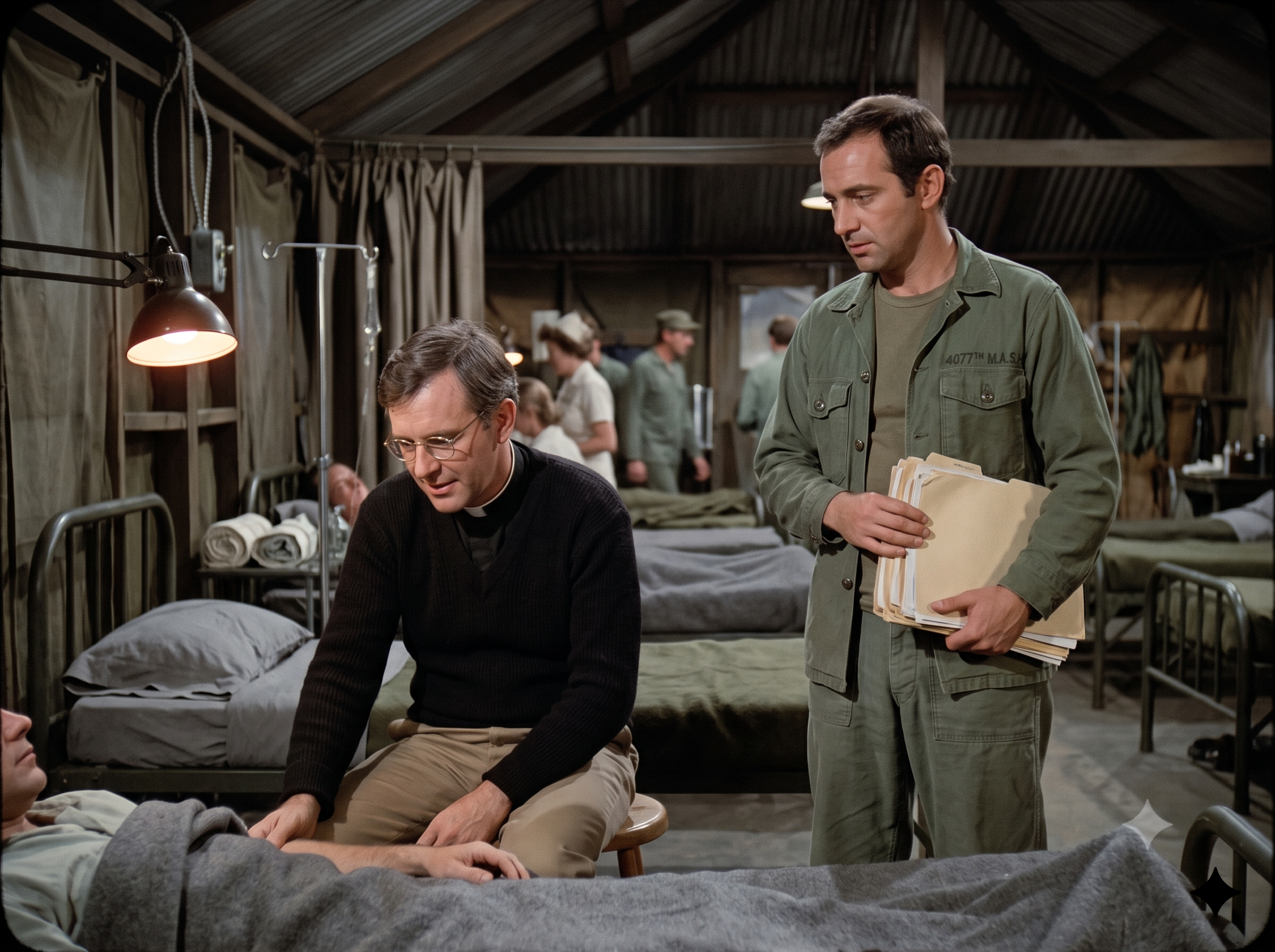
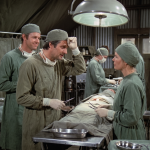
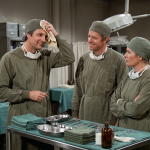
The mud of Korea has a way of seeping into your boots, but it’s the quiet in Post-Op that seeps into your soul.
It was one of those afternoons at the 4077th where the air felt heavy, not just with the humidity, but with the collective fatigue of a long week.
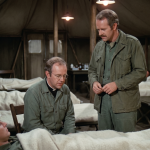
Father Mulcahy sat on a simple wooden stool, his back slightly hunched as he leaned over one of the cots.
He wasn’t praying, at least not out loud. He was just sitting there, his hand resting gently on the forearm of a young soldier who had been through the wringer.
The boy was still, eyes closed, his breathing shallow but steady.
Captain B.J. Hunnicutt stood just a few feet away, clutching a stack of patient files like they were a shield against the rest of the world.
He watched the Father with that familiar, soft look in his eyes—the look of a man who understood that sometimes, medicine wasn’t the only thing that kept a soldier stitched together.
B.J. shifted his weight, his green utility jacket dusty and worn, and cleared his throat softly.
“He’s been asking for his mother, Father,” B.J. whispered, his voice barely rising above the hum of the overhead lamp.
“I know, B.J.,” the priest replied, his eyes never leaving the soldier’s face. “I think he just needs to know he’s not alone in the dark.”
The soldier’s fingers suddenly twitched beneath Mulcahy’s hand, a sharp, involuntary tremor that made both men freeze.
The boy’s eyes flickered open, frantic and unseeing, searching for a home that was thousands of miles away.
“I can’t… I can’t find the letter,” the soldier rasped, his voice a dry desert wind. “They took the letter.”
B.J. stepped forward, the files in his hands rattling, his expression shifting from calm to a sudden, piercing urgency.
B.J. didn’t say a word. He knew that look—the look of a man losing his anchor.
He carefully set the stack of files down on a nearby metal tray, the clatter echoing too loudly in the small, crowded tent.
“Nobody took your letter, son,” B.J. said, stepping into the boy’s line of sight with a smile that was practiced, gentle, and entirely reassuring. “I saw it. It’s right there in your personal effects bag, tucked safe behind your canteen.”
It was a small lie, or perhaps a hopeful guess, but it served its purpose.
The soldier’s frantic eyes locked onto B.J.’s, and the panic began to ebb, replaced by a deep, hollow exhaustion.
Father Mulcahy didn’t pull his hand away. He simply smoothed the blanket over the boy’s shoulder, a gesture so maternal it felt entirely natural in the middle of a war zone.
“You rest now,” the Father murmured. “We’re right here. The mail will be sorted by morning, and you’ll have that letter in your hands before you’ve even had your breakfast.”
The soldier let out a long, ragged breath, his head sinking back into the pillow.
The tension in his shoulders finally broke, his body going limp as he drifted back into the necessary mercy of sleep.
B.J. let out a quiet sigh of his own, his shoulders dropping two inches as he looked over at the priest.
“You’re a good man, Father,” B.J. said quietly. “Though I’m fairly sure that letter is actually halfway to Pusan by now.”
Mulcahy looked up, a faint, wry smile touching his lips—that subtle sense of humor that lived in the corners of the 4077th.
“It will be wherever he needs it to be, B.J.,” the priest whispered, standing up slowly and stretching his stiff back. “Sometimes the truth is less important than the peace it provides.”
They stood there for a moment, two friends in a tent full of wounded boys, surrounded by the ghosts of a thousand similar afternoons.
Outside, the distant rumble of the camp generator hummed a steady, mechanical lullaby.
There was no glory in this moment, no headlines, and no medals to be won.
Just two men, a tired soldier, and the quiet understanding that they were the only family some of these boys would ever know.
They moved on to the next cot, the cycle beginning again, fueled by the strange, bittersweet grace that defined their lives in the mud.
It wasn’t a perfect world, and it certainly wasn’t a fair one, but in the heart of the 4077th, it was enough.
In the quiet corners of the 4077th, it was always the smallest gestures that mattered the most.