The Tastes We Carry Home
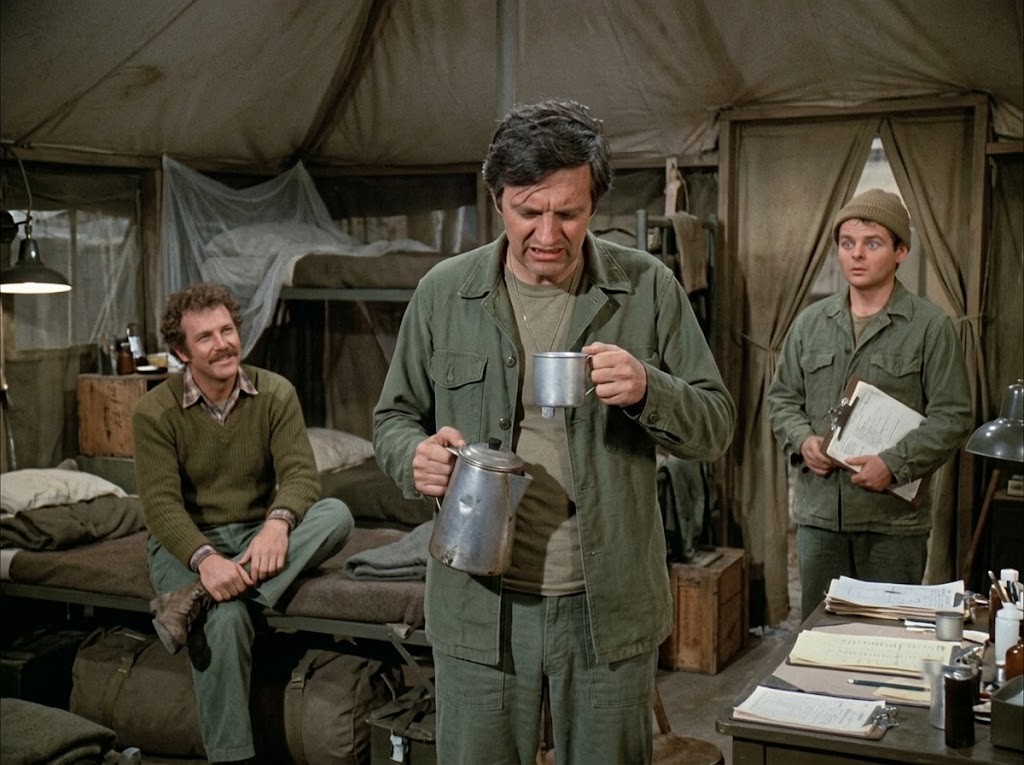
Three miles past the frontline artillery, the mud of Uijeongbu had a way of seeping into everything—your boots, your surgical gowns, and your very bones. But on this particular Tuesday, the heaviest thing in the Swamp wasn’t the mud or the memory of a thirty-hour shift in Post-Op. It was the absolute, unmitigated disaster currently masquerading as morning coffee.
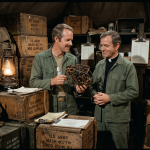
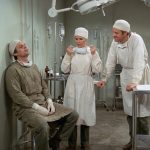
Hawkeye Pierce stood in the center of the tent, his shoulders slouched under the weight of an olive-drab fatigue jacket that had seen far better days. He held a battered aluminum pitcher in one hand and a matching metal mug in the other, staring down into the dark liquid like a man looking at a betrayal.
His face twisted into a mask of pure, concentrated agony as the first sip hit his tongue. It wasn’t just bad; it tasted like boiled combat boots filtered through an old wool blanket.
Across the room, perched on the edge of a canvas cot with his legs crossed, B.J. Hunnicutt watched the spectacle with a slow, knowing grin spreading beneath his mustache. B.J. looked entirely too comfortable for a man who had just spent the night stanching chest wounds, his checkered shirt peeking out from under a heavy green sweater as he waited for his friend’s inevitable theatrical monologue.
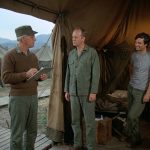
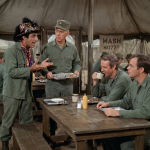
Near the doorway, Radar O’Reilly stood frozen, clutching a clipboard tightly against his chest like a shield. His knit cap was pulled low, his eyes wide behind his round spectacles as he watched Hawkeye’s expression drop from mere disgust into something deeply tragic. Radar had brought the news from the mail tent, but right now, he looked like he was bracing for an explosion.
“It’s an insult to the bean,” Hawkeye finally wheezed, his voice cracking with dry, exhausted indignation. “I don’t know what they did to this, but I’m pretty sure it breaks the Geneva Convention. B.J., I think the mess tent is using battery acid as a starter fluid.”
B.J. chuckled softly, shifting his weight on the cot. “Come on, Hawk. It’s got a kick. Keeps the heart beating. Or at least it melts the fillings in your teeth so you forget about your feet.”
“This isn’t a kick, Beej. This is a personal vendetta from the Quartermaster Corps,” Hawkeye muttered, staring intently into the tin mug as if searching for a sign of life. “I can handle the shrapnel, I can handle the endless stream of incoming choppers, and I can even handle your snoring. But a man needs one thing to separate him from the beasts, and that is a decent cup of coffee.”
Radar took a small, cautious step forward, the papers on his clipboard rustling slightly. “Uh, Captain Pierce? Sir?”
Hawkeye didn’t look up, still holding the aluminum pot aloft like an offering to a forgotten deity. “Not now, Radar. I am mourning. We are at a spiritual crossroads, and the road is paved with instant chicory and despair.”
“But Captain,” Radar insisted, his voice dropping to that quiet, earnest tone that usually meant trouble. “It’s not from the mess tent. That batch… that’s the last of the special roast your father mailed you from Maine. I brewed it exactly how you told me to.”
The theatrical complaint died instantly on Hawkeye’s lips, the tin pitcher suddenly feeling ten times heavier in his hand as B.J.’s smile faded into a look of quiet concern.
The silence that followed was heavy, broken only by the distant, rhythmic thud of artillery miles away. Hawkeye stared down at the mug, his face softening as the sarcasm drained away, leaving only the raw, hollow fatigue of a surgeon who hadn’t slept in two days.
The roast from Maine. His father had gone to three different general stores in Crabapple Cove just to find the specific blend Hawkeye used to drink on rainy Sunday mornings on the porch. It had taken two months to cross the Pacific, packed in a tin can sealed with paraffin wax.
“My dad,” Hawkeye murmured, his voice barely above a whisper. He looked at the dark liquid again, but he wasn’t seeing the Swamp anymore. He was seeing the Atlantic surf, the smell of pine needles, and a kitchen that didn’t smell like ether.
B.J. uncrossed his legs and leaned forward, his humor replaced by the deep, steady warmth that made him the anchor of the tent. “Hey. Let me try it.”
Hawkeye handed the mug over without a word. B.J. took a sip, swallowed, and let out a long breath. He didn’t make a face. He just held the mug in both hands, feeling the heat radiate through the metal.
“It’s not the coffee, Hawk,” B.J. said gently, looking up at his friend. “It’s the water. This local well water… it’s got so much chlorine and lime in it, you could brew pure gold and it would still taste like the bottom of a riverbed.”
Radar looked visibly relieved, adjusting his glasses. “I scrubbed the pot, Captain. Honest I did. I even used the filtered water from Room 1 in O.R., but…”
“I know, Radar. I know,” Hawkeye said, offering a small, tired smile that reached his eyes for the first time all morning. He reached out and gently patted the kid’s shoulder. “It’s not your fault. You’re a prince among clerks. It’s just… the water here doesn’t know how to be home.”
Hawkeye sat down on the edge of his own unmade cot, taking the mug back from B.J. He took another sip, slower this time. It still tasted bitter, still burned with the harsh chemical tang of a war zone’s water supply. But beneath it, if he closed his eyes and tried hard enough, there was the faintest hint of Maine pine and a father’s care.
“You know,” Hawkeye said, staring out the open tent flap toward the helicopter pad, “back home, my dad always said the secret to a good cup of coffee wasn’t the bean at all. It was the company you kept while you drank it.”
B.J. reached over, grabbed his own chipped mug from the nightstand, and poured a splash from Hawkeye’s pitcher. He raised it in a silent toast. “To Crabapple Cove. May its water always run clear.”
“And to San Francisco,” Hawkeye added, clinking his tin against B.J.’s. “Where the coffee is hot and the surgeons get to sleep.”
Radar stood by the door for a moment longer, watching the two doctors share the bitter brew in the quiet tent. He smiled to himself, made a small note on his clipboard, and slipped out into the compound, leaving the friends to the only piece of home they had left.
In the mud of Korea, home wasn’t a place on a map anymore—it was the quiet warmth of a tin cup shared between brothers.