The Mystery Meat and the Miracle of Patience
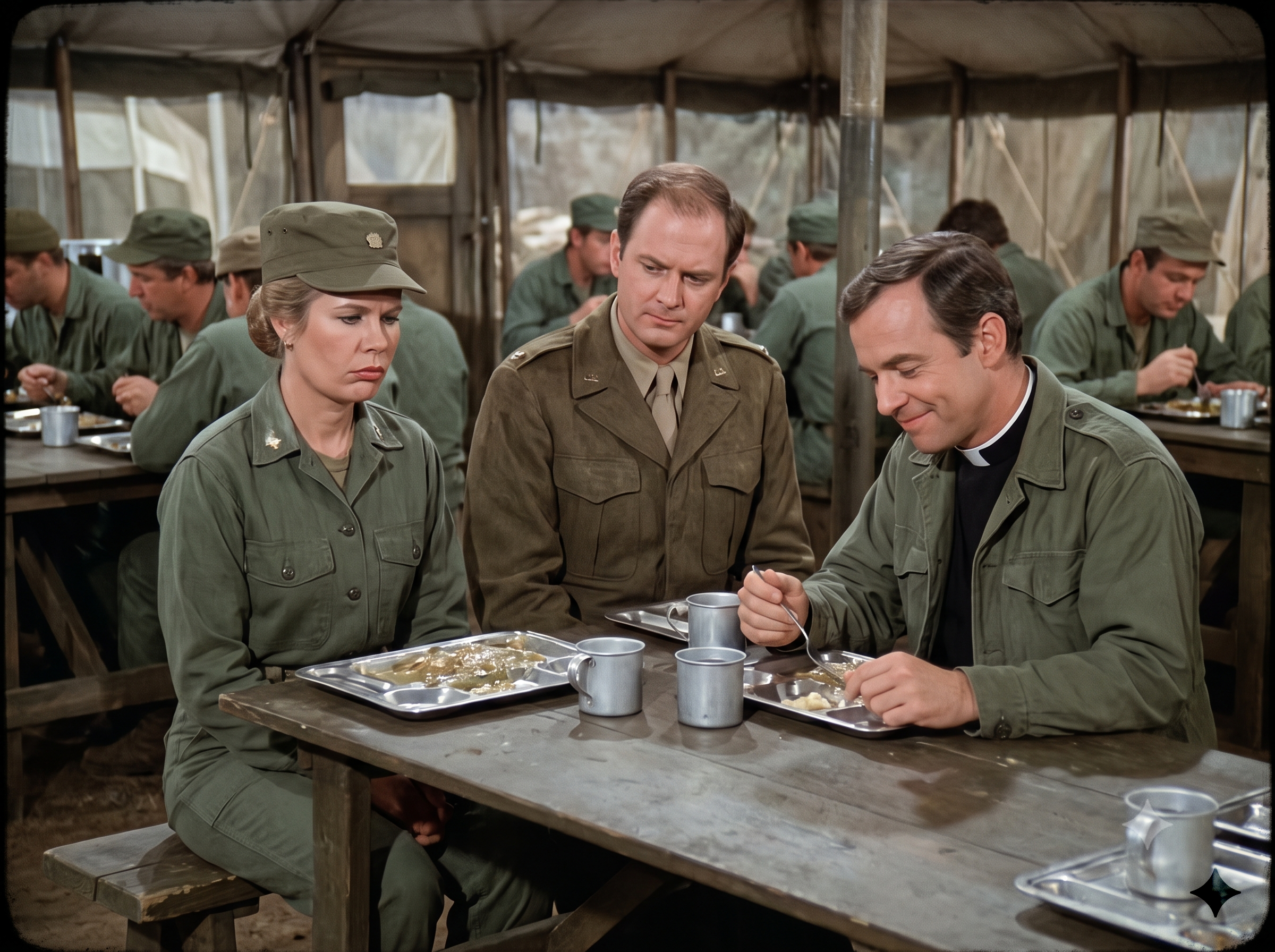
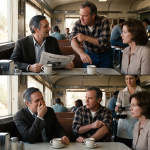
The mess tent at the 4077th had a unique way of humbling even the proudest of souls, usually right around dinnertime.
It was late Tuesday afternoon, the kind of day where the Korean wind battered the canvas walls with a relentless, dusty rhythm. The camp was finally quiet after a grueling eighteen-hour marathon in the operating room.
Inside the mess tent, the air was thick with the smell of strong coffee and whatever culinary tragedy the cooks had boiled into submission. The dull roar of weary chatter filled the space, a backdrop to the endless clatter of tin cups and metal trays.
At a long, olive-drab table near the center, an uneasy silence hung over three officers.
Major Margaret Houlihan sat with her back perfectly straight, her hands resting tightly in her lap. Beneath her fatigue cap, her blonde hair was impeccably pinned, a stark contrast to the utter exhaustion behind her eyes.
She was staring down at her tray with a look of sharp, composed skepticism. Her lips were pressed together in a tight line, silently refusing to acknowledge the grayish-brown mound of unidentified protein sitting in a puddle of its own watery gravy.
Beside her, Major Charles Emerson Winchester III maintained an equally rigid, formal posture. His uniform, though worn, was as neat as he could possibly make it in a war zone.
Charles peered down his nose at the tray, a single eyebrow raised in pure, unadulterated offense. His aristocratic pride was warring with a deep, rumbling hunger, resulting in a look of restrained irritation. He looked as though he had just been insulted by a waiter at a Michelin-star restaurant, only there was no waiter, and there was certainly no star.
Across from them, leaning over his own tray, sat Father Francis Mulcahy.
The chaplain wore his olive drab jacket over his clerical collar, his hands gently holding his utensils. Unlike the two majors, Father Mulcahy was not glaring at the food. Instead, he offered the tray a soft, hopeful smile of polite optimism.
“Well,” Father Mulcahy murmured softly, his voice a gentle hum against the background noise. “It certainly is… plentiful today.”
Margaret’s eyes didn’t leave her tray. “Plentiful isn’t a flavor, Father. It’s a threat.”
Charles drew in a long, slow breath through his nose. His hands gripped the edges of the wooden table. The refined surgeon was reaching his absolute limit. He had operated on a dozen chest wounds, slept on a lumpy cot, and now, he was being asked to consume something that looked suspiciously like a biology experiment.
“I have dined,” Charles began, his voice dangerously low and trembling with aristocratic fury, “at the finest establishments on the Eastern Seaboard. I have savored dishes prepared by masters of the culinary arts.”
He picked up his fork, holding it aloft like a miniature trident.
Margaret’s jaw tightened. She was too tired for a Winchester tantrum. She had just spent the better part of a day keeping exhausted nurses on their feet, and her patience was completely gone. She turned her head, her eyes flashing a warning at Charles to keep his mouth shut.
But Charles was already winding up. His chest puffed out, his eyes locked onto the serving line across the tent. He opened his mouth, drawing a massive breath to summon the cook and unleash a tirade of historic, blistering proportions. The entire tent seemed to hold its breath.
Before Charles could shatter the tired peace of the mess tent, Father Mulcahy leaned in just a fraction closer.
He didn’t raise his voice. He didn’t issue a reprimand. He simply reached out with his spoon, gently tapping the edge of his metal tray.
“You know, Major,” the priest said brightly, his eyes crinkling at the corners. “I do believe I see a pea. A whole, unblemished green pea.”
Charles froze, the air trapped in his lungs.
He looked down at the chaplain. Father Mulcahy was pointing at a tiny, solitary green sphere marooned on the edge of the gravy swamp, his face lit with genuine, innocent delight.
“It’s the little victories, isn’t it?” Mulcahy added, looking up at Charles with a smile so incredibly warm and unpretentious that it felt like a shield.
Charles slowly let the breath out. The blistering insult died in his throat. He lowered his fork, the fight draining right out of his rigid shoulders.
It was impossible to yell at Father Mulcahy. It was like kicking a puppy, or shouting at a sunrise. Charles swallowed his pride, giving a slight, defeated shake of his head.
“A pea, Father,” Charles muttered, his voice dripping with dry, exhausted sarcasm. “How glorious. A veritable harvest festival on your tray. Please, try not to gorge yourself.”
Margaret let out a sudden, sharp breath. It wasn’t quite a laugh, but the tension in her face immediately broke. The harsh lines of her skepticism softened, replaced by the deep, vulnerable exhaustion she usually hid from the world.
She looked at the priest, then at the pompous surgeon, and suddenly, the sheer absurdity of their lives washed over her.
They were three thousand miles from home. They were surrounded by dirt, drafty canvas, and the constant, thumping fear of the helicopters. Yet here they were, a polished Boston aristocrat, a fiercely proud Army nurse, and a gentle priest, gathered around a wooden table, fiercely debating the existence of a single vegetable.
“Eat your harvest, Charles,” Margaret said gently, a rare, fond smirk touching the corner of her mouth. “You’ll need your strength. The rumor is they’re serving powdered eggs for breakfast.”
Charles visibly shuddered, but he didn’t complain. He elegantly tucked his paper napkin into his collar, picked up his spoon, and approached the slop with the delicate precision of a man defusing a bomb.
Father Mulcahy bowed his head for a brief, silent moment of grace. When he looked up, the polite optimism was still there, steady and unshaken. He took a bite, chewed thoughtfully, and gave a small, encouraging nod to the others.
“Not bad,” the chaplain lied smoothly. “Needs salt.”
Margaret finally picked up her fork. The food was terrible, the coffee was bitter, and her feet ached with a pain she knew would be there tomorrow.
But sitting there, bathed in the soft, muted light of the tent, listening to Charles mumble refined complaints under his breath while Father Mulcahy cheerfully asked him to pass the salt, Margaret felt a strange, quiet sense of peace.
This wasn’t a fancy restaurant, and this certainly wasn’t home. But as she watched her friends brave the terrible meal together, she knew there was nowhere else in this war she would rather be.
They ate in silence, three tired soldiers finding grace at the bottom of a tin tray, bound together by the stubborn, beautiful humanity of the 4077th.
In a place filled with so much heartbreak, sometimes the greatest comfort was just having someone to share the terrible coffee with.