A Letter, A Toast, and the Distant Melody of Boston
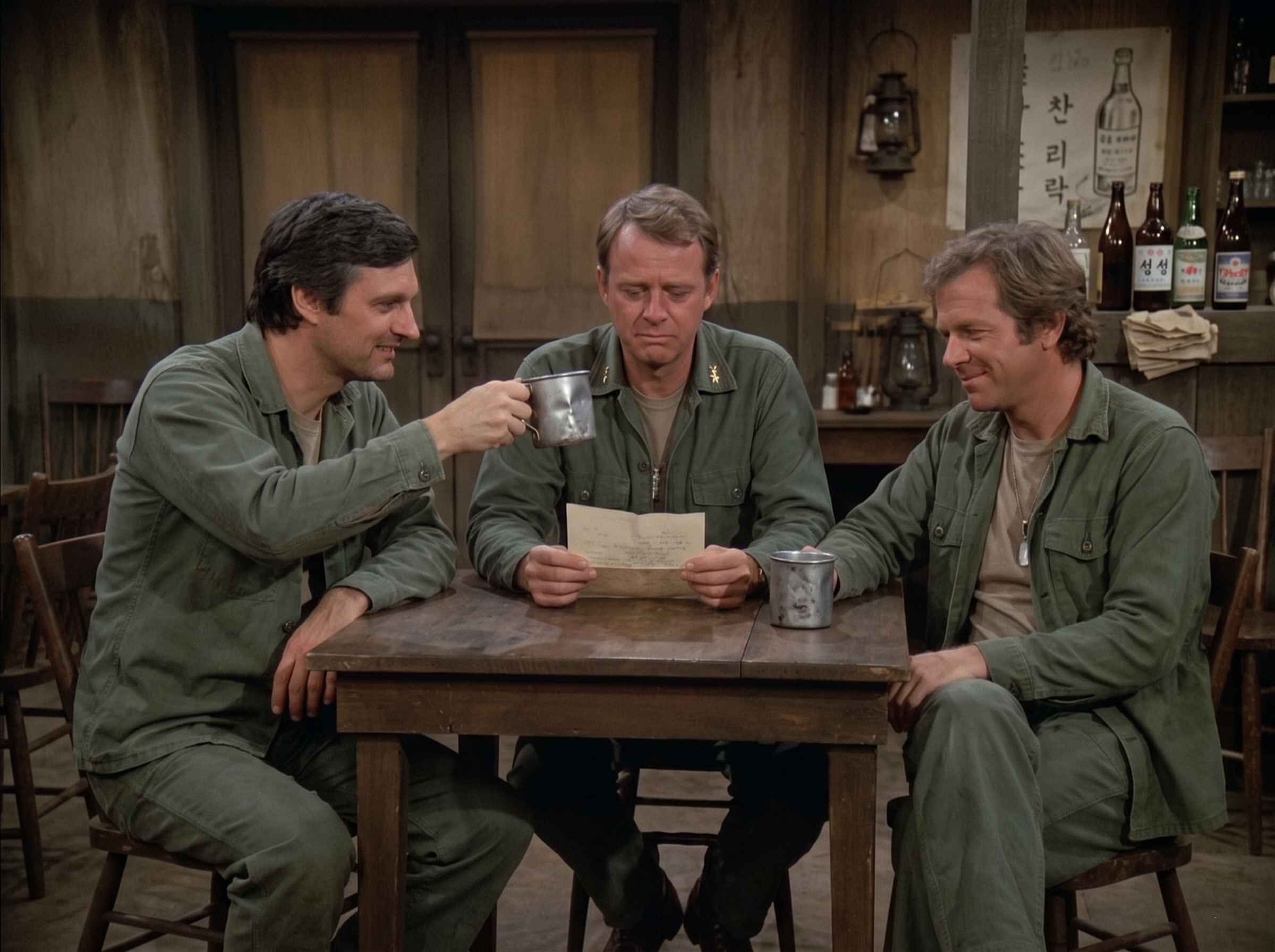
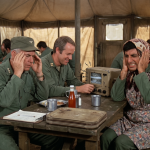
You knew the shift in the OR was over when you could no longer feel your feet, and your hands were vibrating with a fine, caffeine-fueled tremor. That’s when we always found ourselves at Rosie’s Bar, seeking the only kind of anesthetic we were qualified to self-administer.
It wasn’t much of a place. A few rickety tables, chairs that had a serious disagreement with stability, and walls that had absorbed more heartache than any church in Seoul. But it was ours, the 4077th’s sacred ground.
We were sitting around one of those wooden tables on a night that felt particularly long. Triage had been a meat grinder. The silence between us wasn’t awkward; it was necessary, a temporary holding pattern while our souls tried to catch up with our bodies.
Then the evening mail call reached us, a small stack of letters delivered in that familiar green fatigue shirt. Radar usually brought them, with his big eyes that always seemed to read the contents before you did, but tonight, someone else had dropped them off.
Among the pile, sitting on the scarred wood table, was one envelope that didn’t belong. It was cream-colored, thick, and smelled faintly of lavender and old paper—a stark contrast to the dust and diesel fumes of Korea.
It was addressed to Major Charles Emerson Winchester III. He took it delicately, holding it between his thumb and forefinger as if it were a fragile artifact from a civilized world.
Hawkeye Pierce, of course, couldn’t let the moment pass without comment. “Well, look at that,” Hawkeye said, his wit still sharp despite the fatigue, gesturing with his metal Army cup. “Proof that civilization still exists, even if it’s currently hiding on the upper east side.”
B.J. Hunnicutt, the steady center to Hawkeye’s chaotic rotation, offered a tired smile. He watched Charles, his eyes holding that gentle warmth that made him the unit’s resident anchor. “Good news from Boston, Charles?”
Charles didn’t answer immediately. He was carefully unfolding the single sheet of paper, his eyes scanning the elegant cursive. His face, usually a mask of haughty disdain, began to change, a crack appearing in his carefully constructed armor.
He read the letter once, then twice, and as he did, his breathing hitched, a sound too small to be a sob but too large to be an exhale. The lines around his eyes deepened with a pain that wasn’t physical.
His lower lip trembled, just slightly, and he looked up, not at Hawkeye or B.J., but at some point far beyond the confines of Rosie’s Bar. His eyes were wide, pained, and suddenly brimmed with tears.
For a moment, the atmosphere froze. Hawkeye, still holding his cup in that casual toast, felt the humor dry in his throat. B.J.’s smile faded into a quiet concern. The man who usually held himself above all of us was, for the first time, completely, vulnerably broken.
The silence that followed was different from the OR silence; this one was thick with the realization that even the strongest among us had a heart that could be shattered by a simple piece of paper.
Charles closed his eyes, and a single, silent tear escaped, tracing a path down his cheek. He quickly crumpled the letter in his fist, trying, too late, to restore the Major Winchester veneer.
Hawkeye lowered his cup slowly to the table. The wit was gone, replaced by a deep, resonant empathy. We knew that look. It was the look of a doctor who couldn’t heal this specific wound.
“Charles?” B.J. asked, his voice low, gentle, reaching out to cover Charles’s hand with his own. He didn’t offer a platitude or a cliché. He offered his presence.
Charles’s voice cracked when he finally spoke, a stark contrast to his usual refined tone. “It’s… it’s Honoria. My sister. She writes… my childhood violin teacher, the Maestro. He’s passed.“
The admission hung in the air. In a war zone, the death of an elderly music teacher in Boston might seem trivial, but to Charles, it was a earthquake. That man represented a world he loved, a world that was slipping away.
Hawkeye understood this implicitly. He’d seen men weep for their dead pets, for their high school sweethearts, for the old oak tree that got chopped down. It was the anchoring memory that the war was slowly eroding.
Instead of making a joke, Hawkeye reached across the table and touched Charles’s shoulder, a rare gesture of unironic comfort. “The man who gave you the music,” Hawkeye said quietly. “That’s a heavy loss.“
B.J. nudged his own metal cup towards the Major. “I’m sorry, Charles. That’s a piece of home you can’t replace.” He shared that knowing smile of friendship, the kind that didn’t require him to solve the problem, only to witness it.
Charles seemed surprised by their reaction. He’d expected sarcastic remarks about his ‘pretentious grief.‘ Instead, he found himself being held by the very men he claimed were beneath him.
He inhaled deeply, fighting for control, and a small, genuine memory slipped out. “He used to tell me that the silence between the notes was just as important as the notes themselves. Because that is where the soul of the piece resides.“
Hawkeye took another sip from his cup, nodding thoughtfully. “Maybe that’s why we appreciate the quiet in Rosie’s so much,” he said, turning the moment into a small, fragile philosophy. “We’re just living in the silence between the chaos.“
B.J. smiled warmly, a true smile this time. “You know, B.J., Hawkeye,” Charles said, composing himself, wiping away the tear with his knuckles. “You two have the musical appreciation of a ton-deaf yak, but your presence is… not entirely unpleasant.”
It was the closest Major Winchester could get to saying ‘thank you,’ and it was perfect. The humor, dry and specific to Charles, softened the pain and restored the equilibrium in the room.
We sat there for a long time, the three of them, watching the shadows dance on the rustic walls and listening to the soft murmur of Korean from the other tables. The metal cups were refilled, a silent affirmation that we would keep each other company.
In that small, dimly lit room, with the scent of bad whiskey and old paper, we were more than a mobile hospital. We were a makeshift family, bound by shared weariness, unspoken understanding, and a profound, stubborn humanity.
As the image captures them, with Hawkeye raising that playful toast and B.J. offering that quiet smile, you can see the truth. They weren’t just colleagues. They were brothers, holding each other up in the face of the war’s slow erosion.
And as long as they had each other, and as long as they could find the warmth in the silence between the notes, they would keep doing the work that needed to be done.
They were the only symphony they had, playing their best in the quiet moments between the artillery.