A Telegram in the Swamp: When Black Ink Held More Than Hope
The Swamp was a rare quiet. The generators hummed a steady background drone, the sound of the 4077th’s mechanical heart. The surgical shifts had finally eased, leaving only the usual persistent ache of being.
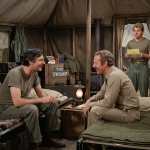
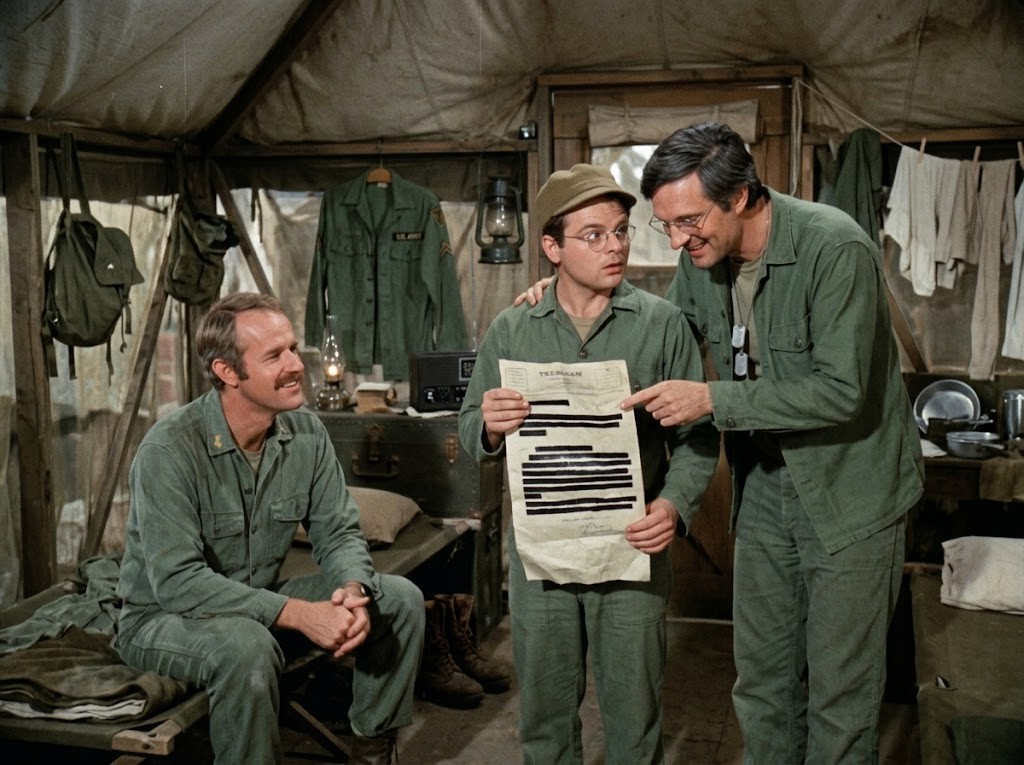
Three figures, familiar as family, occupied the dim, canvas sanctuary. Hawkeye, perpetually leaning but always alert, had his arm loosely around the shoulder of Radar O’Reilly. He was grinning, that sideways grin that usually preceded a punchline or a brilliant, terrible idea.
Radar stood perfectly still, his round, dark-framed glasses reflecting the oil lamp’s low light. He held a large, yellow sheet of paper – a telegram, heavily blacked out with thick markers. His expression was a mix of innocent curiosity and wary anticipation.
B.J. Hunnicutt, the quiet anchor with the steady hand and the warm mustache, sat relaxed on the edge of his cot. His posture was easy, his smile gentle and observant. The setting was classic Swamp – cots, footlockers, laundry drying on a line in the corner.
Hawkeye pointed to a heavily obscured paragraph. “Look at this, Radar. Our esteemed military censors have achieved a new artistic peak. They’ve reduced your grandmother’s latest missive to a dramatic abstract painting.”
B.J. chuckled softly. “They are thorough, Radar. I think they blacked out your birthday greetings just to make sure no enemy radio op could decipher your age.”
Radar blinked, looking between the telegram and Hawkeye. “But Captain Pierce, sir, they always cross some stuff out. This one looks… important. Like, extra secret.”
The joke seemed to land. Hawkeye leaned a little closer, his grin widening, a spark in his eye. Radar was poised on the edge of his usual polite confusion. B.J. watched them with affectionate amusement.
Then, the mood in the room seemed to subtly shift. Radar glanced down at the paper again, his brow furrowing as he traced the heavy black lines. He looked up at Hawkeye, his innocence suddenly replaced by a quiet, deep focus.
“Sir,” Radar said, his voice unusually small, “I got this just before mail call closed. But if everything is blacked out… how do we know what she was trying to tell me?”
He looked into Hawkeye’s face, and all the witty defenses seemed to hit a wall. He looked into B.J.’s, but B.J.’s gentle smile had also faltered.
The tent was absolutely still. The hum of the generator was gone; the only sound was the crackle of the oil lamp. And Radar, holding the blacked-out paper like it was the key to everything, seemed to be waiting.
It was a question too large for a joke, yet too tender for a simple, dry answer. The air between the three friends held the weight of a world defined by what was always missing, and the hope of what *could* be, hidden just beneath the surface.
Radar’s gaze didn’t waver. His question hung there, honest and raw. How *do* we know?
Hawkeye’s signature wit, usually faster than a reflex, had simply failed to deploy. He looked from Radar’s earnest eyes to the dense black geometry of the censor’s work. The armor of cynicism he wore so well cracked. This wasn’t a medical quandary. This was human.
Hawkeye sighed, a long, tired sound. His hand tightened slightly on Radar’s shoulder. He couldn’t give the usual flippant dismissal. Not to Radar. Not with B.J. watching.
“Radar,” Hawkeye began, his voice dropping into that rare, quiet tone he reserved for the true moments, “the army has a way of looking at words like potential weapons. And when words are weapons, everything must be neutralized.”
He gestured to the largest block of ink. “But ink is just ink. It’s dense, yes. It covers the letters. But it can’t erase the impulse that sent them.”
Radar nodded slowly, absorbing the change in tone. “But Captain, if I can’t read it, it’s just…” He looked at the sheet again. “…black shapes.”
B.J. stood up silently from his cot. He crossed the small distance and put his other hand gently on Radar’s arm. The circle was closed.
“Radar,” B.J. said softly, “look at where she *didn’t* put the marker.”
Radar lifted the paper, squinting.
“Here at the top,” Hawkeye continued, his voice steadying, “it says ‘Dearest Grandson.’ Not even a five-star general would censor that. It means you are cherished. It means you are thought of. It means you exist to her, beyond all this.”
B.J. pointed further down. “And right here, in the little margin that escaped the ink… see that tiny scribble? That’s her signature. She didn’t just type it. She took a pen. She made that mark herself, just for you.”
Hawkeye took the paper from Radar, holding it by the edges. He looked past the dark bars, right into the texture of the telegram sheet.
“And finally, Radar,” Hawkeye said, his smile returning, softer now, “look at how solid those black lines are. Look at how much effort went into hiding… well, probably a discussion of casserole recipes, or your cousin Elmo’s new pig. A *lot* of effort. They didn’t censor the news about Uncle Mort’s gout. They censored the trivial, the domestic, the *boring*.”
“Because, Radar,” B.J. added, catching Hawkeye’s intent, “in this place, the mundane is the most dangerous thing. It reminds us what we’re missing. Casseroles and pigs aren’t military targets, but they’re the targets of the heart. And the heart is one thing the army doesn’t know how to defend against.”
Hawkeye handed the telegram back. “They covered the words, Radar, because they didn’t want you to feel how much she loves you, because that feeling is too powerful for a battlefield. But you feel it, don’t you? Even through all that ink?”
Radar traced the lines again, but his expression had cleared. A small, tentative smile appeared beneath his glasses. “Yes, sir. I do feel it. And I suppose you’re right. Uncle Mort’s gout probably isn’t a secret weapon.”
The joke landed, light and human. Radar carefully folded the telegram, placing it into the top pocket of his fatigue jacket, patting it flat. The moment of deep stillness passed.
“Excellent,” Hawkeye said, his usual persona fully restored. “Now that we’ve decoded the secrets of the O’Reilly family, I believe the army censors owe me a royalties payment for my literary analysis. And until that arrives, B.J., I suggest we celebrate this act of resistance against domestic trivia with a medicinal martini. Radar, you may observe.”
Radar grinned, back to being his earnest self. B.J. chuckled as he returned to his cot. The hum of the generator returned. The Swamp was just a tent in a war zone again, but for a moment, the black ink hadn’t covered everything.
Because sometimes, the heart could read what the eyes were never allowed to see.