The Midnight Inventory of the 4077th
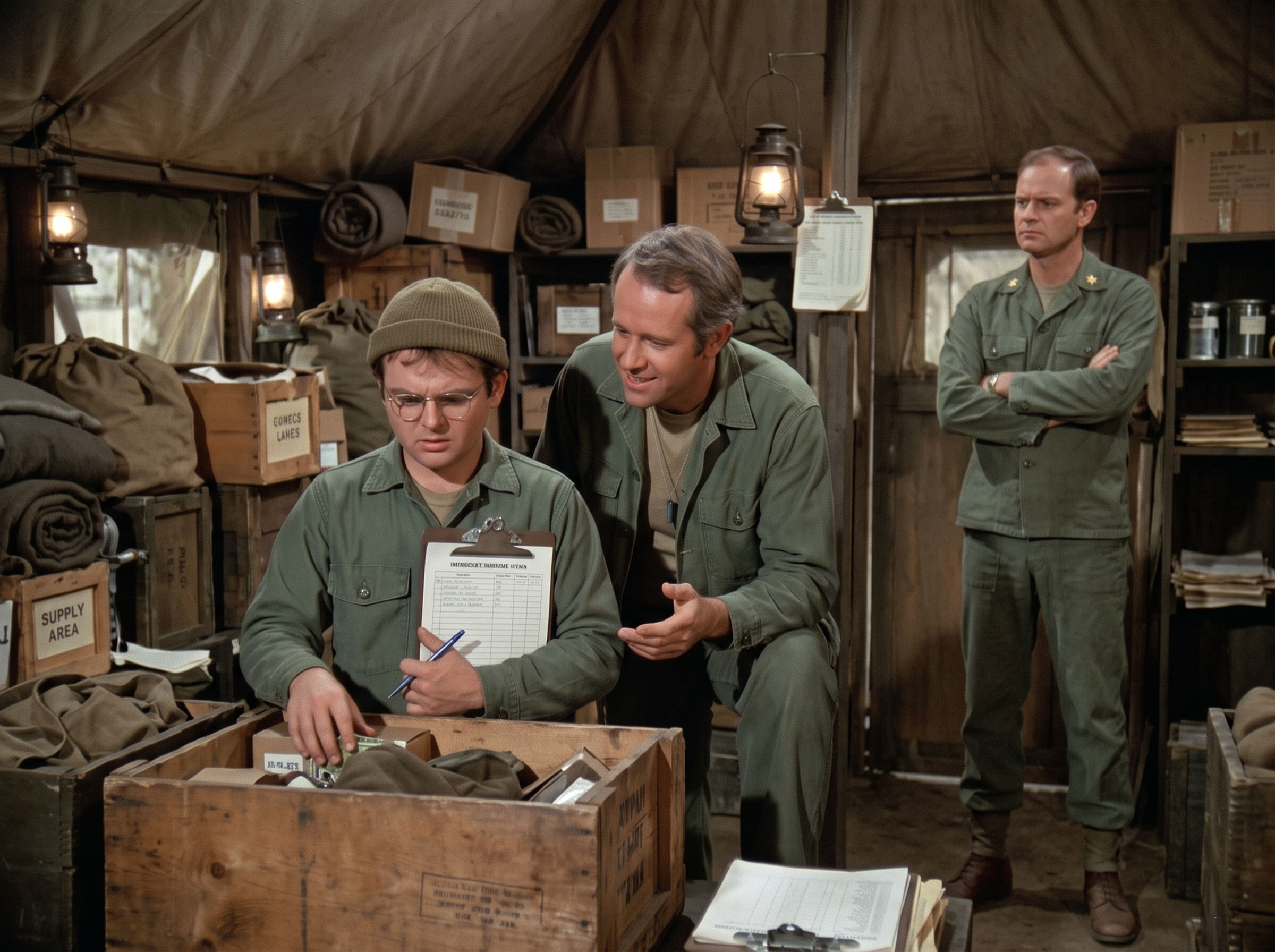
The supply tent at the 4077th always smelled of old canvas, heavy mothballs, and the exhausting weight of army bureaucracy.
At two in the morning, under the soft, dull amber glow of a single hanging utility bulb, it looked like a dusty purgatory.
Wooden crates were stacked in precarious, leaning towers. Rough canvas bags and tall piles of folded olive-drab blankets rested uneasily against the dirt walls.
The dim light caught the faded paper labels of military requisition forms and the dull metal edges of footlockers. It was a room that held the lifeblood of the camp, but tonight, it only held a profound sense of panic.
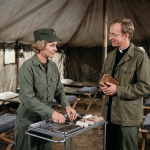
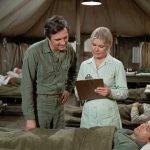
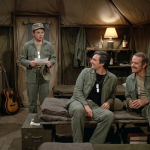
In the center of this organized chaos stood Corporal Walter “Radar” O’Reilly.
He was holding his battered wooden clipboard like a shield, but it wasn’t protecting him. His shoulders were hunched, his uniform looked slightly too big for him, and his eyes darted frantically between the paperwork and the towering stacks of supplies.
“It’s not here,” Radar muttered, his voice trembling at the edges. “It’s just not here. I checked three times. I checked the manifest, I checked the carbon copies, I even checked the back of the envelope Klinger used for his betting pool.”
Leaning forward over a crate of what was supposed to be sterile gauze, Captain B.J. Hunnicutt offered a warm, quietly ironic smile.
B.J. looked incredibly tired, his shoulders slumped beneath his faded, lived-in shirt. But his eyes were steady, offering the kind of calm, grounding warmth that had pulled this camp back from the brink of insanity countless times.
“Radar, the United States Army has misplaced entire infantry divisions,” B.J. said softly, his voice a gentle rumble in the quiet tent. “I think they can manage to lose one box of supplies without tossing you in the stockade.”
“But it’s not just a box, Captain!” Radar squeaked, flipping a page on his clipboard so hard it nearly tore. “It’s the winter shipment of surgical gloves. Form 412-B. If we don’t have them by tomorrow morning, Colonel Potter is gonna have my hide, and then he’s gonna use it to make his own gloves!”
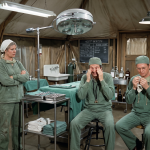
Standing slightly apart from the group, Major Charles Emerson Winchester III sighed deeply.
He stood perfectly upright, refusing to let his tailored, albeit slightly worn, garments touch the dusty wooden crates. His hands were clasped firmly behind his back. He projected an aura of refined irritation, staring at the clutter of the camp as if the very concept of a military supply tent was a personal insult.
“Corporal,” Charles began, his voice dripping with dry, aristocratic sarcasm. “While I am deeply moved by this tragic tale of missing rubber, I fail to see why my presence is required in this… warehouse of squalor at this ungodly hour.”
“Because you were the last one to sign for a package from the supply truck, Major,” Radar said, his voice dropping into an apologetic whisper.
“I signed for a package of French milled soap and a single tin of smoked oysters,” Charles retorted, his chin lifting defensively. “I hardly think I could have accidentally smuggled a crate of surgical gloves under my arm.”
“I don’t know, Charles,” B.J. mused, leaning his elbows on a canvas bag. “Your ego takes up a lot of space. A crate of gloves could easily get lost in its shadow.”
Charles closed his eyes, inhaling slowly as if praying for patience. “Hunnicutt, your wit is as dull as the scalpels in this wretched facility.”
Radar wasn’t listening to the banter. He was hyperventilating now, taking short, shallow breaths as he dug furiously into a large, unmarked canvas bag.
“They’re gone,” Radar whispered, stepping back from the bag. The clipboard fell to his side. “The gloves are gone, the spare sutures are gone, and… oh no. Oh no.”
“What is it, Radar?” B.J. asked, his quiet humor fading into genuine concern as he saw the sheer terror wash over the young clerk’s face.
Radar looked up, his eyes wide and bright with unshed tears. “The Colonel’s blood pressure medicine was in that crate too. If I lost that… I didn’t just lose supplies. I lost the Colonel.”
The silence in the supply tent suddenly felt very heavy.
Outside, the faint sound of a jeep engine starting up in the motor pool broke the stillness, but inside, the three men were frozen in the dim, warm light.
Radar stood trembling, his innocent, earnest face pale with guilt. He wasn’t just a clerk who had lost a box; he was a young man carrying the immense, crushing responsibility of keeping his makeshift family alive. Every bandage, every pill, every letter from home passed through his hands.
B.J. pushed himself off the canvas bag and walked slowly over to Radar. He didn’t make a joke. He didn’t offer a sarcastic quip.
He simply reached out and placed a heavy, warm hand on the young corporal’s shoulder.
“Breathe, Walter,” B.J. said quietly. “Just breathe. Nobody is losing the Colonel. And nobody is blaming you.”
“But I signed for it, Captain,” Radar choked out, staring down at the dirt floor. “I saw the box. I checked the little box on the paper. I did. I remember doing it. But I don’t know where it went. I’m supposed to know where everything goes. If I don’t know… then I’m not doing my job.”
Charles, who had been staring off into the middle distance with a look of supreme boredom, slowly turned his head.
Beneath his refined arrogance and constant irritation, Charles possessed a quiet, fiercely guarded sense of compassion. He could tolerate incompetence, but he could not abide the sight of genuine suffering, even in a farm boy from Iowa.
“Corporal,” Charles said, his voice losing a fraction of its usual bite. “May I see that wretched piece of paper you are clutching?”
Radar sniffled and handed the clipboard over.
Charles held it by the very edge, as if the paper itself might infect him with a midwestern accent. He pulled a pair of reading glasses from his pocket and peered at the faded, carbon-smudged print under the weak light bulb.
“Let’s see,” Charles muttered. “Supply manifest… requisition order… Form 412-B. You are correct, Corporal. It says here that one crate of surgical gloves and one small parcel of medical sundries were delivered. And you signed for them at fourteen-hundred hours.”
“See?” Radar said miserably. “I lost them.”
“However,” Charles continued, holding up a single, manicured finger. “If one were to actually read the alphanumeric coding applied by the spectacularly incompetent clerks in Tokyo, one would notice a small discrepancy.”
B.J. stepped closer, peering over Charles’s shoulder. “What discrepancy?”
“Look here, Hunnicutt,” Charles said, pointing to a blurred string of numbers. “The destination code is 4077. But the departmental routing code is not ‘MED’ for Medical. It is ‘MESS’.”
Radar blinked, his brow furrowing beneath his round glasses. “Mess?”
“Precisely,” Charles said, handing the clipboard back to Radar with a dramatic flourish. “The military, in its infinite wisdom, did not send your surgical gloves to the hospital. They sent them to the kitchen.”
B.J. let out a short, tired laugh, rubbing a hand over his face. “You mean Igor is sitting on our surgical gloves?”
“Knowing our illustrious kitchen staff,” Charles said dryly, “they are likely attempting to boil them into a stew as we speak.”
Radar’s face transformed instantly. The color rushed back into his cheeks, and a massive, goofy grin spread across his face. The crushing weight of the war seemed to lift off his small shoulders, leaving behind only the exhausting, familiar relief of a crisis averted.
“The mess tent!” Radar exclaimed, hugging his clipboard to his chest. “I’ll go get them right now! I’ll wake up Igor! Thank you, Major! Thank you, Captain!”
Radar turned and practically tripped over a wooden crate in his rush to get out the door, his boots thudding against the dirt as he disappeared into the cool, dark Korean night.
B.J. and Charles were left alone in the quiet, dusty tent.
The crisis had passed. The tension had evaporated. All that remained was the deep, bone-aching fatigue of two surgeons who had seen too much and slept too little.
B.J. looked over at Charles, a slow, appreciative smile tugging at the corners of his mouth. “That was a nice thing you did, Charles. You didn’t have to look at the paperwork.”
Charles stiffened, adjusting the cuffs of his shirt. “I assure you, Hunnicutt, my actions were entirely selfish. The boy’s whining was giving me a migraine. Furthermore, I have an operation scheduled for tomorrow morning, and I refuse to perform thoracic surgery bare-handed like some sort of medieval barber.”
B.J. chuckled softly, shaking his head. He knew better. They all knew better. Beneath the bluster and the wealth, Winchester was just another tired doctor trying to keep his family intact.
“Whatever you say, Charles,” B.J. said, turning toward the tent flap. “Let’s go get some sleep. We’ve got a war to fight tomorrow.”
“After you, Hunnicutt,” Charles replied, taking one last look around the dusty, cluttered supply room before switching off the single, dull amber bulb.
In the heart of the 4077th, even the smallest lost box could break your heart, and even the smallest found grace could mend it again.