The Taste of Home in a Canvas Tent
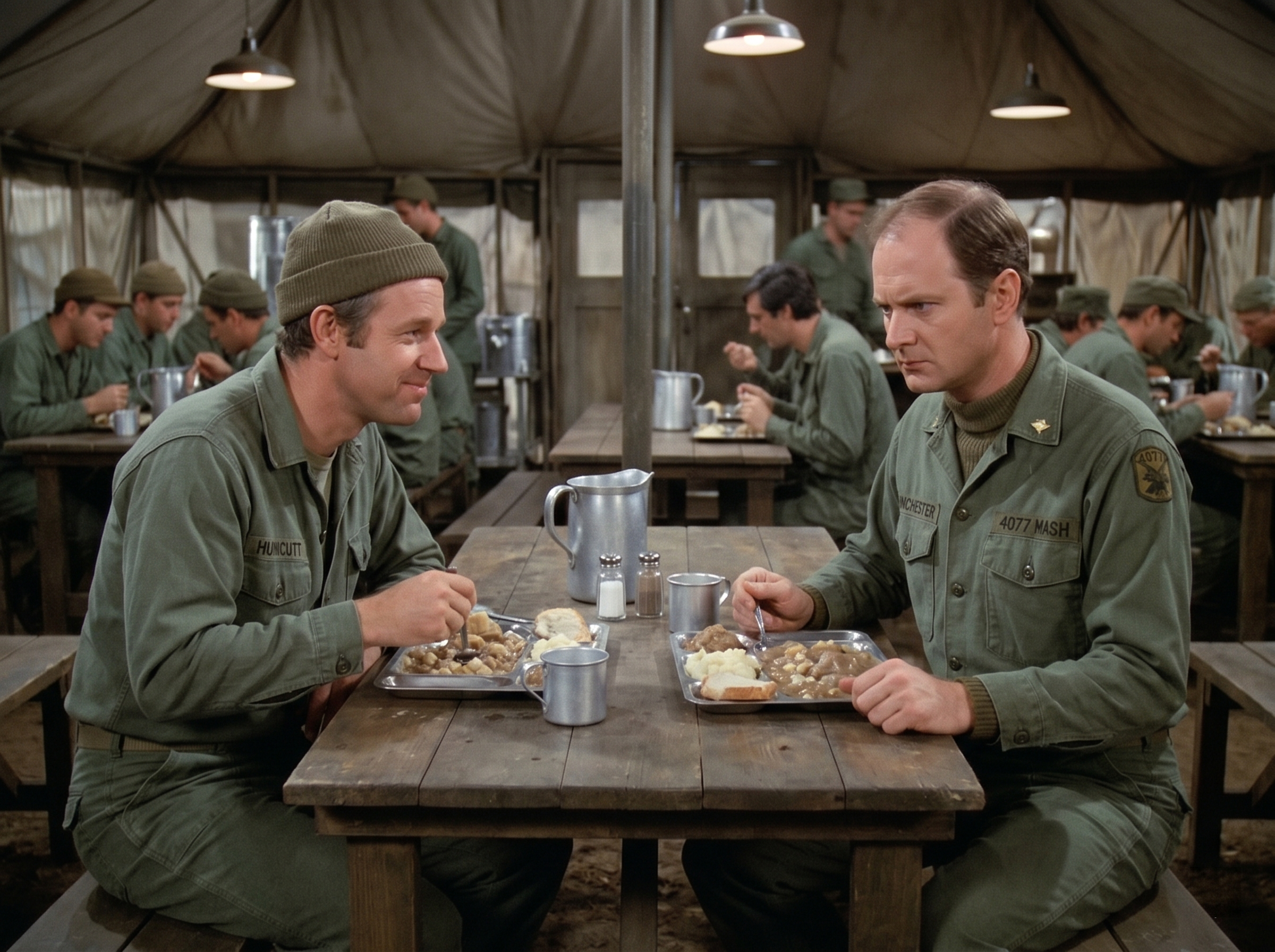
There were three distinct stages of exhaustion at the 4077th Mobile Army Surgical Hospital.
The first stage made you angry. The second stage made you laugh at things that weren’t funny. But the third stage—the bone-deep, spirit-crushing fatigue that followed a thirty-six-hour marathon in the operating room—made you completely numb to the world around you.
It was during this third stage that the Mess Tent somehow seemed like a sanctuary. It didn’t matter that the canvas walls smelled permanently of boiled cabbage and damp wool. It didn’t matter that the wind howling down from the Korean hills rattled the tin cups on the wooden tables. It was a place to sit. A place where nobody was bleeding.
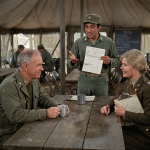
Major Charles Emerson Winchester III stared at his aluminum tray as if it had personally insulted his ancestors.
He sat impeccably upright, his green turtleneck pulled up high against the draft, his fatigue jacket buttoned with whatever dignity he could muster in a war zone. Before him sat a culinary disaster. It was a gelatinous puddle of brown gravy, harboring suspect chunks of mystery meat, slowly bleeding into a mound of instant mashed potatoes that possessed the exact texture of drying plaster.
“It is a marvel, Hunnicutt,” Charles muttered, his voice dripping with aristocratic venom. “A genuine marvel. The United States Army has managed to take ingredients that once grew in the earth and turn them into something that violates the Geneva Convention.”
Across the rough wooden table, Captain B.J. Hunnicutt did not respond.
B.J. was slouched comfortably, his olive-drab knit cap pulled low over his messy hair. He held his fork lightly in his hand, resting his forearms on the table.
He wasn’t groaning. He wasn’t complaining.
In fact, B.J. was smiling.
It wasn’t one of his usual mischievous grins. It was a soft, private, incredibly warm smile. The kind of smile a man wears when he is thousands of miles away from the freezing mud of South Korea.
Charles narrowed his eyes. His refined, expressive face twisted into a mask of pure, unadulterated suspicion. He leaned forward, studying his tentmate.
“What are you doing?” Charles asked, his tone sharp.
B.J. blinked, as if slowly returning from a dream. He looked down at his tray, then back up at Charles. “I’m eating dinner, Charles.”
To demonstrate, B.J. scooped up a forkful of the congealed brown gravy and potatoes. He brought it to his mouth, chewed slowly, and swallowed.
The warm smile never left his face. He actually looked content.
Charles was instantly appalled. He cast a quick, frantic glance around the crowded mess tent, half-expecting to see Hawkeye or Radar pulling some elaborate prank. But Hawkeye was asleep in his soup three tables over, and Radar was nowhere to be seen.
This was real. Hunnicutt was actually enjoying the food.
Charles leaned in closer across the wooden planks. The irritation in his eyes was suddenly replaced by a sharp, clinical flash of medical concern.
“Hunnicutt,” Charles said slowly, keeping his voice down. “I have stood beside you through endless, agonizing shifts in triage. I have watched you endure the unimaginable with stoic, homespun resilience.”
B.J. chuckled softly, taking another bite. “It’s really not that bad today, Charles.”
Charles went perfectly still. He slowly lowered his own fork, leaving it beside his tray.
“Good lord,” Charles whispered, his voice dropping to a grave, terrified hush. “You’ve finally snapped. The endless parade of meatball surgery has fractured your mind. Tell me the truth, B.J. What year do you think it is, and who do you think is serving us this poison?”
B.J. let out a tired, gentle laugh that barely rose above the dull clatter of metal trays and the low hum of exhausted soldiers.
He didn’t look offended by Charles’s impromptu psychiatric evaluation. He just looked incredibly at peace.
“I haven’t snapped, Charles,” B.J. said softly. “I know exactly where we are. We’re in purgatory, freezing our toes off, and eating something Igor probably scraped off the bottom of a jeep.”
“Then explain the grotesque display of joy on your face,” Winchester demanded, crossing his arms tightly over his chest. “Because a sane man does not grin at a plate of toxic sludge unless he is experiencing a profound disconnect from reality.”
B.J. looked down at his tray. He used his fork to gently push a lump of gray meat around in the thick sauce.
“It’s Peg,” B.J. said quietly.
Charles blinked, momentarily derailed. “Your wife? What does she have to do with this culinary tragedy?”
“It was our first anniversary,” B.J. murmured, his eyes losing focus on the mess tent as the memory took hold. “We were living in this tiny apartment in San Francisco. The kind of place where the radiator clanked all night and the windows rattled every time a truck drove by. We didn’t have much money, but Peg wanted to do something special. She wanted to make a traditional Sunday roast.”
Charles remained silent, watching the profound shift in B.J.’s demeanor.
“She spent all afternoon in that tiny kitchen,” B.J. continued, a fond light dancing in his tired eyes. “She bought a beautiful cut of beef. She was so incredibly proud. But… she didn’t know you were supposed to add a little liquid to the bottom of the roasting pan.”
A faint ghost of an amused smirk tugged at the corner of Charles’s mouth, despite himself. “I foresee a disaster.”
“Disaster is a mild word,” B.J. laughed quietly. “The smoke was unbelievable. It poured out of the oven like a locomotive. We had to throw open all the windows in the middle of January. We were freezing, waving towels around to clear the air.”
B.J. looked down at his metal tray, pointing his fork at the brown puddle.
“She was so upset. She tried to save the dinner by making homemade gravy. But she was rushing, and the flour clumped up. It was thick, it was lumpy, and it tasted vaguely of burnt carbon.”
B.J. looked back up at Charles. The smile was still there, but now there was a heavy, beautiful ache behind it.
“It looked exactly like this,” B.J. whispered.
Charles stared at the man across from him. The aristocratic wall of pompous superiority that Winchester so carefully maintained began to crack, just a fraction.
“We ended up sitting on the living room floor in our heavy winter coats,” B.J. said, his voice dropping to a soft, reverent hum. “Eating burned meat and lumpy gravy. And we laughed. We laughed until our ribs hurt. It was the best meal I’ve ever had in my entire life.”
B.J. took another slow bite of the terrible mess tent food.
“So, when I eat this,” B.J. said gently, “I’m not in Korea, Charles. I’m sitting on a cold floor in San Francisco, freezing my tail off with the woman I love.”
The noise of the mess tent seemed to fade away. The clatter of the trays, the shouting from the kitchen, the distant rumble of choppers—none of it reached their table in that moment.
Charles looked at B.J. for a long, quiet minute.
He thought of his own home in Boston. He thought of the immaculate dining room, the crystal goblets, the silent servants moving perfectly in the background. He thought of the flawlessly prepared duck a l’orange, eaten in an atmosphere of polite, emotionally sterile silence.
Charles realized, with a sudden, painful clarity, that he had never eaten a meal as rich as the burned, lumpy roast B.J. had just described.
Charles looked down at his own tray. The food was still terrible. The war was still raging outside the canvas walls. Nothing had physically changed.
Slowly, with deliberate dignity, Charles uncrossed his arms. He reached out and picked up his fork.
“Well,” Charles said softly, his voice stripped entirely of its usual biting sarcasm. It was replaced by a quiet, incredibly tender respect. “Far be it from me to interrupt an anniversary dinner.”
Charles dug his fork into the gelatinous brown gravy. He picked up a solid lump of the mystery meat. He looked at it for a brief second, took a deep breath, and placed it into his mouth.
He chewed. He closed his eyes, his refined palate screaming in protest, but he forced himself to swallow it down.
When he opened his eyes, he looked directly at his bunkmate.
“My compliments,” Charles murmured gently, raising his tin cup of stale water in a small, private toast. “To Mrs. Hunnicutt. Her recipe… is truly unforgettable.”
B.J.’s smile widened, shifting from nostalgic memory to deep, unspoken gratitude for the man sitting across from him.
“Thanks, Charles,” B.J. said softly. “I’ll be sure to tell her.”
They didn’t say another word. They just sat together in the damp, freezing mess tent, finding a tiny, fleeting piece of home at the bottom of an aluminum tray.
In a place surrounded by war, the greatest medicine was always the memory of who they were waiting to go back to.