A Table for Three in the Mess Tent
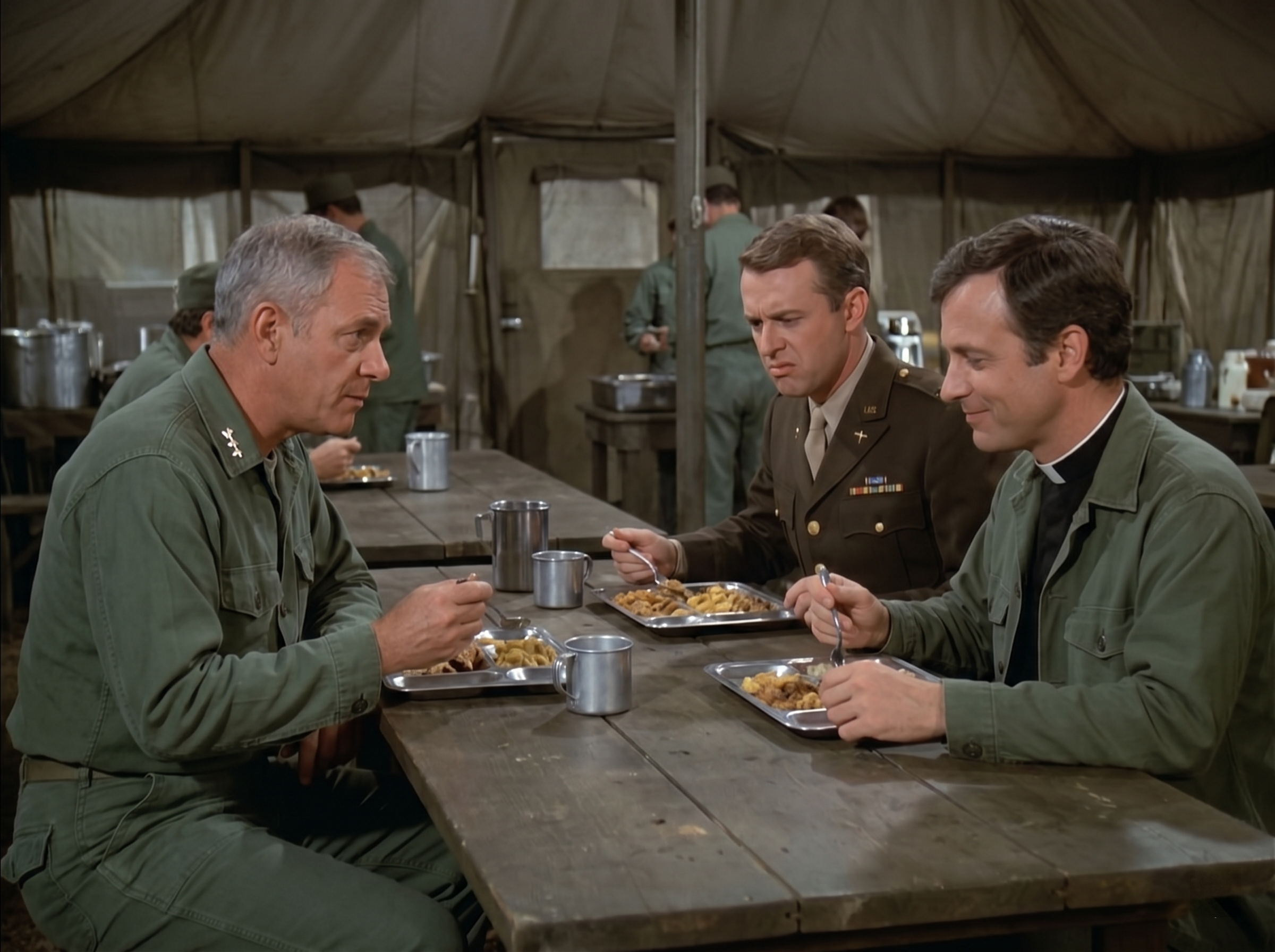
If the canvas walls of the mess tent could speak, they’d tell you about the best coffee and the worst stew in the Army.
But they’d also tell you about the conversations that were the only thing keeping the saner people sane.
The 4077th was running low on everything – coffee, penicillin, even fresh linen.
It had been another forty-eight-hour O.R. session, the kind that makes your legs turn to lead and your mind go numb.
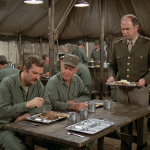
That’s when Colonel Potter, Father Mulcahy, and a nervous young Lieutenant found themselves at the same scarred wooden table.
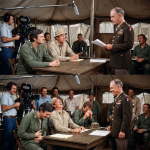
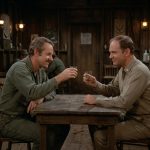
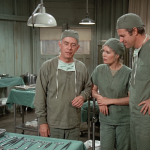
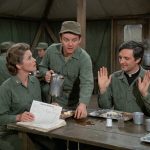
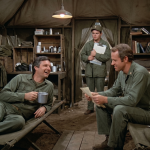
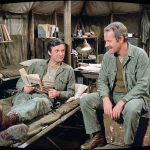
We see the image, taken just as a strange quiet settled over the chaotic tent.
Colonel Potter sat, shoulders slightly stooped, his fork resting over the metal tray that held “the gray.” He looked tired, but his eyes still held that steady, comforting strength that anchored the camp.
Across from him sat Father Mulcahy, his gentle smile looking particularly soft as he nudged some questionable potatoes on his tray. He knew the gray was gray, but he always managed to look at it as if maybe it was just *slightly* darker than beige.
But the real heart of this moment is the Lieutenant in the center.
He is not a regular at the 4077th. You can tell by the way his uniform shirt is perfectly pressed, and his dress jacket is immaculate, contrasting sharply with Potter’s practical fatigue jacket.
He’s not a doctor; he’s an admin officer from Seoul, here on a supply audit.
His brows are furrowed. His lips are set in a tense, confused pucker.
He looks at his meal with absolute dread. He’s looking at “the gray” as if it’s radioactive.
It’s the classic 4077th mess tent scene: seasoned veterans trying to eat the unbearable with some semblance of normal appetite, and the new guy, completely undone by the lack of… well, edible options.
Lieutenant Davies had been taking meticulous notes all morning about linen counts and fuel consumption. He thought he knew “rules” and “efficiency.”
He hadn’t planned on the gray.
Potter had watched Davies spend five minutes just *staring* at the food. The Colonel, knowing a man’s pride was about to clash with his hunger, just waited.
Father Mulcahy, bless him, tried to help. “It’s… warm, Lieutenant. And, uh, substantial?”
Davies had finally picked up his fork, his eyes fixed on a lump of gray meat. His whole face was an advertisement for civilian sensibilities meeting military reality. He had been holding that fork poised for so long, his hand was beginning to shake.
And just as Davies finally screwed up the courage to bring the fork toward his mouth, just when the tension at the table was thick enough to chew—
The entire tent rumbled as a helicopter swooped low over the camp.
The sound shattered the quiet. Davies, already on edge, jumped as if a mortar had landed on the coffee pot.
Potter didn’t even look up at the chopper. For him, it was just the rhythm of the place.
But Lieutenant Davies dropped his fork. It clattered against the metal tray with a noise that made half the mess tent turn.
He froze. His face went even paler than “the gray.” He looked like a man about to apologize to a General, while simultaneously fighting back the urge to flee.
Father Mulcahy’s smile never faltered, but his expression softened with concern. He gently put his own fork down.
“It’s just an inbound medical chopper, Lieutenant,” Mulcahy said, his voice quiet against the fading engine noise. “We’re, uh… used to it here.”
Potter, without saying a word, finally lifted his eyes from his tray to look directly at Davies.
“Eat up, son,” Potter said, his voice gruff but kind. “Don’t let the noise spoil the finest dining experience north of the 38th parallel.”
Davies looked between the priest and the Colonel. He saw the genuine, unbothered acceptance in their expressions. They weren’t judging him. They understood.
He looked back at “the gray.” It hadn’t changed.
“But… sir,” Davies stammered. “This food… I… is it always like this?”
Potter chuckled, a low, dry sound. “Let’s put it this way, Lieutenant. If the enemy ever invades and takes over the mess tent, they’ll surrender before dinner is served.”
The smallest ripple of a smile cracked on Davies’ face.
“Father Mulcahy here,” Potter continued, “is currently trying to bless the gray to make it beige. He’s had some success with the green beans, though.”
Mulcahy looked appropriately modest. “Well, Colonel, the Lord *does* work in mysterious ways.”
Davies picked up his fork. This time, he didn’t stare. He didn’t evaluate. He just scooped up some mashed potatoes, closed his eyes slightly, and took a bite.
He swallowed. It wasn’t good. But it was food. And more importantly, he was at *their* table.
“It’s not so bad,” Davies said, his voice still a bit strained. He actually managed a genuine, albeit pained, smile. “You learn to… adjust the criteria.”
Potter nodded, looking back at his own tray. “The criteria here is simple: Can you eat it without it eating you? If the answer is yes, then you’ve won the day.”
He was just a pencil pusher from Seoul, in a fancy pressed uniform. But in that small moment, surrounded by the absurdity of “the gray,” he had been taken in. He was part of it.
For the next ten minutes, they sat in a different kind of quiet. They ate their unbearable meals not as superior officer, priest, and visitor, but just as three people sharing the same strange fate.
It was just another meal at the 4077th.
But in that image we see, with Potter’s steady look and Mulcahy’s warm grin, they were teaching a young officer that courage wasn’t just about big battles; sometimes it was about swallowing your fear, and “the gray.”
It’s the little humanity in the big mess. That’s what always brought you back.
Sometimes the best prayer you can offer in a war is just showing up at the table.