The Botany of Survival at the 4077th
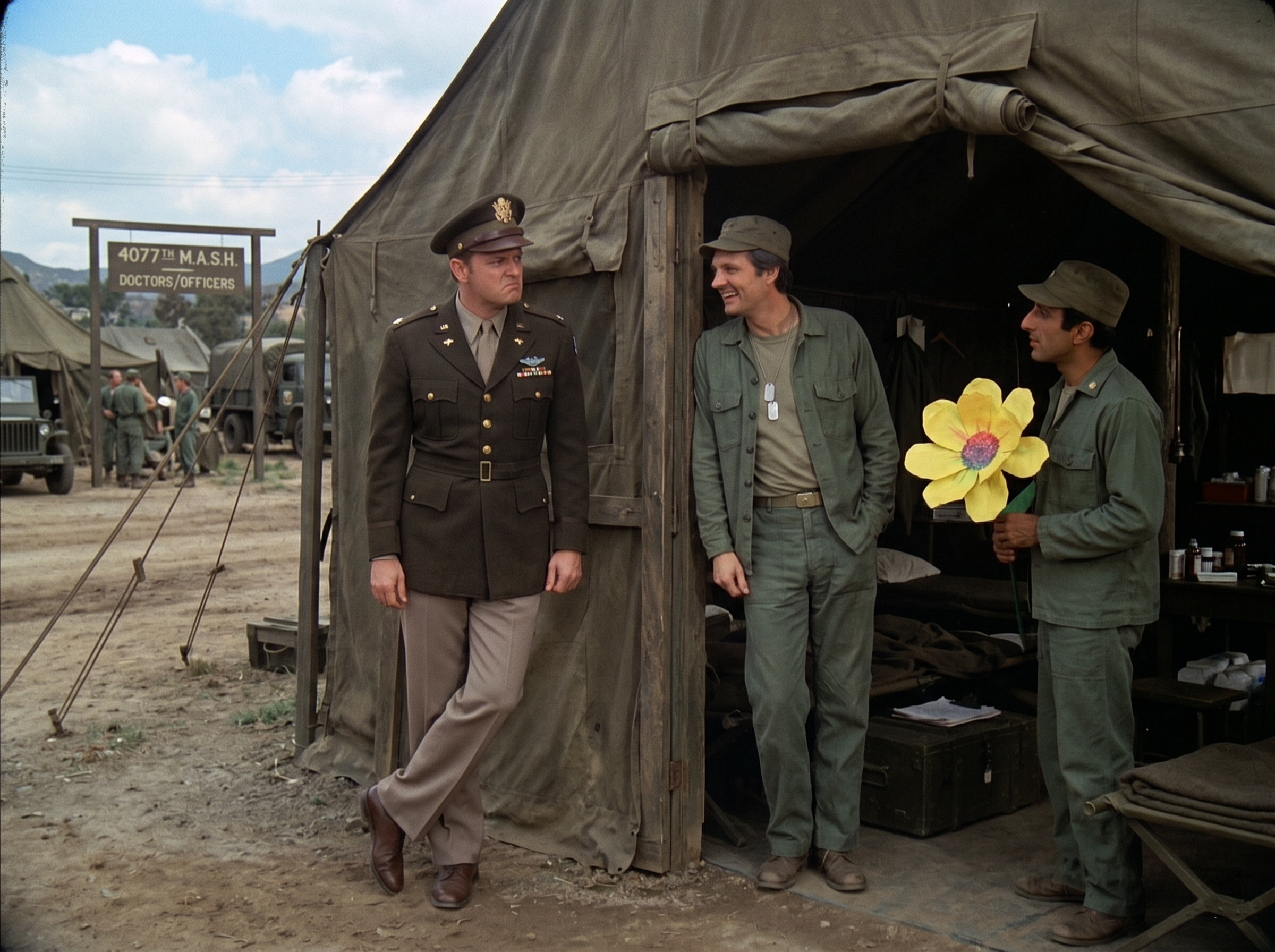
The dust of the 4077th had a special way of ruining everything, but Major Charles Emerson Winchester III was determined not to let it ruin his afternoon.
It had been three days since the last choppers arrived, leaving the camp in a state of suspended, exhausting boredom. To combat the oppressive drabness of the Korean landscape, Charles had decided to reclaim a shred of his Boston dignity. He had spent the better part of an hour meticulously pressing his Class A uniform, shining his boots, and adjusting his tie.
He was scheduled to attend a rare, civilized briefing at I Corps, and he intended to leave the Swamp looking like an officer, a gentleman, and a physician of means.
With his cap set perfectly on his head, Charles grabbed his orders, turned on his heel, and marched toward the tent flap. He was ready to escape the squalor, if only for a few hours.
He didn’t make it out the door.
Frozen mid-step in the doorway, Charles felt his jaw tighten in an expression of heavily restrained irritation. His path was completely blocked.
Leaning casually against the wooden frame of the tent was Captain Benjamin Franklin Pierce. Hawkeye was dressed in his usual state of comfortable disarray—a faded green fatigue shirt hanging open over a dusty undershirt, his dog tags catching the dull afternoon light.
Hawkeye wasn’t moving. He just stood there, wearing a spontaneous, clever smile that told Charles he was walking into a trap.
“Step aside, Pierce,” Charles said, his voice clipped and dripping with aristocratic warning. “I have a jeep waiting and a schedule to keep.”
“Can’t do it, Charles,” Hawkeye replied smoothly, not budging an inch. “There’s a toll on this road. A strict customs inspection for anyone attempting to smuggle high-grade pomposity across the border.”
Charles drew in a sharp breath, his chest swelling beneath his pristine wool jacket. He was about to unleash a localized hurricane of insults, ready to verbally obliterate Hawkeye and walk right over his combat boots.
But then, out of the corner of his eye, Charles noticed movement inside the dim interior of the tent.
Corporal Maxwell Klinger stepped into the light. For once, Klinger wasn’t wearing a velvet gown, a feathered boa, or a fruit-basket headdress. He was wearing standard-issue fatigues.
However, what he lacked in fashionable attire, he more than made up for with the object he was cradling in his hands.
It was a flower. But not just any flower. It was a massive, absurdly proportioned, papier-mâché monstrosity of a flower. It had bright, garish yellow petals and a violently purple center, attached to a thick green stalk.
Charles stared at it, the sheer absurdity of the object short-circuiting his anger for a fraction of a second.
He looked at Klinger’s face, expecting the usual chaotic grin or a desperate plea for a Section 8 discharge based on botanical delusions. But Klinger wasn’t joking.
The Corporal stood there with an expression of complete, unguarded emotional sincerity. He looked incredibly proud of the massive, ridiculous craft project in his hands.
“For you, Major,” Klinger said softly, holding the giant blossom forward.
Charles froze. The tension in the dusty doorway thickened. He looked from Hawkeye’s knowing, testing smile to Klinger’s earnest, hopeful eyes. The great Boston surgeon stood at a crossroads, trapped between his cultivated arrogance and an unexpected, absurd ambush of camp affection.
He tightened his grip on his orders, his face flushing beneath his cap. The war was outside, the jeep was waiting, and Charles opened his mouth, ready to crush the delicate, ridiculous moment into dust.
The silence in the doorway stretched out, heavy and expectant.
Hawkeye’s smile faded just a fraction, his eyes narrowing slightly as he watched Charles. This was the moment of truth. They all knew Winchester could be incredibly cruel when his dignity was offended, and nothing offended Charles quite like uninvited sentimentality from the enlisted ranks.
Charles stared down at the giant yellow petals. He could see the brushstrokes of cheap motor pool paint. He could see the texture of what appeared to be cast-off medical gauze and cardboard ration boxes shaping the massive purple center. It was a hideous creation.
“Corporal,” Charles began, his voice dangerously low. “What, in the name of all that is holy, is this monstrosity?”
Klinger didn’t flinch. He just held the flower a little higher, his dark eyes shining with quiet resilience.
“It’s a Toledo Sun-Catcher, Major,” Klinger said, his voice completely steady. “Or, well, my version of one anyway.”
Charles blinked, momentarily derailed. “A what?”
“A Toledo Sun-Catcher,” Klinger repeated earnestly. “I heard you talking to Father Mulcahy yesterday by the mess tent. You were talking about your mother’s greenhouse back in Massachusetts. You said this was the exact week the yellow daffodils usually bloom.”
Charles felt a sudden, strange tightness in his chest. He had thought that conversation with the Father had been entirely private. He had been feeling particularly homesick yesterday, the smell of the latrines and the sight of endless olive drab finally wearing down his defenses.
“I know it ain’t a daffodil, Major,” Klinger continued, a modest, almost shy smile touching the corners of his mouth. “And it sure ain’t Boston. But I figured… well, nobody should have to miss the spring. Even here.”
Charles looked at Klinger. He really looked at him. Beneath the fatigue and the constant, desperate schemes to escape the army, the Corporal possessed a deeply observant, profoundly human heart.
He had spent hours making this ridiculous thing. He had scavenged for materials, painted it, and waited here to present it, risking Winchester’s infamous wrath, just to give a homesick snob a piece of spring.
Charles slowly shifted his gaze to Hawkeye.
Hawkeye was no longer smiling that clever, mocking smile. The sarcasm had melted away, leaving behind a look of quiet, genuine warmth. Hawkeye wasn’t blocking the door to irritate Charles; he was blocking the door to make sure Charles didn’t miss this moment. He was making sure the Major stopped running long enough to accept a gift.
The anger that had been bubbling in Charles’s chest evaporated, replaced by a heavy, humbling wave of affection for these infuriating people.
He couldn’t break character entirely, of course. He was still a Winchester. But he knew exactly what was required of him.
Charles reached out slowly. His impeccably manicured hands, the hands of one of the finest thoracic surgeons in New England, gently closed around the thick, green, papier-mâché stem.
He lifted the giant flower, holding it with the same reverence he would use to hold a priceless piece of Ming porcelain.
“Corporal,” Charles said, his voice returning to its usual refined cadence, though it had lost all its bite. “The pistil is entirely disproportionate to the petals. The stem lacks any structural integrity, and the color is frankly aggressive.”
Klinger’s face fell just a fraction.
“However,” Charles continued smoothly, his eyes softening as he looked directly into Klinger’s face. “I must admit… it is the most striking piece of horticulture I have seen in all of Korea. I shall… treasure it.”
Klinger’s face lit up instantly. The sheer pride radiating from the Corporal could have powered the camp’s generators. “You really like it, Major?”
“I am astounded by it, Max,” Charles said quietly, using the Corporal’s first name—a rare and deliberate choice.
Hawkeye let out a soft, huffing laugh. He pushed himself off the doorframe, his hands still in his pockets, and stepped aside, clearing the path.
“Have a good trip to Seoul, Charles,” Hawkeye said gently. “Try not to wilt on the way.”
Charles gave Hawkeye a dignified nod, acknowledging the unspoken respect passing between them. He adjusted his cap with his free hand, squared his shoulders, and stepped out of the tent.
He didn’t leave the flower behind.
Major Charles Emerson Winchester III marched out into the glaring Korean sunlight, heading toward his waiting jeep. He was a picture of perfect, unyielding military and aristocratic formality, except for the massive, absurd, bright yellow paper flower he carried proudly by his side.
Back in the doorway, Hawkeye and Klinger watched him go. Klinger was beaming, and Hawkeye just shook his head, a warm, tired smile playing on his lips.
They were thousands of miles from home, surrounded by mud, blood, and endless noise. They were exhausted, frightened, and losing their minds a little more every day.
But as long as they had moments like this, as long as they could find a way to grow something beautiful in the dirt, they were all going to be okay.
In the heart of a war zone, the greatest medicine they ever administered to each other was simply paying attention.