The Fragile Chords of the 4077th
The dirt of Korea had a way of settling into everything—your boots, your uniform, your fingernails, and eventually, your bones. But every now and then, if you looked closely through the dust, you could find a few square feet of pure, unadulterated sanity.
Outside the canvas walls of the Swamp, the afternoon sun was beginning its slow descent behind the jagged, indifferent mountains. The air was finally cooling down, carrying with it the faint, omnipresent scent of rubbing alcohol, diesel oil, and yesterday’s rain.
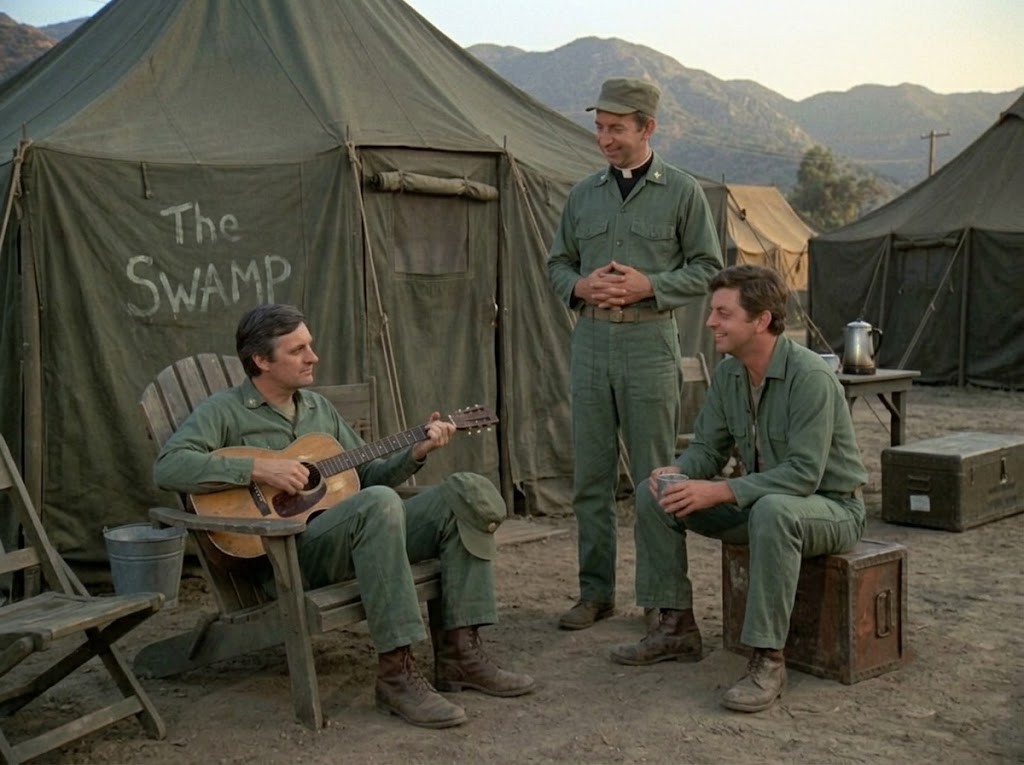
Hawkeye sat slumped in his familiar wooden Adirondack chair, his long legs stretched out in front of him, looking every bit the weary surgeon he was. His olive-drab shirt was unbuttoned at the collar, and his worn combat boots were caked in dried mud.
In his hands, he held an old acoustic guitar, his fingers lightly tracing the bruised wood of the fretboard. It wasn’t a fine instrument by any means; the finish was scratched, and one of the tuning pegs was slightly loose, but it was a bridge to another life.
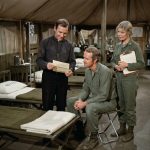
A few feet away, B.J. sat perched on an old wooden crate, holding a tin cup of cold water in his hands. He looked equally exhausted, his shoulders sagging with the weight of a twelve-hour shift in Post-Op, yet his face wore that characteristic, comforting warmth.
Father Mulcahy stood between them, his hands clasped gently in front of his pristine green uniform, a soft, small smile gracing his face. He looked like a man who had just stepped out of a chapel, even though his chapel that morning had been a blood-slicked operating room.
For nearly twenty minutes, none of them had spoken a single word. The silence wasn’t uncomfortable; it was the kind of heavy, functional quiet that only people who have stared into the same darkness together can truly appreciate.
Then, Hawkeye’s fingers began to move, plucking out a slow, tentative melody that drifted into the camp’s quiet air. It wasn’t a standard army march or a loud, brassy show tune, but a gentle, sweeping folk melody from a home that felt millions of miles away.
B.J. tilted his head, a spark of recognition lighting up his tired eyes as he listened to the fragile chords. Father Mulcahy’s smile widened just a fraction, his thumbs turning over each other as the music seemed to wash away the tension in his shoulders.
“You’re out of tune on the G string, Pierce,” B.J. murmured softly, not wanting to break the spell but unable to resist a gentle rib.
“That’s not out of tune, Beej,” Hawkeye replied without looking up, his voice carrying that familiar, dry, razor-sharp edge. “That’s what we call artistic license. It’s meant to reflect the general state of disassembly of my current surroundings.”
“I think it sounds lovely, Captain,” Father Mulcahy said quietly, his voice a soothing balm against the harsh reality of the camp. “It reminds me of the evenings back in Philadelphia, just before the autumn leaves begin to turn.”
Hawkeye didn’t answer, but his fingers shifted smoothly into a softer, more rhythmic pattern, the notes ringing out clear and resonant against the green canvas.
Suddenly, from just around the corner of the tent, the distinctive, shrill sound of the compound’s PA system crackled to life with a burst of static, making all three men instantly freeze in place.
The static hissed through the air, a cruel reminder of where they were, threatening to shatter the fragile peace they had so carefully built.
Each of them held their breath, waiting for the inevitable voice of Radar to announce another incoming chopper, another influx of broken bodies, another sleepless night under the blinding lights of the OR.
Instead, the speaker hummed for a long second, clicked twice, and went completely silent again. It was just a glitch in the wires, a momentary lapse in the camp’s mechanical heartbeat.
Hawkeye let out a long, slow breath, his fingers relaxing against the guitar strings as B.J. took a quiet sip from his tin cup. The collective sigh of relief was almost palpable in the small dirt clearing.
“Don’t do that to a man with a hangover, Father,” Hawkeye joked weakly, though the humor didn’t quite mask the sudden tightness in his jaw. “My heart just tried to escape through my left ear.”
“The Almighty handles the big miracles, Hawkeye,” Mulcahy said with a gentle chuckle, stepping a bit closer to the crate where B.J. sat. “I believe that little pause was just a small favor for three tired souls.”
Hawkeye looked down at the guitar again, his thumb softly brushing against the low E string, letting the deep vibration fill the silence left by the PA system. He began to play again, a different tune this time—somber, steady, and deeply comforting.
“You know,” B.J. said, looking out toward the distant, purple-hued peaks, “sometimes I forget what a song sounds like without the accompaniment of artillery in the distance.”
“That’s because the artillery has no sense of rhythm, Beej,” Hawkeye said, his wit returning, though his eyes remained soft and focused on the moving chords. “They’re all brass and no soul. Completely unteachable.”
Father Mulcahy watched the two doctors, a profound sense of gratitude warming his chest. He saw the deep lines of fatigue etched into their young faces, faces that should have been enjoying backyard barbecues and quiet medical practices back home.
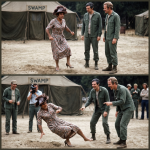
Yet here they were, sitting in the mud, finding a way to share a laugh and a melody in the shadow of a tent they called the Swamp.
A couple of enlisted men walked past the clearing, carrying a stack of clean laundry, but they slowed their pace as they neared the tent. They didn’t speak, they didn’t interrupt; they just walked a little slower, letting the sound of Hawkeye’s guitar follow them down the dirt path.
The sun dropped a little lower, casting long, dramatic shadows across the compound, painting the green tents in shades of deep amber and gold.
Hawkeye brought the song to a gentle close, letting the final chord ring out until it naturally faded into the evening air. He rested his palm across the strings, silencing the instrument, and looked up at his friends.
“Not bad for a kid from Maine, huh?” Hawkeye asked, a genuine, boyish smile breaking through his tired facade.
“Not bad at all, Hawk,” B.J. replied, raising his tin cup in a silent, affectionate toast to his tentmate. “In fact, I’d even say it was almost worth the dirt in my water.”
Father Mulcahy nodded in agreement, his hands still clasped, his spirit lifted by the simple, beautiful reminder that even in the darkest corners of the world, humanity always finds a way to sing.
Because sometimes, a few simple chords on a scratched guitar were the only things keeping the chaos at bay.