A Toledo Lullaby in Post-Op
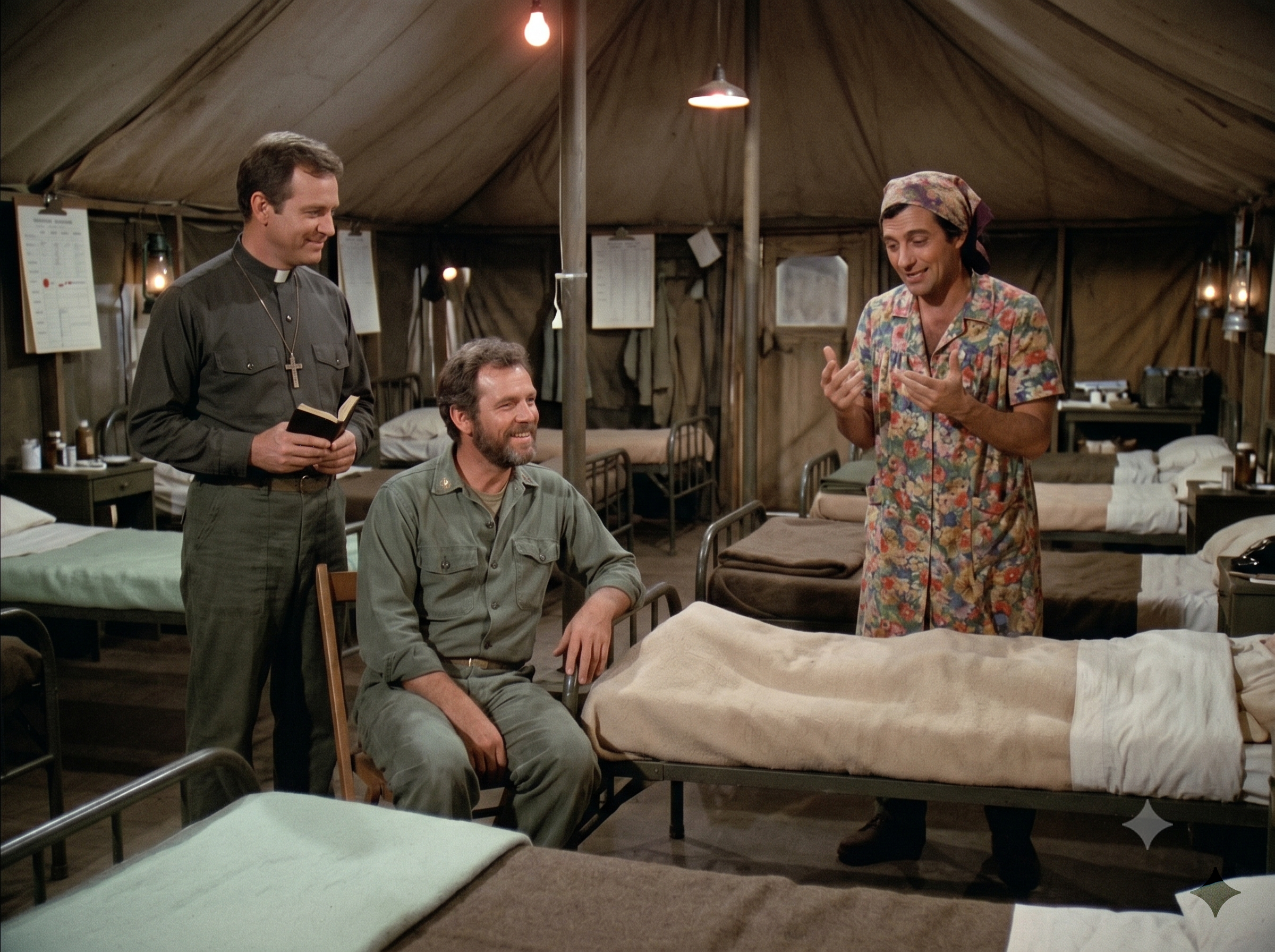
Post-Op was rarely a quiet place, but when the silence did fall, it was often heavier than the noise.
It was late afternoon, the time of day when the Korean sun baked the green canvas of the 4077th until the air inside the recovery ward felt thick and slow. The smell of ether, strong black coffee, and damp wool blankets hung in the air.
There had been no choppers for twelve hours. For a frontline MAS*H unit, that was a miracle. But for the boys already lying in the cots, the quiet just meant there was too much time to think.
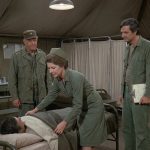
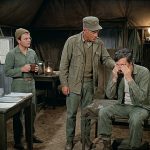
In the center of the ward, Captain B.J. Hunnicutt sat slumped in a wooden folding chair. He was still wearing his olive drab fatigues, the collar open, his shoulders carrying the invisible weight of the morning’s endless surgeries.
He was sitting beside the cot of a young private named Miller. Miller was nineteen, maybe twenty, with a face pale enough to blend into the sheets. The boy’s physical wounds were neatly stitched and bandaged, but he had spent the last four hours staring at the canvas ceiling, refusing to speak, refusing to sleep, and refusing to ask for the pain medication he clearly needed.
It was the kind of hollow, distant stare that worried doctors far more than screaming. B.J. knew that look. It was the look of a kid who had suddenly realized how far away he was from his mother’s kitchen.
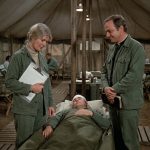
Standing quietly at the head of the bed was Father Mulcahy. The chaplain held a small black prayer book in his hands, his thumb resting gently on the worn leather cover. He had come to offer spiritual comfort, to read a psalm or simply hold the boy’s hand.
But Mulcahy had quickly realized that the boy wasn’t ready for heaven. He was desperately missing earth.
Before B.J. could try another gentle coaxing, the flap of the Post-Op tent flew open.
In walked Corporal Max Klinger.
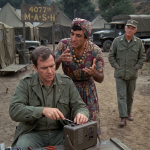
He did not walk in quietly. He never did. Today, he was a vision of domestic absurdity, draped in a bright, wildly patterned floral housecoat with a matching bandana tied elegantly over his dark hair.
Against the drab browns, pale greens, and sterile whites of the army hospital, Klinger looked like a walking, talking, aggressively cheerful garden.
He took one look at the grim faces of B.J. and the chaplain, took another look at the pale boy in the bed, and instantly understood the assignment. Klinger didn’t ask questions. He marched straight to the foot of Miller’s cot, planted his combat boots firmly on the dirt floor, and threw his hands into the air with theatrical grace.
“Private!” Klinger announced, his voice carrying the rich, brassy cadence of a carnival barker mixed with an overbearing aunt. “You are looking at a woman on the verge of a nervous breakdown! Do you have any idea what the humidity in this valley is doing to my complexion?”
B.J. didn’t shoo him away. He didn’t tell him to keep his voice down. Instead, B.J. leaned back in his chair, rested his hands on his knees, and let a warm, dry smile spread across his tired face.
Father Mulcahy stepped back just an inch, leaning in with compassionate curiosity, a soft, hopeful smile touching the corners of his mouth.
Klinger launched into a grand, elaborate tale about a girl named Charmaine from Toledo, a stolen streetcar, and a misplaced pair of rhinestone earrings. He gestured wildly, his hands weaving an invisible tapestry of urban gossip and hometown nonsense in the middle of a war zone.
He was putting on the performance of a lifetime. He was loud, he was proud, and he was undeniably alive.
But Private Miller didn’t blink. The boy just kept staring upward, his face a mask of grief and shock, completely untouched by the comedy unfolding at the foot of his bed.
Klinger’s hands paused in mid-air. The punchline died in his throat. The tent grew suffocatingly quiet, the silence suddenly deafening as Klinger stared at the broken boy, the weight of the war threatening to crush the last bit of humor out of the room.
For a fleeting second, the illusion cracked.
Standing there in his floral dress, Max Klinger looked incredibly small. He looked like just another drafted kid from Ohio, desperately trying to juggle brightly colored balls while the world burned down around him.
B.J. shifted slightly in his chair. His warm smile faltered for a fraction of an inch. He knew how hard Klinger tried, and he knew how much it hurt the corporal when his crazy antics failed to lift the gloom. B.J. opened his mouth to speak, to offer Klinger an easy way out of the awkward silence.
But Klinger didn’t retreat.
He didn’t run out of the tent, and he didn’t drop his head. Instead, Klinger drew in a long, slow breath, his chest expanding under the absurd floral fabric. He lowered his hands, letting the grand, theatrical gestures melt away into something much softer, much more human.
He took half a step closer to the foot of the cot.
“You know, kid,” Klinger said. His voice was completely different now. The brassy aunt was gone. The carnival barker had vanished. It was just Max. “When I was your age, my Uncle Amos used to run a deli right off the main drag. Best pastrami in the northern hemisphere.”
Klinger lifted his hands again, but this time, the gesture was small. Intimate. He held his palms open, as if he were holding a delicate, invisible object right there in the dim light of the recovery tent.
“I’m talking about the kind of pastrami that melts,” Klinger continued, his dark eyes locking onto the boy’s pale face. “Piled high. Dark rye bread. A smear of spicy mustard that clears your sinuses right up to your forehead. And the smell… God, kid, the smell of that deli. It smelled like Tuesday mornings. It smelled like home.”
B.J. watched Klinger with a profound, quiet respect. The dry amusement in the doctor’s eyes had deepened into an ocean of quiet empathy. This was the true medicine of the 4077th. It wasn’t the penicillin, and it wasn’t the sutures. It was the stubborn, beautiful resilience of a guy in a dress refusing to let a teenager slip away into the dark.
Father Mulcahy leaned in a little closer, his grip tightening gently on his small book. The soft smile returned to the chaplain’s face, radiant and true. He didn’t need to read a scripture right now. Klinger was already preaching the gospel of life.
Klinger kept talking. He talked about the sound of the streetcars grinding against the tracks. He talked about the cold wind coming off Lake Erie. He talked about the annoyed look his mother would give him when he tracked mud onto the linoleum floor.
He painted a picture of America so vivid, so breathtakingly mundane, that the scent of ether in the tent almost seemed to vanish.
Slowly, agonizingly slowly, Private Miller’s head turned on the flat pillow.
The boy’s hollow eyes dragged themselves away from the canvas ceiling. He looked down the length of his own battered body. He looked at the hairy legs sticking out from beneath the floral hem. He looked at Klinger’s earnest, pleading, beautifully ridiculous face.
Miller’s cracked lips parted. He swallowed hard.
“Did it…” the boy whispered, his voice sounding like dry leaves. “Did it have pickles?”
The entire tent seemed to exhale all at once.
B.J.’s shoulders dropped two inches. His broad smile returned, warmer and more grounded than before. He reached out casually, resting two fingers against the boy’s wrist, feeling the steady, rhythmic pulse of a kid who had decided to stick around.
Father Mulcahy closed his eyes for a brief, silent moment of profound gratitude.
At the foot of the bed, Klinger’s face lit up like a spotlight. He threw his hands back up, the grand theatricality returning with a triumphant flare.
“Pickles?!” Klinger gasped, clutching imaginary pearls at his neckline. “Kid, we’re talking kosher dills the size of artillery shells! The crispest, greenest, most glorious pickles you ever laid eyes on!”
A tiny, fragile smile broke across Miller’s face. It was weak, and it was tired, but it was real. The boy let his eyes slide shut, not in despair, but in comfort. The tension drained from his face, replaced by the heavy, healing pull of natural sleep.
Klinger didn’t break character. He gave the sleeping boy a crisp, elegant curtsy, smoothing the front of his floral housecoat with absolute dignity.
He looked over at B.J. and gave a short, silent nod.
B.J. nodded back, his eyes shining with unspoken gratitude. Good job, Max, the look said. You saved one. Klinger turned and strutted quietly out of the Post-Op tent, the screen door slapping softly behind him, leaving behind a trail of invisible Toledo dust and the faint, lingering warmth of a hard-won victory.
B.J. leaned back in his chair again, crossing his arms comfortably over his chest. He looked up at Father Mulcahy. The chaplain met his gaze, the small black book still held safely in his hands. There was no need for words between them. They were thousands of miles from the lives they had known, exhausted to their very bones, and surrounded by madness.
But sitting there in the dim light, watching a young boy sleep peacefully because a grown man in a dress had told him a story about a sandwich, B.J. knew they were exactly where they were supposed to be.
In a place built for fixing broken bodies, it was the broken people who somehow knew exactly how to mend a soul.