The Longest Night’s Quietest Answer
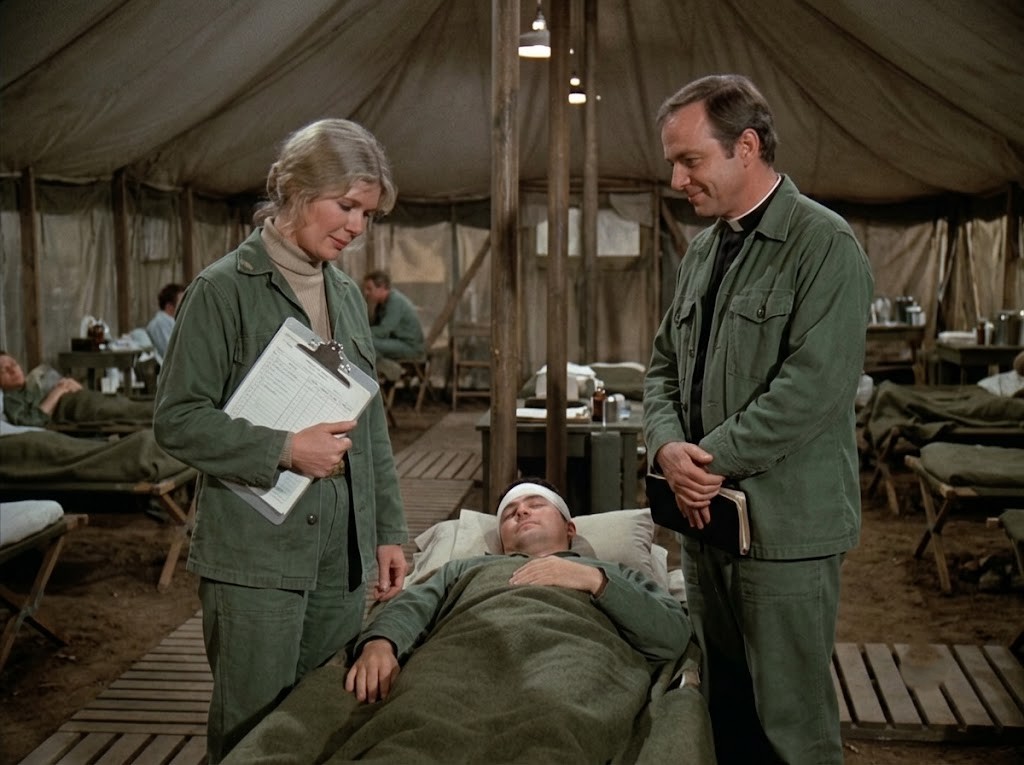
The Operating Room was empty now, but the air still held that stale, copper-tang of crisis, the heavy scent of sweat, and the ghosts of frantic conversations. Inside the dimly lit, canvas Post-Op tent, the silence was its own presence. For the personnel of the 4077th, this silence was earned, paid for with hours of breathless work.
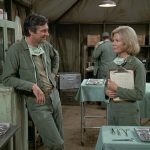
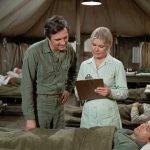
Margaret Houlihan adjusted the starched collar of her turtleneck, her eyes fixed on the clipboard she held tightly against her green fatigue jacket. She felt the residue of the day’s exhaustion clinging to every muscle. In front of her, lying quietly under a heavy olive drab blanket, was Private Thomas.
A bandage wrapped around his head was the visible souvenir of the war he’d seen. Margaret had double-checked the charts; he had stabilized well enough, but he was resting. His eyes were closed, his breathing was shallow but steady, and he was finally still.
Beside her, Father Francis Mulcahy was a steady, quiet companion. He wore his black clerical collar under his own utility jacket, and a black leather-bound prayer book was clasped in his hands. He stood looking down at Private Thomas with a profound, compassionate sadness, his hands held low in front of him.
“His chart says he is ‘resting comfortably’,” Margaret said, her voice a low murmur that barely carried over the canvas walls. She looked up from the clipboard, catching Mulcahy’s warm, observant gaze. “Comfort is relative around here, isn’t it, Father?”
Father Mulcahy offered a gentle, sympathetic nod. “Indeed, Major. Relative to the day he has had, comfort is a profound blessing. He’s safe now. At least for the moment.”
They had been standing here for some time, just the two of them. It was a familiar, shared vigil. Margaret knew every detail of this ward by heart: the smell of canvas, the sound of other wounded soldiers stirring, and the single, low-wattage bulbs that strung across the ridge poles, casting more shadows than light.
Margaret let out a silent sigh, the weight of the day pressing in on her professionalism. The war often stole their humanity, replacing it with efficiency and grit. Sometimes she struggled to remember what kindness felt like when it wasn’t being measured in surgical minutes.
Suddenly, Private Thomas’s breathing hitched. His right hand, previously lying resting on his stomach, began to shift. He was waking up. Margaret froze, her professional instinct taking over. She wanted to check his vitals, to verify his stability, to make sure the anesthesia was clearing as it should.
But instead of the groan or the frantic call for a nurse she often heard, Private Thomas did something small and devastating. As his consciousness returned, he let out a shallow, shaky breath. He turned his head ever so slightly toward them.
His hand reached up, fumbling, and weakly touched his bandaged head. Then, with a heartbreaking simplicity that cut through both Margaret’s command and Mulcahy’s prayers, his hand dropped back and searched for something on the blanket.
When his fingers found nothing, they clenched into a small, weak fist. And then, he just spoke one syllable, barely a whisper. “Home,” he said, and a single tear escaped his closed eyelid and began to pool in the corner of his eye. It was a silent moment, but it shattered the quiet carefully held by the canvas.
Margaret’s clipboard felt heavier. That one small, weak whisper broke through her defenses faster than any trauma case. She was trained for blood, for bone, for the mechanics of life and death, but this was a wound of a different kind. Private Thomas wasn’t just a patient; he was someone’s son, perhaps someone’s husband.
His weak, seeking hand touched his bandages once more, the gesture so innocent it stung. Father Mulcahy, standing beside her, felt a profound, gentle shift in his own heart. He didn’t know the Private’s full story yet, but he knew the soul of a man facing his own quiet abyss.
Father Mulcahy discreetly shifted his prayer book to one hand. With the other, he reached out and, with incredible tenderness, laid his fingers gently on Private Thomas’s forearm, offering a simple anchor of presence. He didn’t speak. In that stillness, no prayer was necessary. The touch itself was an affirmation.
Private Thomas flinched slightly at the contact, but then his fingers unfurled and settled onto the blanket. He let out another soft, shaky breath, this one marginally more relaxed. His hand lay in the small, warm circle of comfort Mulcahy provided.
Margaret watched the scene unfold. Her first instinct was to command, to check, to manage. But something held her back. The professional wall she built for survival wasn’t working. Instead, she just stood there, observing the quiet grace of Mulcahy’s touch. She saw the lines of worry ease around Private Thomas’s eyes.
She looked from the Private’s weak, seeking hand back to Mulcahy’s steady, compassionate gaze. The father’s expression didn’t contain pity; it was filled with deep, resonant empathy. Margaret felt a strange lump forming in her throat, a wave of tenderness that had no business being in a military medical tent, and yet was the only thing that belonged there.
Without thinking, she shifted the clipboard to her left arm, freeing her right. She took one step closer to the bed and, with a motion that was entirely unchoreographed and completely sincere, placed her other hand over the top of the Private’s hand.
The Private’s small, weak fist was now sandwiched between both of their larger, steadier hands. The three of them stood in a silent huddle of connection: a major, a chaplain, and a wounded young man searching for home.
There were no wise quacks from Hawkeye. No B.J. jokes. No Colonel Potter wisdom. Just this. The canvas tent, the distant hum of machinery, the single bare bulb, and this shared moment of found family. It was the only answer that mattered to the question hanging in the stale air.
The silence returned, but this time it felt different. It was no longer empty; it was filled with something profoundly human. For a few more moments, nobody moved. The war was outside, but here, in this quiet circle, for this one tired private, the longest night had found its gentlest response.
We mended their bones, and sometimes, if we were quiet enough, we mended their hearts too.