The Toledo Timepiece and the Boston Brahmin
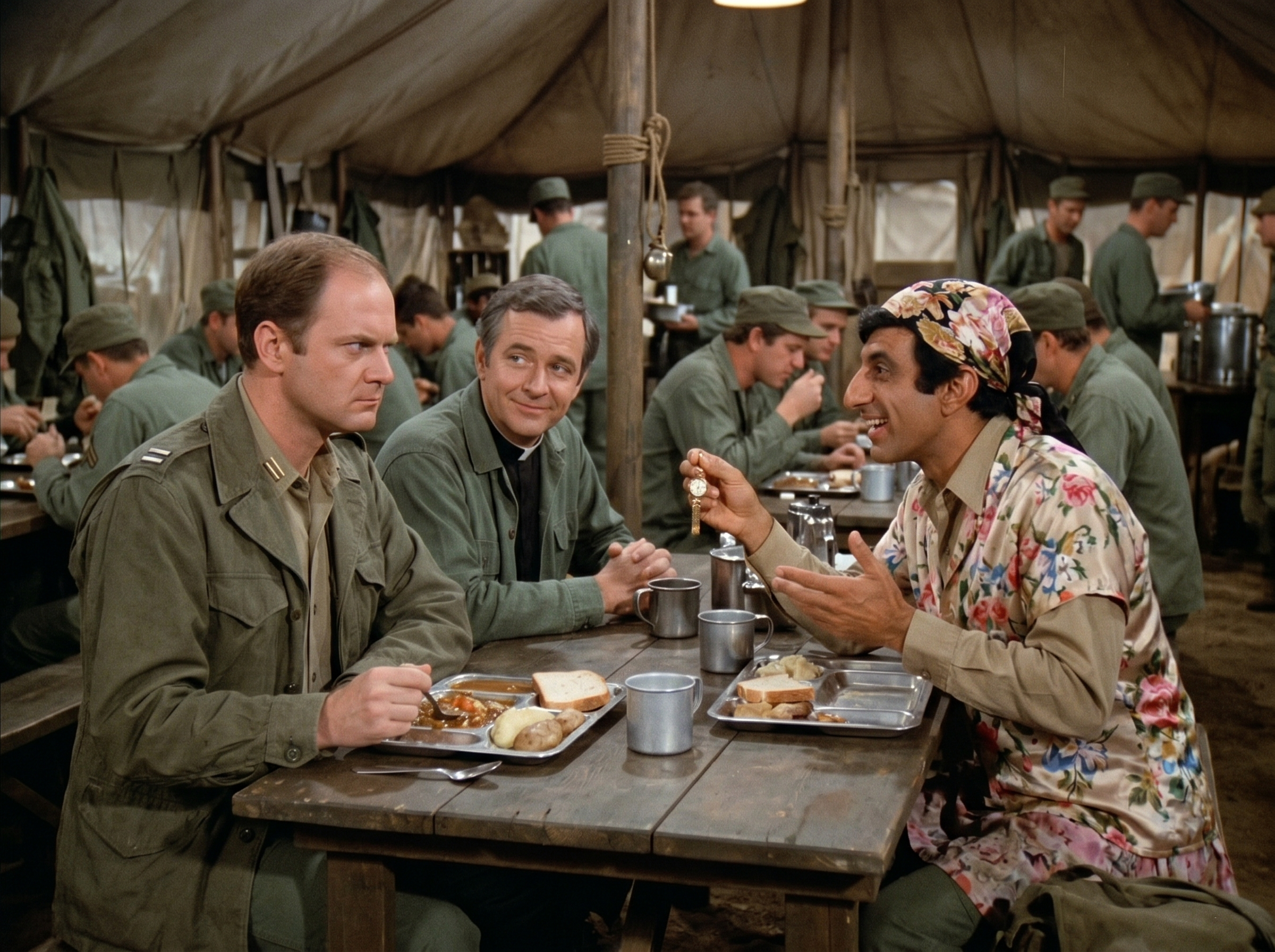
The Mess Tent of the 4077th Mobile Army Surgical Hospital was rarely a place of peace, but at 0700 hours, after a grueling three-day marathon in the operating room, it was practically a sanctuary.
The heavy green canvas walls flapped lazily in the morning breeze.
Inside, the air was thick with the scent of boiled coffee, damp wool, and whatever mystery meat Igor was bravely attempting to pass off as beef stew.
It was a quiet, weary morning.
The kind of morning where the war felt a million miles away, replaced only by the heavy, bone-deep ache of exhausted doctors trying to remember what it felt like to be human.
Major Charles Emerson Winchester III sat rigidly at one of the long, battered wooden tables.
Even in the depths of Korea, surrounded by dirt and despair, Charles maintained the upright posture of a man dining at the Ritz.
He wore his standard-issue olive drab fatigue jacket, his gold major’s leaves gleaming faintly in the soft, dusty light filtering through the tent.
Before him sat a dull metal tray piled with a tragic arrangement of beige potatoes, brown gravy, and a single, unyielding slice of white bread.
Charles stared at the tray with a look of profound, restrained irritation, as if the potatoes had personally insulted his Boston lineage.
To his right sat Father John Mulcahy, a quiet island of grace in a sea of olive drab.
The chaplain wore his black clerical collar peeking out from beneath his green shirt, his hands resting gently near his metal coffee cup.
He was observing the room with a soft, peaceful smile, enjoying the rare moment of quiet communal survival.
But at the 4077th, quiet was never meant to last.
The fragile peace was suddenly broken by the rustle of synthetic silk and the unmistakable scent of cheap lavender perfume.
Corporal Maxwell Klinger had arrived.
He did not walk; he swooped.
Today’s ensemble was a masterpiece of eccentric desperation: a loudly patterned floral top in shades of pink, white, and blue, topped with a matching headscarf tied tightly under his chin.
It was an outfit that screamed “springtime in Toledo,” entirely out of place against the drab, muddy backdrop of a military camp.
Klinger slid into the bench opposite Charles, leaning entirely across the table.
His posture was highly expressive, a theatrical invasion of the Major’s personal space.
In Klinger’s right hand, dangling by a delicate chain, was a shiny, gold-colored pocket watch.
“Major Winchester, sir,” Klinger whispered, his voice dripping with sly hope and a salesman’s practiced urgency. “Have I got an opportunity for you.”
Charles did not flinch.
He slowly lifted his eyes from his depressing tray, his left eyebrow inching upward in a perfect arch of aristocratic disdain.
“Corporal,” Charles rumbled, his voice tight with controlled exhaustion. “I am attempting to consume what the United States Army playfully refers to as a meal. Remove yourself.”
Klinger leaned in closer, the floral scarf brushing the edge of Charles’s metal tray.
“But Major, this isn’t just any timepiece,” Klinger pressed, giving the chain a little shake.
The watch caught the warm, overhead studio lighting, glinting cheaply in the dim tent.
“This is a genuine, pre-war, 24-karat gold-plated masterpiece. Belonged to a European count. Practically a royal heirloom. And I’m willing to part with it for a mere twenty bucks.”
Father Mulcahy tilted his head, mild confusion washing over his gentle features.
He looked at the watch, then at Klinger, his smile turning into one of amused bewilderment.
Charles sat perfectly still, his eyes locked on the dangling trinket.
The tension at the table thickened, tight as a drum, as Charles slowly raised his spoon.
He pointed the dull metal utensil directly at Klinger’s nose.
“Corporal,” Charles said, his voice dropping to a dangerous, icy whisper. “You have exactly three seconds to remove that Toledo tin-can from my airspace, or I will personally ensure your next outfit is a full body cast.”
Klinger didn’t pull back.
Instead, he clicked the watch open.
A tinny, slightly off-key rendition of “Camptown Races” began to plink from the open face of the watch.
The ridiculous, cheerful little melody tinkled through the heavy, exhausted air of the mess tent.
Father Mulcahy let out a soft, involuntary chuckle, quickly covering his mouth with a folded hand to hide his amusement.
Charles slowly closed his eyes, taking a deep, shuddering breath.
The sheer audacity of the moment was almost too much for a man running on black coffee and three hours of sleep.
He opened his eyes, glaring at the offending object.
“A European count, you say?” Charles drawled, his voice practically dripping with sarcasm. “Fascinating. Tell me, Klinger, did this noble aristocrat purchase his family heirlooms at a carnival in Ohio? Because the word ‘Taiwan’ is stamped quite clearly on the clasp.”
Klinger snapped the watch shut, silencing the tinny music.
The sly, theatrical salesman persona dropped instantly, deflating like a punctured tire.
He slumped back onto his side of the wooden bench, his floral shoulders dropping.
“Alright, alright. You got me, Major,” Klinger sighed, looking down at the watch in his palm. “It’s not from a count. I won it off a truck driver from the 8063rd.”
Charles scoffed, adjusting his cuffs with an air of vindicated superiority.
“Naturally. And now you attempt to peddle this garbage to me? A man who wears a Patek Philippe?”
“I wouldn’t normally bother a man of your… refined tastes, sir,” Klinger said, his voice unusually quiet, stripped of its usual bravado.
He picked at a loose thread on his silky sleeve.
“It’s just… I need twenty bucks, Major. And I need it by noon.”
Father Mulcahy leaned forward slightly, his expression shifting from mild amusement to genuine pastoral concern.
“Is everything alright, Maxwell?” the chaplain asked gently. “You aren’t in any sort of trouble, are you?”
Klinger shook his head, looking earnestly at the priest.
“No, Father. It’s nothing like that.”
He hesitated, glancing around the mess tent.
The other doctors and nurses were huddled over their own trays, lost in their own fatigue, paying no attention to the strange trio.
“It’s just… there’s this local farmer down the road,” Klinger explained, his voice low.
“He’s got a small crate of real, fresh apples. Not the canned mush we get. Actual, crisp, red apples. He wants twenty dollars for the whole crate.”
Charles paused, his spoon hovering halfway to his mouth.
He looked at Klinger, really looking at him.
Beneath the absurd pink and blue dress, beneath the ridiculous headscarf and the five o’clock shadow, Klinger looked just as beaten down and bone-tired as the rest of them.
“I just thought,” Klinger continued, looking down at the scarred wooden table. “I thought maybe, after the three days we just had in that OR… maybe the camp could use something real. Something that tastes like home.”
The mess tent was silent, save for the distant hum of a jeep engine outside.
Father Mulcahy’s eyes softened completely.
He looked at Klinger with a profound, quiet tenderness, a silent acknowledgment of the beautiful, resilient humanity hiding beneath the corporal’s crazy schemes.
Charles stared at his tray.
He looked at the beige potatoes.
He remembered the endless stream of wounded, the smell of blood, the desperate, frantic hours trying to stitch broken boys back together.
He remembered the feeling of absolute, crushing helplessness.
Slowly, deliberately, Charles reached into the breast pocket of his green jacket.
He pulled out a sleek, leather wallet, opening it with practiced grace.
He extracted a crisp, clean twenty-dollar bill.
He placed it on the table, sliding it across the rough wood toward Klinger.
Klinger’s eyes went wide. He looked from the money to Charles, stunned.
“Major… you’re buying the watch?”
Charles’s upper lip curled into a look of absolute horror.
“Good heavens, no,” Charles snapped, his aristocratic tone returning in full force.
“I wouldn’t have that mechanical abomination in my quarters if you paid me. Consider this a… logistical advance. You are to procure those apples, Corporal.”
Charles picked up his spoon, returning his attention to his miserable tray.
“And be warned,” Charles added, not looking up. “If I find a single bruise on my apple, or if it is anything less than crisp, I will personally see to it that your next wardrobe consists entirely of burlap.”
Klinger stared at the money, a slow, brilliant smile spreading across his face.
It wasn’t a sly smile; it was a genuine, warm beam of pure gratitude.
He snatched the bill off the table, slipping it into a hidden pocket in his dress.
“You won’t regret this, Major! Best apples in Korea, I swear it on my mother’s stuffed cabbage!”
Klinger stood up, giving a sharp, theatrical salute before turning and practically dancing out of the mess tent, his floral skirt swishing around his boots.
Charles let out a long, heavy sigh, shaking his head.
“The things I endure in this purgatory,” he muttered to his potatoes.
Father Mulcahy picked up his metal cup, his gentle smile returning, warmer and brighter than before.
He took a slow sip of the terrible coffee, looking fondly at the Boston surgeon.
“You know, Major,” Mulcahy said softly, his voice full of quiet affection. “For a man who claims to detest this place, you have a remarkable way of looking after it.”
Charles stiffened slightly, refusing to meet the priest’s eye.
“Nonsense, Father,” Charles replied, taking a stiff bite of his bread. “I merely require adequate fruit for my digestion.”
Mulcahy just smiled, looking out toward the canvas flap where Klinger had disappeared.
In a place built for tearing people apart, there was a strange, undeniable magic in the way they kept putting each other back together.
It wasn’t elegant, and it certainly wasn’t normal.
But in the weary, dusty heart of the 4077th, it was family.
Even in the darkest of places, the truest comfort comes from the strange, beautiful, and utterly human family we find along the way.