A Different Kind of Discharge
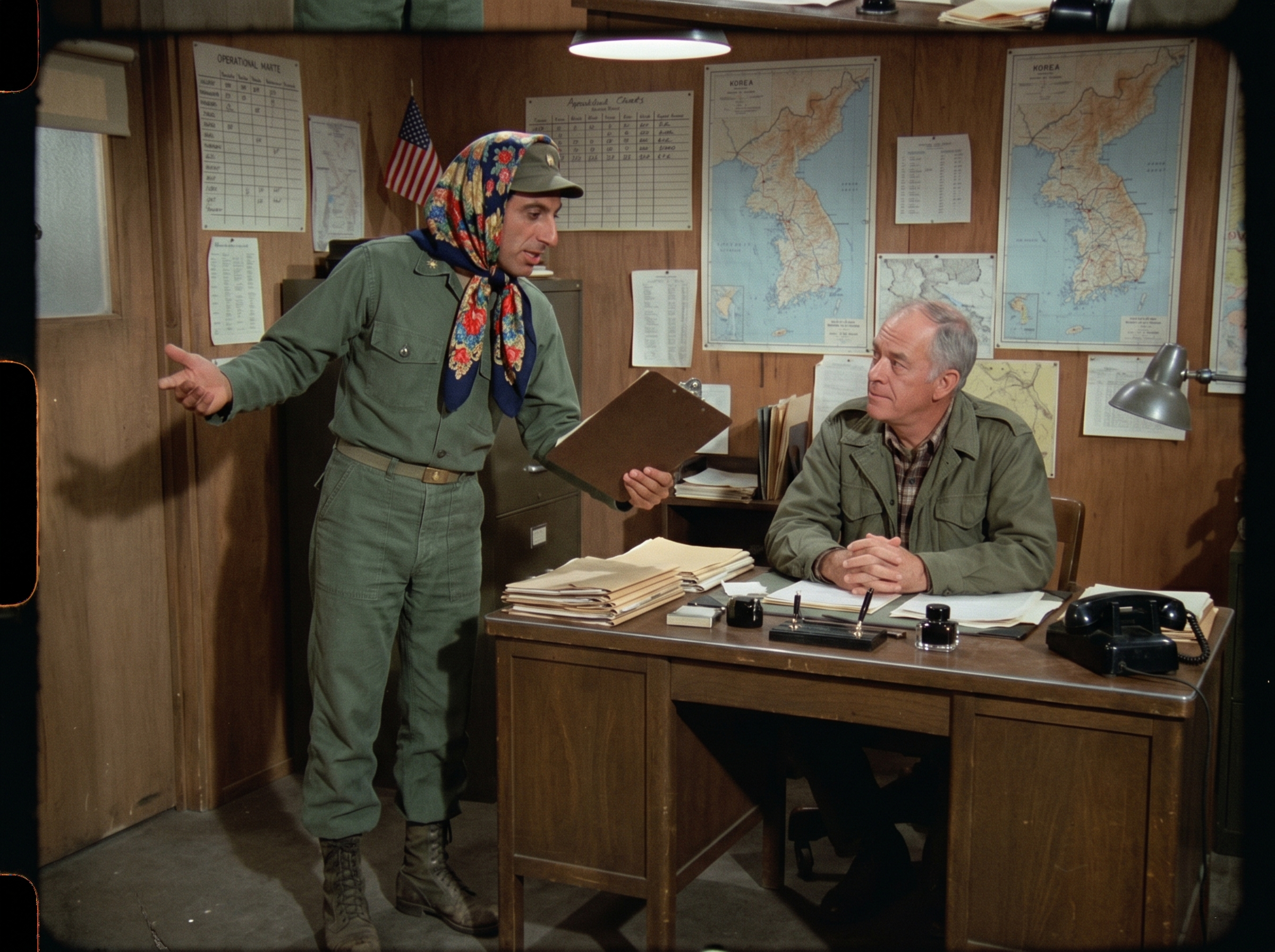
If there’s one thing you could count on in Korea, it was the unexpected knocking on Colonel Potter’s door. It wasn’t always a crisis. Sometimes, it was just the theater of the absurd.
This morning, the sound was different. A frantic, rhythmic tapping. Not quite a knock, not quite a plea. Just… persistent.
Sherman Potter sighed, his fountain pen hovering above the endless stream of paperwork. The inkwell, so neatly placed, seemed to mock the chaos that often entered this room. Behind him, the maps of Korea remained static, a constant reminder of why they were all here.
He took a slow sip of coffee. Lukewarm. Typical. “Enter.”
The door burst open, and there he was. Corporal Max Klinger. Or, perhaps more accurately, *Aunt Maxie.*
He wasn’t wearing his usual flowing dress, or a feather boa, or the increasingly elaborate headwear. He was in full fatigue green. But it was the *shawl* that commanded the attention. A vibrant, red and blue floral scarf, wrapped around his fatigue cap and tied meticulously under his chin. It was as elegant as it was entirely out of place.
He looked… frantic. Agitated. Ready to plea.
Potter’s eyebrows arched. “Klinger,” he said, his voice a gravelly rumble. “I didn’t know the Toledo modeling agency had a ‘Front Line Flora’ division.”
Klinger ignored the jab. He was on a mission. He stepped into the room, holding up a single, well-worn clipboard. The posture was defensive, desperate. His eyes were wide, and he was mid-sentence, already making his case as he walked.
“Colonel, I am not asking. I am presenting *evidence*. Irrefutable evidence. A pattern. A biological, physiological, and psychological pattern of complete and total incompetence that renders me unfit… nay, *dangerous*… to continue in this capacity.”
He gestured wildly with his free hand, like a politician making a final closing argument. The shadow of his arm stretched across the wood paneling, emphasizing the dramatic flair.
Potter didn’t move. He kept his hands clasped on the desk, looking up over his reading glasses. It was the look of a man who had seen everything, but was still curious to see how *this* specific train wreck would unfold. The warmth was always there, just hidden beneath decades of command and exhaustion.
“Dangerous incompetent, eh? What happened? Did you organize a synchronized napping unit and fail to set the alarm?”
“This is *not* a joke, Colonel! This is my sanity. This is about… *the incident.*” Klinger practically shouted the last word, leaning in. He lowered the clipboard slightly, allowing Potter to see… absolutely nothing but pages and pages of Klinger’s scrawl.
Potter’s expression didn’t change. He simply blinked once. “The incident. Care to elaborate, Corporal, before I have Radar file you under ‘Misplaced Grievances’?”
Klinger deflated slightly, but only to regroup. He snapped the clipboard back up, close to his face, as if it contained the secrets of the universe.
“*The incident*,” he began, his voice drops to a conspiratorial whisper, “involved the mess tent, Private Iggy, and a misplaced sack of potatoes. It wasn’t my fault, Colonel. It was the universe conspiring against me. The stars were aligned… poorly.”
Potter’s gaze shifted to the wall-sized map of Korea behind him. A million serious situations, and here was Klinger, explaining a potato-related astrological alignment. The contrast was always what got you.
“Klinger, in thirty years of service, I’ve heard many excuses. This might be the first involving root vegetable karma. Give me the non-cosmic details.”
Klinger swallowed hard. He looked at the clipboard, then at Potter, then back at the clipboard. His voice softened. “It wasn’t potatoes, Colonel. That was the cover story.”
“The real issue is… I don’t belong here. I am a delicate soul. Look at this scarf! This isn’t just fashion. This is a cry for HELP. This is *my* distress signal. My grandmother wore this when she heard about World War I. My mother wore it when she found out my father had enlisted. It’s a legacy of bad news and emotional frailty, and now I’M wearing it!”
He raised his free hand again, not a plea this time, but as if pushing away an unseen enemy. His expression was a mixture of humor, frustration, and genuine, tired pain. It was a cry that Potter had heard a thousand times, in a thousand different ways, always from good people who had simply reached their breaking point.
Potter looked at the man. He saw the Toledo boy, the family legacy, the endless parade of dresses, and the surprisingly efficient clerk who never let anyone down when it counted. He also saw the fatigue in the man’s eyes, the same fatigue he felt in his own bones.
He took his glasses off, placing them gently next to the inkwell. The room was silent, save for the hum of the distant generator. He didn’t say anything. He just looked. And Klinger, despite all his theatrical flair, didn’t try to fill the silence. He just stood there, holding his evidence, wearing his grandmother’s distress signal, waiting.
Finally, Potter spoke. His voice was quiet, but firm. It was the father speaking now, not the Colonel.
“Klinger, you’re an artist. A master of creative solutions. You know, we all have things we’d rather be doing than being stuck here. I’d rather be sitting on my porch, drinking lemonade, listening to the crickets. Radar would probably rather be milking a cow. And Hawkeye… well, Hawkeye’s list of alternatives would probably require another inkwell.”
He gave a dry smile. “But we’re here. Together. And every one of us, in our own way, wears a ‘shawl of distress.’ Yours is just… a little more vibrant than most.”
Klinger looked down at his feet, the bravado fading. The clipboard lowered. The gesture was defeated. He had failed again. But Potter wasn’t finished.
“You’re not getting out of here on a 10-K, Klinger. I need you. The camp needs you. If you leave, who’s going to make sure the supplies are always miraculously ‘misplaced’ into the hands of the orphans? Who’s going to maintain the delicate balance of sartorial insanity?”
Klinger looked up, a flicker of something new in his eyes.
“You’re a good clerk, Klinger. The best. And yes, a delicate soul. The two aren’t mutually exclusive. We keep each other sane, one way or another. You with your dresses, me with my horses, and this entire camp with its collective, beautiful madness.”
He gestured with his own hand now, sweeping across his desk, the papers, the inkwell, the entire space.
“We are all incompetent, Klinger. If we weren’t, we wouldn’t need each other so damn much. So, take your clipboard, take your legacy of bad news, and go find out what *really* happened with Iggy and the potatoes. I want a full report. And maybe, just maybe… you can trade that scarf for something less… distressed… during office hours.”
Potter gave him a knowing look, a subtle nod. The conversation was over. But something important had been said. Something about family, about endurance, and about the shared, quiet understanding that we are all, in our own way, just wearing a different kind of uniform.
Klinger looked at him, the expression on his face a mix of disappointment and a strange, deep relief. He nodded. He didn’t speak. He just turned, the clipboard clutched to his side like a shield, the red and blue floral shawl trailing behind him as he quietly opened the door and walked back out into the beautiful, chaotic world of the 4077th.
Potter watched him go. He took his pen back up. The inkwell was still full. The maps were still there. The work continued. He took another sip of coffee. Cold now. He put the cup down, and a small, almost invisible smile crossed his lips. “Iggy and the potatoes,” he muttered. “What a family.”
They say home is where the heart is, and for a few long years, we all kept our hearts, and each other, from breaking in that dusty little office.