A Small Piece of Home at the 4077th
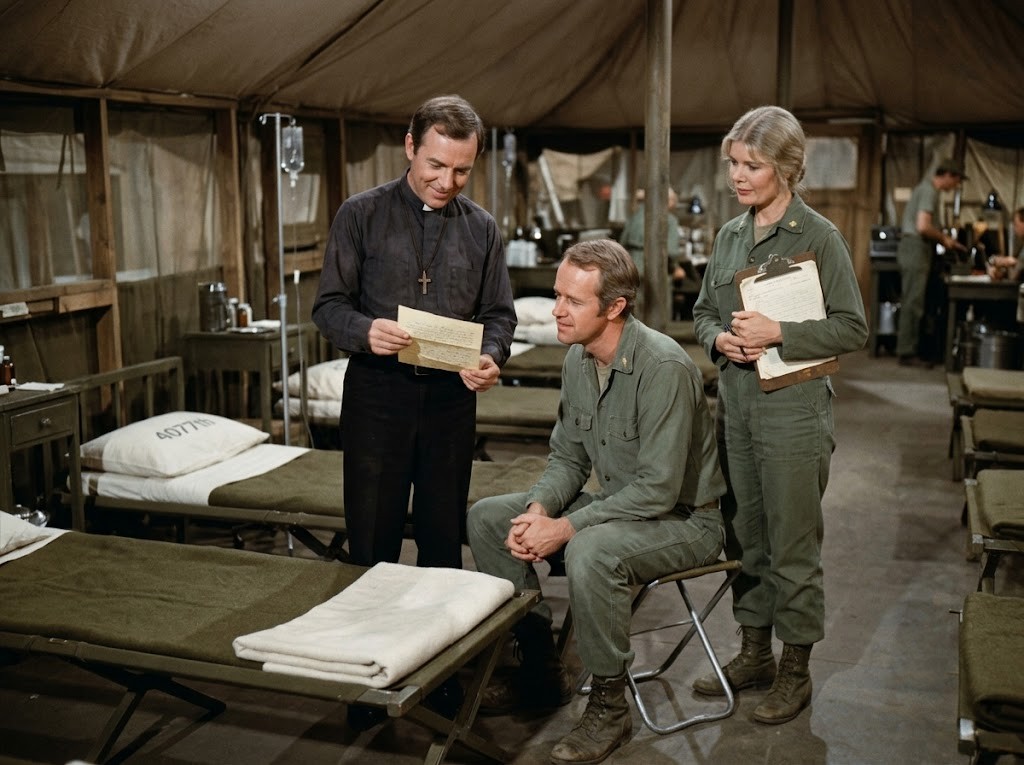
The canvas walls of Post-Op always smelled the same—a mixture of drying laundry, antiseptic, and the faint, lingering scent of damp earth from the Korean rain. It was that time of afternoon when the frantic pace of the operating room had slowed to a dull, throbbing ache, and the exhaustion of the day finally began to settle into the marrow of our bones.
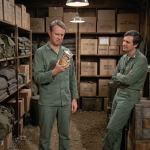
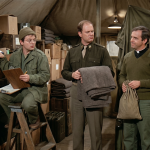
Father Mulcahy stood in the center of the aisle, his gentle face illuminated by the soft light filtering through the tent flaps. He was holding a letter, the paper worn soft from being folded and unfolded a dozen times.
Across from him sat B.J. Hunnicutt. He wasn’t the usual wise-cracking surgeon in that moment; he was just a husband and a father, his shoulders slumped with a weight that had nothing to do with the war. He sat on a small, uncomfortable stool, his hands clasped tightly between his knees.
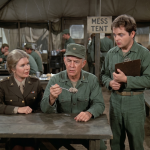
Major Margaret Houlihan stood nearby, her clipboard held against her chest like a shield. She was observing them, her professional guard still up, but there was a flicker of something softer in her eyes—a rare, unguarded glimpse of empathy that she usually reserved for the patients.
Mulcahy began to read, his voice low and rhythmic, cutting through the silence of the nearly empty tent. As he spoke the words written from Peg, a sudden, heavy stillness filled the room. B.J. looked up, his expression a fragile mix of longing and profound, hollowed-out fatigue.
The letter wasn’t just paper anymore; it was a lifeline, a fragile bridge spanning thousands of miles of ocean and fire.
“She says here,” Mulcahy paused, his eyes scanning the page, “that the garden is coming in early this year. Erin is asking if you’ve seen any ‘funny-looking’ soldiers in your travels.”
A shadow crossed B.J.’s face, a sudden, sharp contraction of pain behind his eyes. He didn’t laugh at the childhood innocence of the question. Instead, he bowed his head, his hands tightening until his knuckles went white, the crushing reality of his isolation suddenly feeling too immense to bear.
The silence that followed was thick, almost suffocating. Margaret took a half-step forward, the metal of her clipboard clicking quietly against her uniform. She didn’t say anything, but the professional mask had finally slipped, replaced by a weary, shared understanding. She knew exactly what it felt like to have a heart sitting somewhere on the other side of the map.
“B.J.,” Mulcahy said softly, his voice devoid of any preachy undertones, just pure, steady companionship. “She also says she knows you’re doing good work. She says she’s proud.”
B.J. finally looked up. His eyes were bright, shimmering with an emotion he was desperately trying to keep under control. He let out a long, shaky breath, the kind that seemed to drain the last of the adrenaline from his system. He looked at the priest, then at Margaret, and for a fleeting second, the walls of the 4077th felt a little less like a prison and a little more like a sanctuary.
“I don’t know if I’m doing good work, Father,” B.J. whispered, his voice raspy. “I just know I’m tired of seeing the results of the alternative.”
“None of us are doing what we were meant to do,” Margaret added, her voice uncharacteristically soft. She reached out, placing a hand briefly on the back of the folding chair before withdrawing it, keeping her distance but offering the solidarity that only people in this hellhole could truly offer one another.
The comic relief that usually defined the mess tent or the Swamp was nowhere to be found, and they didn’t miss it. There was a different kind of grace in this moment—a quiet, unadorned humanity.
B.J. reached out and gently took the letter from Mulcahy. His touch was reverent, as if the paper were made of gold leaf rather than cheap stationery. He didn’t read it again; he just held it, letting the words settle into his heart.
“She’s right about the garden,” B.J. said finally, a ghost of a weary smile touching his lips. “It’s always a good year for tomatoes in Mill Valley.”
Margaret gave a small, almost imperceptible nod, her own posture relaxing as the tension in the room began to diffuse. Mulcahy simply smiled, patted B.J.’s shoulder with a feather-light touch, and turned to walk toward the exit, leaving the surgeon to his private thoughts.
They remained there for a while longer—a nurse, a priest, and a surgeon, held together by the thin thread of a letter from home and the unspoken promise that, for as long as they were stuck in this muddy field, nobody had to be alone with their ghosts. The war was still out there, and the next siren would surely sound before long, but in the golden, dusty light of that tent, the world felt just a little bit smaller, and a little bit kinder.
In a place built for breaking, it’s the quiet moments of holding one another together that keep us whole.