The Feathered Cure for a Heavy Heart
Sometimes, the mud in Korea doesn’t just stick to your boots; it seeps directly into your soul.
After a grueling seventy-two-hour shift in Post-Op, the 4077th M*A*S*H was entirely out of jokes, out of clean fatigues, and out of miracles. The relentless hum of the generators felt like a headache that wouldn’t quit, and the silence in the swamp was heavier than the July heat.
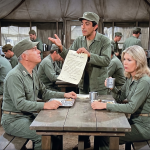
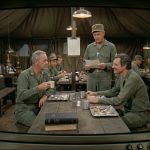
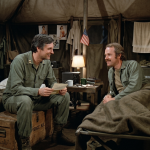
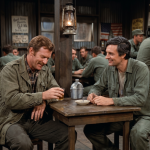
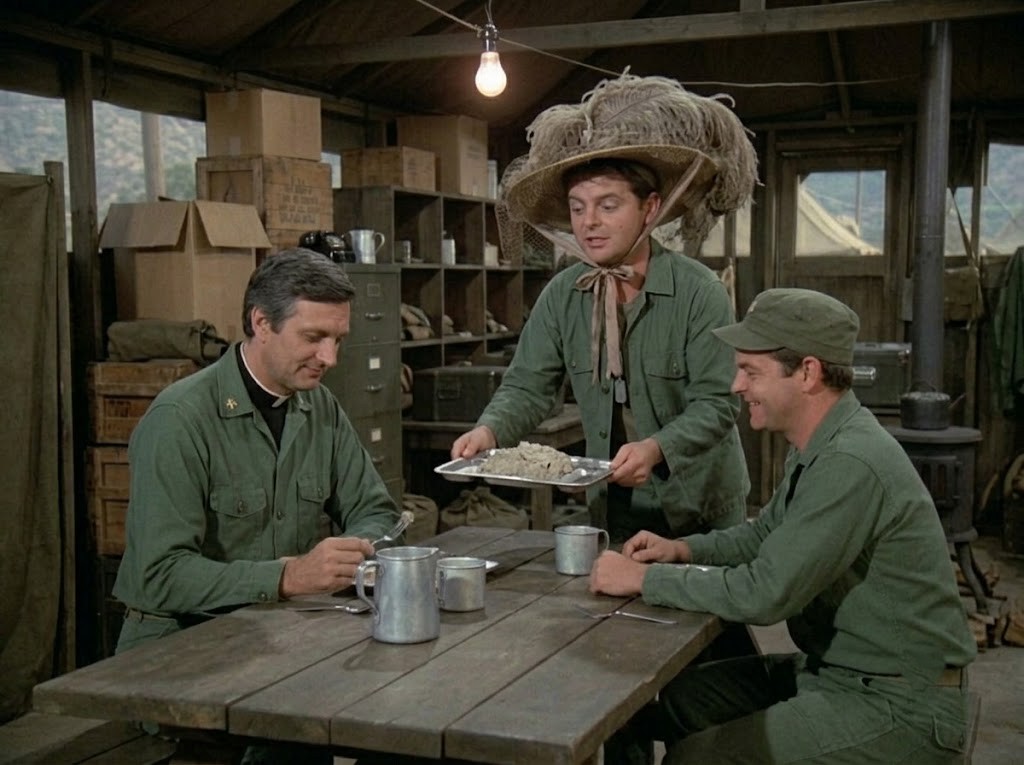
Inside the supply shack, away from the immediate chaos of the compound, a bare lightbulb flickered against the wooden rafters, casting long, tired shadows over a rough wooden table.
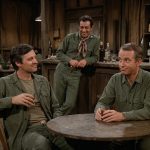
Father Mulcahy sat quietly on the bench, his collar slightly frayed, staring intently at the metal fork in his hand. Across from him, Captain B.J. Hunnicutt leaned his elbows on the table, a faint, exhausted smile tugging at the corner of his mustache, though his eyes carried the unmistakable weight of a man who desperately wanted to see his daughter back in San Francisco.
They were waiting for comfort, or perhaps just a distraction, when the door squeaked open.
In walked Corporal Radar O’Reilly, carrying an aluminum mess tray loaded with a dubious mound of grey, gelatinous mystery food. But it wasn’t the culinary disaster that made B.J. pause, nor was it the gentle rattle of the metal tray.
Perched spectacularly on Radar’s head was an enormous, utterly ridiculous Edwardian lady’s straw hat, overflowing with a mountain of wild, untamed bird feathers and tied securely beneath his chin with a fraying silk ribbon.
“Compliments of the mess hall, gentlemen,” Radar announced earnestly, completely ignoring the towering plumage swaying precariously above his ears. “Chef’s surprise. Though, if you ask me, the surprise is that it stayed on the plate.”
B.J. let out a short, surprised bark of laughter, his shoulders finally dropping an inch from his ears as he looked up at the young corporal. “Radar, please tell me you didn’t trade your helmet for a flock of pheasants.”
Father Mulcahy looked up from his plate, his gentle blue eyes blinking in utter bewilderment as he took in the sight of the camp’s youngest clerk sporting high fashion amidst the filing cabinets and olive drab boxes.
“My goodness, Radar,” the priest said, a soft smile breaking through his exhaustion. “That is quite… avant-garde. Did a care package arrive from Iowa?”
Radar’s face fell slightly, the humor draining from his eyes as he carefully set the tray down on the wooden table between them. He adjusted the silk ribbon under his chin, his fingers trembling just a fraction.
“No, Father,” Radar whispered, his voice cracking with a sudden, heavy gravity that cut right through the lighthearted moment. “It didn’t come from Iowa. It belonged to Private Miller… the boy who didn’t make it out of OR this morning. It was in his personal effects, wrapped in tissue paper with a note for his mother.”
The room went completely still, the flickering bulb above suddenly feeling very cold. B.J.’s smile vanished instantly, and Father Mulcahy slowly lowered his fork, the weight of the war rushing back into the small room like a sudden draft.
—
The silence stretched, thick and suffocating, broken only by the distant, familiar thud of a lone helicopter coming in from the hills.
B.J. stared at the hat, no longer seeing a joke, but rather the heartbreaking pieces of a life left behind. “A note for his mother?” B.J. asked softly, his voice thick with the empathy of a father who knew exactly what it meant to love someone from across an ocean.
“Yes, sir,” Radar said, looking down at his boots, the massive feathers casting a shadow over his face. “The note said he found it in an abandoned shop in Seoul. He wrote that his mother always wanted to go to the Kentucky Derby, and he wanted her to have the biggest, grandest hat in the whole state when he got home.”
Radar swallowed hard, his lower lip quivering slightly. “I was supposed to log it into the deceased effects bin. But… but it just felt so wrong to put something so beautiful into a dark canvas bag. I thought… if I wore it, just for a minute, maybe it would bring a little bit of that home-feeling back into the camp. Maybe it wouldn’t feel so much like he’s just… gone.”
Father Mulcahy reached out, his hand steady and warm, and gently touched Radar’s forearm. The priest’s eyes were shiny with unshed tears, but his expression was filled with a profound, unconditional grace.
“Radar, my boy,” Father Mulcahy said quietly, his voice a soothing balm in the cramped room. “There is no disrespect in bringing light to a dark place. Private Miller wanted this hat to bring joy. By wearing it, by making us smile even for a second, you’ve honored his wish more than a canvas bag ever could.”
B.J. nodded slowly, a deep, genuine warmth returning to his face as he reached across the table and lightly tapped one of the long, ridiculous feathers. “He’s right, Radar. Lord knows we needed the laugh. And honestly? It brings out the color of your eyes.”
A small, hesitant smile broke through Radar’s tears, and he wiped his nose with the back of his sleeve. “You really think so, Captain?”
“Absolutely,” B.J. grinned, leaning back and gesturing to the tray of mystery food. “Now, if you can just explain how this hat relates to whatever it is you just served us, you might just win a medal.”
“Well,” Radar said, his usual nervous, endearing energy returning as he adjusted the brim. “Klinger said it’s creamed chipped beef, but I think it’s just the kitchen trying to surrender.”
The laughter that followed was quiet, modest, and deeply human—the kind of laughter that doesn’t cure the pain of war, but provides the strength to endure it for one more day.
Outside, the evening sun began to dip below the Korean mountains, painting the canvas tents in shades of amber and bruised purple. Inside the shack, three tired men shared a moment of profound, found-family comfort, bound together by a ridiculous hat, a terrible meal, and an unbreakable love for the boys they couldn’t save, and the ones they still could.
Behind the jokes and the olive drab canvas, the 4077th always found a way to keep the home fires burning, one beautiful, broken memory at a time.