A Quiet Grace Under the Canvas
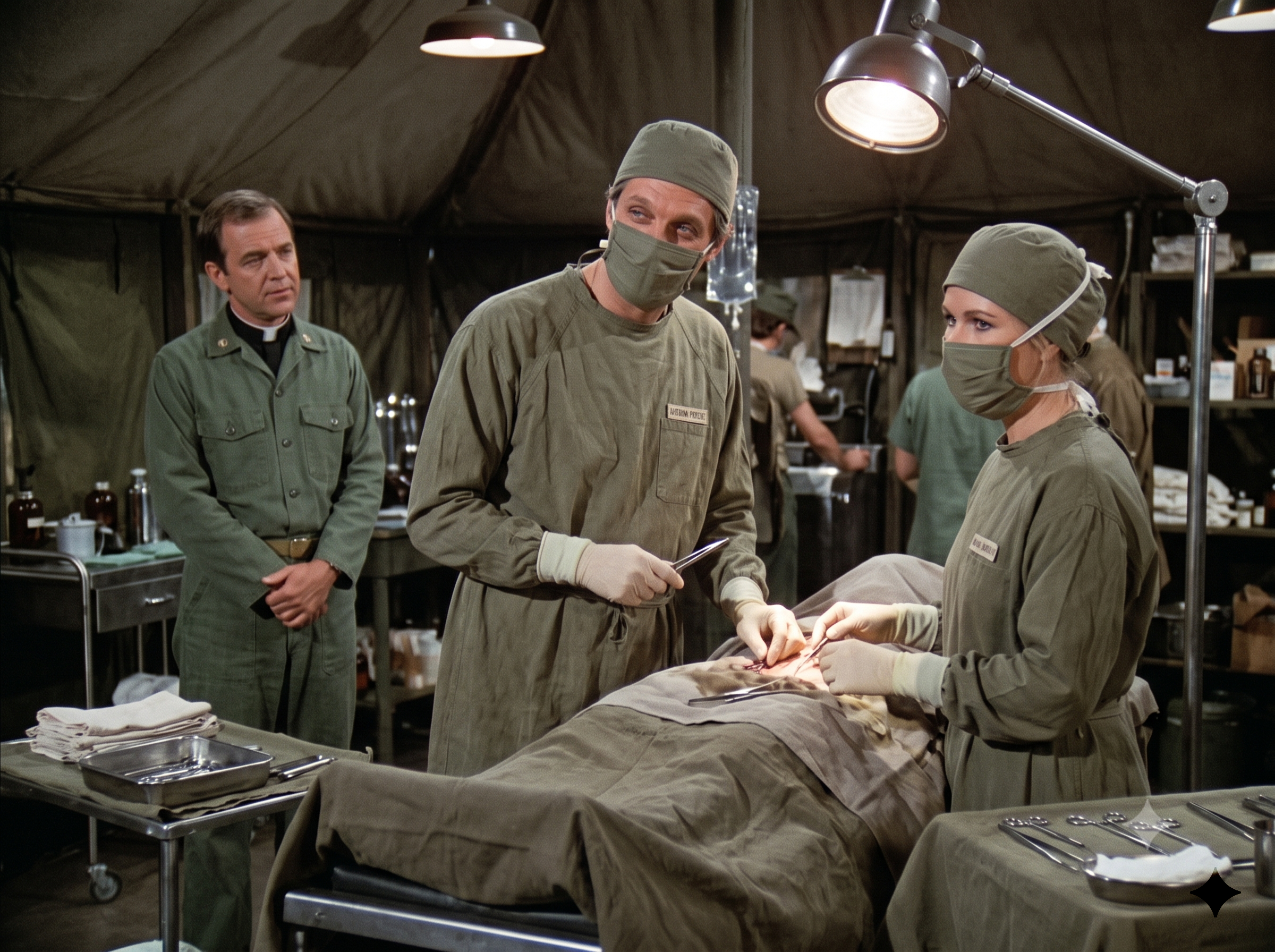
The O.R. was not just a room; it was a universe entirely its own, built of green canvas, glaring lights, and the heavy smell of ether.
Outside, the Korean night was cold and indifferent, but inside, the heat was stifling.
The generator hummed its endless, rattling tune, the only soundtrack to the relentless parade of broken boys being wheeled through the double doors.
It was hour fourteen of a session that had blurred the lines between yesterday, today, and tomorrow.
At the center operating table, Captain Benjamin Franklin “Hawkeye” Pierce stood with his shoulders hunched, completely absorbed in the delicate task before him.
He was draped in the standard issue olive-drab gown, a mask covering everything but his eyes.
Those eyes were a map of exhaustion, bloodshot and ringed with dark shadows, yet they moved with a sharp, undeniable focus.
Across from him stood Major Margaret Houlihan.
Her posture was rigid, perfectly straight despite the hours she had spent on her feet.
She was a portrait of professional capability, her gloved hands resting at the edge of the sterile field, anticipating his next move before he even realized he needed to make it.
There was a rhythm to their work, an unspoken language forged over hundreds of hours spent standing over this exact same table.
Standing a few feet away, in the dim space just beyond the halo of the surgical lamps, was Father John Patrick Mulcahy.
He wore his standard green fatigue shirt, the stark white of his clerical collar peeking out as a quiet reminder of faith in a place that constantly tested it.
His hands were softly folded in front of him, his posture completely still.
He wasn’t a surgeon, and he couldn’t stitch a wound, but his presence was as vital to the room as the oxygen tanks in the corner.
He stood there observing, his eyes filled with a gentle, hopeful warmth, acting as a silent guardian for both the boy on the table and the doctors trying to save him.
The patient was just a kid, maybe nineteen, far away from whatever hometown he had left behind.
For the last twenty minutes, the only sounds had been the sharp snap of metal instruments and the rhythmic squeak of rubber soles on the wooden floorboards.
The tension was thick enough to cut with a scalpel.
They were navigating a treacherous stretch of anatomy, and the margin for error was non-existent.
Suddenly, Hawkeye paused.
He didn’t drop his hands, but his shoulders gave a microscopic slump, a momentary surrender to the bone-deep ache of the war.
He held a pair of forceps mid-air, the silver gleaming under the harsh light.
Instead of looking down at the surgical field, Hawkeye slowly lifted his head.
He cast a wry, utterly exhausted glance upward, looking past the glaring lamps and toward the sloping canvas roof of the tent.
It was a look of dry wit mixed with a compassionate, heavy fatigue.
“You know,” Hawkeye broke the heavy silence, his voice muffled by the green cotton mask, “I don’t want to tell the management how to run this resort…”
Margaret’s eyes immediately darted up to meet his.
“…but the room service is appalling, the lighting is terribly unflattering, and the local entertainment leaves a lot to be desired.”
Margaret didn’t sigh, but her eyes narrowed in a look of sharp, caring skepticism.
She was annoyed, as she always was when he broke decorum, but underneath the annoyance was a profound, reluctant understanding.
She knew exactly what he was doing.
He was letting the steam out of the kettle before it blew.
Hawkeye lowered his gaze from the ceiling and looked over his shoulder, locking eyes with the chaplain standing quietly in the shadows.
The wryness faded from his expression, replaced by a sudden, raw vulnerability that hung in the humid air of the tent.
“Tell me, Father,” Hawkeye said softly, the humor entirely gone from his voice. “When you have your weekly staff meetings with the Big Guy upstairs… does He ever mention when He plans on calling an end to this particular matinee?”
The O.R. fell deathly silent, the only sound the rhythmic, labored breathing of the young soldier on the table.
Hawkeye remained frozen, his forceps suspended, waiting for an answer from the quiet man in the shadows.
Margaret’s eyes shifted from Hawkeye to Father Mulcahy, her usual strict demeanor softening into something remarkably tender.
She, too, was waiting.
Father Mulcahy unclasped his hands and took a half-step forward, moving just to the edge of the light.
He didn’t offer a booming sermon or a hollow platitude.
Instead, a gentle, sad smile touched the corners of his mouth.
“He doesn’t share the schedule with me, Hawkeye,” Mulcahy said, his voice a calm, steady anchor in the chaotic room.
“But,” the priest continued softly, his eyes reflecting the harsh glare of the surgical lamps, “I like to think He put you and Margaret here to make sure the audience survives until the curtain falls.”
Hawkeye stared at the chaplain for a long, quiet moment.
The heavy, suffocating tension that had gripped his chest slowly began to dissolve.
It was a small comfort, a tiny raft of meaning in an ocean of madness, but it was enough to keep him afloat.
The corners of Hawkeye’s eyes crinkled behind his mask.
“Well,” Hawkeye murmured, turning his attention back down to the bright red field of the operating table. “If we’re the opening act, I hope the folks in the back row brought tomatoes.”
“Clamp,” Margaret said instantly, her voice crisp and clear.
Before Hawkeye even had to ask, she slapped the precise instrument he needed directly into his waiting palm.
The sharp smack of metal against rubber gloves echoed like a starting pistol.
The pause was over.
The dance resumed.
“Thank you, Major,” Hawkeye said, his tone shifting back to the focused, rapid-fire cadence of a surgeon at work.
“Don’t mention it, Captain,” Margaret replied, her eyes never leaving the surgical field. “Just finish the job so I can go soak my feet in a bucket of gin.”
“You bring the bucket, I’ll bring the gin,” Hawkeye shot back. “We’ll make a romantic evening out of it. Just you, me, and a severe case of trench foot.”
Margaret actually let out a short, muffled huff of laughter behind her mask.
It was a small, almost imperceptible sound, but in the sterile, terrifying environment of the 4077th, it was a victory.
Father Mulcahy watched them from the background, his hands once again folded patiently at his waist.
He watched the way Margaret anticipated Hawkeye’s needs, the way her steady hands guided the retractors, holding the darkness at bay so Hawkeye could work in the light.
He watched the way Hawkeye’s shoulders relaxed, the wry humor returning to his eyes, masking the profound, bleeding compassion he felt for every boy he tried to put back together.
They were exhausted, covered in the grim evidence of war, running on nothing but terrible coffee and stubborn defiance.
Yet, to Mulcahy, they looked remarkably like angels.
Slightly rumpled, profoundly sarcastic angels, but angels nonetheless.
“Alright,” Hawkeye finally said, stepping back from the table and letting out a long, shuddering breath. “He’s closed. The bleeding has stopped.”
Margaret quickly moved in to apply the final dressings, her hands moving with practiced, gentle efficiency.
“Vitals are holding steady,” she reported, her voice carrying a quiet note of triumph. “He’s going to make it.”
Hawkeye pulled his mask down, letting it hang loosely around his neck.
His face was pale, lined with deep creases of exhaustion, but a genuine smile ghosted across his lips.
He looked at Margaret, really looked at her, seeing past the rank and the regulations to the fierce, capable woman who stood by his side through the darkest hours of his life.
“Good work, Margaret,” he said softly.
Margaret paused, her hands resting lightly on the sleeping soldier’s chest.
She looked back at him, her own eyes betraying a deep, unspoken affection and respect.
“You too, Pierce,” she replied quietly.
Hawkeye turned his head and gave Father Mulcahy a small, tired nod of gratitude.
Mulcahy returned the nod, his heart swelling with a quiet, fierce pride for the people in this room.
The corpsmen came in to wheel the young boy off to post-op, leaving the three of them alone in the quiet hum of the O.R.
There would be more helicopters.
There would be more long nights, more terrible jokes, and more moments where the weight of the war felt too heavy to bear.
But for now, in this brief, stolen moment under the hot canvas roof, they had won.
They were just a tired doctor, a strict head nurse, and a gentle priest, leaning on each other to survive another day at the edge of the world.
And as they stood together in the fading light of the surgical lamps, bound by an invisible thread of shared humanity, they knew they would never have to carry the burden alone.
In the heart of a senseless war, their greatest rebellion was simply taking care of each other.