A Piece of Paper from Maine
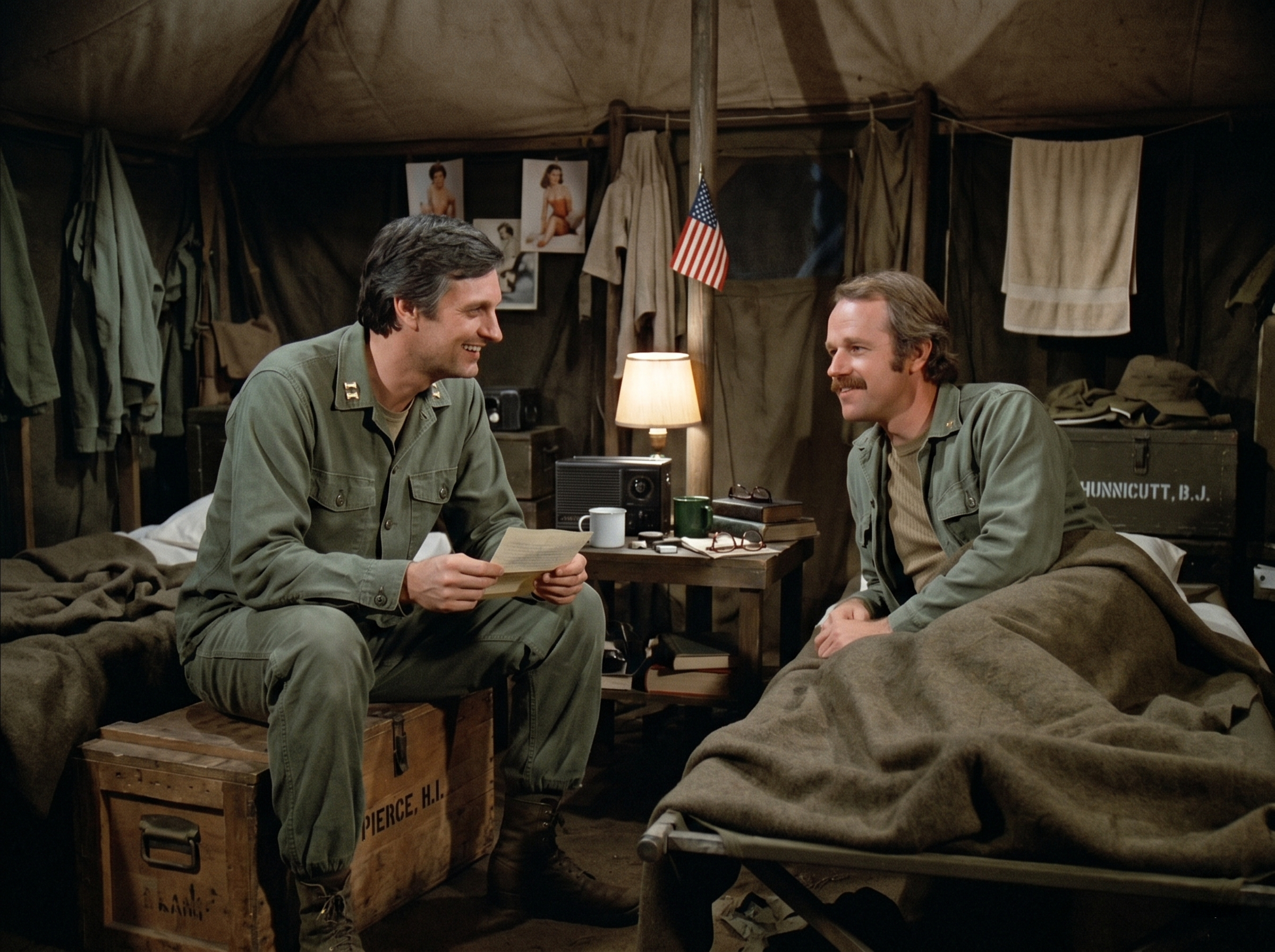
In the 4077th, the most precious sound wasn’t the silence after a twenty-four-hour shift in the OR.
It was the thin, delicate crinkle of an envelope from home.
The Swamp was drafty, smelling of damp canvas, old boots, and the faint, ever-present ghost of iodine. Outside, the Korean wind was howling across the compound, rattling the guy wires and threatening to blow the 4077th right off the map.
But inside, a fragile bubble of peace had settled over the tent.
Hawkeye sat perched on the edge of his wooden footlocker, his long legs stretched out in front of him. His name, “PIERCE, H.I.”, was stenciled in bold black letters on the worn wood beneath him.
He was still in his green fatigues, the silver captain’s bars catching the faint, warm glow of the small lamp on their makeshift nightstand.
Across the aisle, B.J. was propped up on his cot. He hadn’t even bothered to take off his olive-drab thermal shirt. He was wrapped tight in a heavy brown wool blanket, fighting off the deep bone-chill that always seemed to follow a marathon session over a surgical table.
The little American flag tied to the center pole fluttered slightly as a draft snuck through the tent flaps.
But neither of them noticed the cold.
Mail call had arrived just before dusk. And right now, Hawkeye was holding a piece of Crabapple Cove right in the palm of his hand.
“Okay, okay, listen to this,” Hawkeye said, his voice dropping into that familiar, theatrical cadence he used whenever he was about to deliver a punchline.
A broad, genuine smile was plastered across his face. It was the kind of smile that actually reached his eyes, erasing the dark circles and the fatigue, if only for a moment.
B.J. shifted under his blanket, leaning in slightly. A soft, affectionate grin tugged at the corners of his mustache.
There was a quiet comfort in this routine. Whenever the letters from Maine or Mill Valley arrived, they didn’t just read them alone. They shared them. They had to. It was the only way to prove to each other that a sane, normal world still existed somewhere across the ocean.
“This is from my dad,” Hawkeye continued, smoothing out the creased white paper. “He writes: ‘Son, I have to report a major scandal at the town hall. Mrs. Higgins decided that the annual Crabapple Cove bake sale needed a modern touch, so she tried to make a French tart.’”
B.J. chuckled softly, his eyes crinkling. “I’m assuming the good people of Maine weren’t ready for a French tart.”
“Ready?” Hawkeye laughed, a bright, loud sound that bounced off the canvas walls. “Beej, they practically called in the National Guard. My dad says Mr. Henderson took one bite, claimed it tasted like sweetened tree bark, and demanded his nickel back. It turned into a twenty-minute shouting match about the sanctity of the American blueberry pie.”
B.J. let out a tired, hearty laugh, pulling the blanket a little tighter around his shoulders.
It was a ridiculous, meaningless story. It had nothing to do with shrapnel, or helicopters, or the endless line of ambulances. And that was exactly why it was so beautiful.
Hawkeye beamed, looking up from the letter to share the laugh with his friend. For a few seconds, the Swamp wasn’t a tent in the middle of a warzone. It was just a room where two guys were shooting the breeze.
But as Hawkeye looked back down at the paper to read the next paragraph, his laughter suddenly caught in his throat.
The bright, easy smile on his face froze, then slowly began to slip away.
B.J.’s own smile faded as he watched his friend. He recognized that shift instantly. He had seen it a hundred times in the mess tent, in the OR, and right here in the Swamp.
It was the moment the armor cracked.
The tent grew incredibly quiet. The only sounds were the static humming from the old radio on the desk and the distant, lonely howl of the wind outside.
Hawkeye stared at the bottom of the page, his eyes tracking the same line of ink over and over again. His jaw tightened, and his knuckles turned slightly white where he gripped the paper.
“Hawk?” B.J. asked softly, his voice barely above a whisper. “What is it?”
Hawkeye didn’t answer right away. He just took a slow, deep breath, staring at the letter as if the words on the page were suddenly too heavy to hold.
The silence stretched out, thick and heavy in the small space between their cots.
B.J. didn’t push. He just waited, his warm, steady gaze fixed on Hawkeye. He knew better than to force a joke or rush the moment. In this place, you let a man process his ghosts at his own pace.
Hawkeye finally blinked, shaking his head slightly as if trying to clear a sudden fog. He ran a hand through his dark, messy hair.
“It’s nothing,” Hawkeye lied automatically. His voice was a little tighter than it had been a moment ago. “Just my dad rambling.”
“Hawk,” B.J. said gently. He didn’t say anything else. He just let the name hang in the air, loaded with a quiet, undeniable demand for the truth.
Hawkeye looked up, meeting B.J.’s eyes. He saw the genuine concern there, the unwavering, grounded friendship that had pulled him back from the edge more times than he could count.
Hawkeye sighed, his shoulders slumping. The wisecracking, deflecting persona drained out of him, leaving behind just a tired doctor who missed his father.
“It’s the postscript,” Hawkeye murmured, his eyes dropping back to the bottom of the page. “He always leaves the heavy stuff for the P.S. Sneaky old guy.”
Hawkeye cleared his throat. It sounded a bit rough.
“He says… ‘Hawk, I walked down to the docks yesterday evening. The leaves are turning that bright, angry orange you always loved. The water was perfectly still. I stood there for a long time, just watching the tide come in.’”
Hawkeye paused, swallowing hard.
“‘I realized I was waiting to hear your boots on the wooden planks behind me,’” Hawkeye read, his voice dropping to a near whisper. “‘It’s awfully quiet around here, son. The town is loud, but the house is quiet. I miss you. We all do. Come home in one piece. Love, Dad.’”
Hawkeye stopped reading. He didn’t look up. He just sat on his wooden footlocker, staring at the signature of a man who was half a world away.
B.J. felt a familiar, dull ache bloom in his own chest. It was the same ache he felt every time he looked at the picture of Peg and Erin he kept tucked by his bed.
It was the crushing weight of homesickness. It was the realization that while they were stuck in this muddy purgatory patching up broken kids, life back home was moving on without them. The leaves were changing. The tides were turning. And the people they loved were standing on docks and porches, staring out into the distance, waiting for them to come back.
B.J. didn’t offer a platitude. He didn’t tell Hawkeye that the war would be over soon, or that they were doing important work. They both knew those lines, and they both knew they didn’t help when the pain was this sharp.
Instead, B.J. just offered his presence.
“He sounds like a good man, Hawk,” B.J. said quietly. “A really good man.”
Hawkeye slowly lifted his head. The sadness was still there in his eyes, but it wasn’t as overwhelming now. He had shared the burden, and the simple act of saying the words aloud to someone who understood made them easier to carry.
“He is,” Hawkeye said softly. A genuine, nostalgic smile slowly returned to his face, smaller this time, but deeper. “He’s a terrible cook, he can’t tell a joke to save his life, and he still treats me like I’m twelve years old when I get a cold. But yeah. He’s the best man I know.”
B.J. smiled back, leaning his head against the canvas wall. “You think he’d get along with Peg?”
“Are you kidding?” Hawkeye chuckled, the familiar spark returning to his voice. “They’d form a support group. ‘The Long-Suffering Relatives of Irritating Doctors.’ They’d have meetings, bake terrible French tarts, and complain about our complete lack of domestic skills.”
B.J. laughed, the sound warm and filling the tent. “Peg makes a great pie, for the record. I won’t have you slandering her baking.”
“I’ll believe it when she sends me one,” Hawkeye countered, carefully folding his father’s letter and sliding it back into his shirt pocket, right over his heart.
He patted the pocket gently, a subconscious gesture of comfort.
The heavy, melancholic air in the Swamp had lifted, replaced once again by the easy, comfortable rhythm of their friendship. The war was still waiting for them outside the canvas flaps. In a few hours, the choppers would likely bring another wave of shattered reality to their doorstep.
But for now, they were safe.
Hawkeye leaned back, looking around the cluttered, messy tent. He looked at the pin-ups on the wall, the muddy boots on the floor, and finally at B.J., who was already closing his eyes, letting exhaustion pull him toward sleep.
“Get some rest, Beej,” Hawkeye said softly. “I’ve got a feeling those leaves in Maine are going to keep turning for a little while longer without me.”
B.J. just nodded, pulling the wool blanket up to his chin. “Night, Hawk. Tell your dad… tell him I said hello.”
“I will,” Hawkeye replied.
He reached over and clicked off the small desk lamp. The Swamp plunged into the cool shadows of the Korean night, leaving only the memory of the light, and the quiet comfort of knowing that home wasn’t just a place, but the people who were waiting there.
In a place built on patching up the wounded, sometimes the only medicine you needed was a friend to help you read a letter from home.