The Weight of the Dust
Korea had a way of getting under your skin, but for Major Charles Emerson Winchester III, the true daily tragedy was that it inevitably got on his clothes.
Dust was the undisputed, tyrannical sovereign of the 4077th Mobile Army Surgical Hospital. It hung suspended in the late afternoon air, painting the sky a dull, hazy beige. It coated the olive-drab canvas of the tents, settled into the floorboards of the Mess Tent, and turned the simple act of breathing into a gritty, exhausting chore.
For most of the camp, the dirt was simply an accepted reality. It was worn like a second skin by Hawkeye and B.J., and practically bathed in by the enlisted men. But for Winchester, keeping the filth at bay was an ongoing, desperate crusade for his own sanity.
His uniform was not merely Army issue; it was the last crumbling fortress of his Bostonian dignity.
Which made the current situation entirely unbearable.
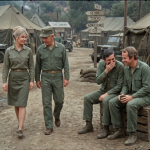
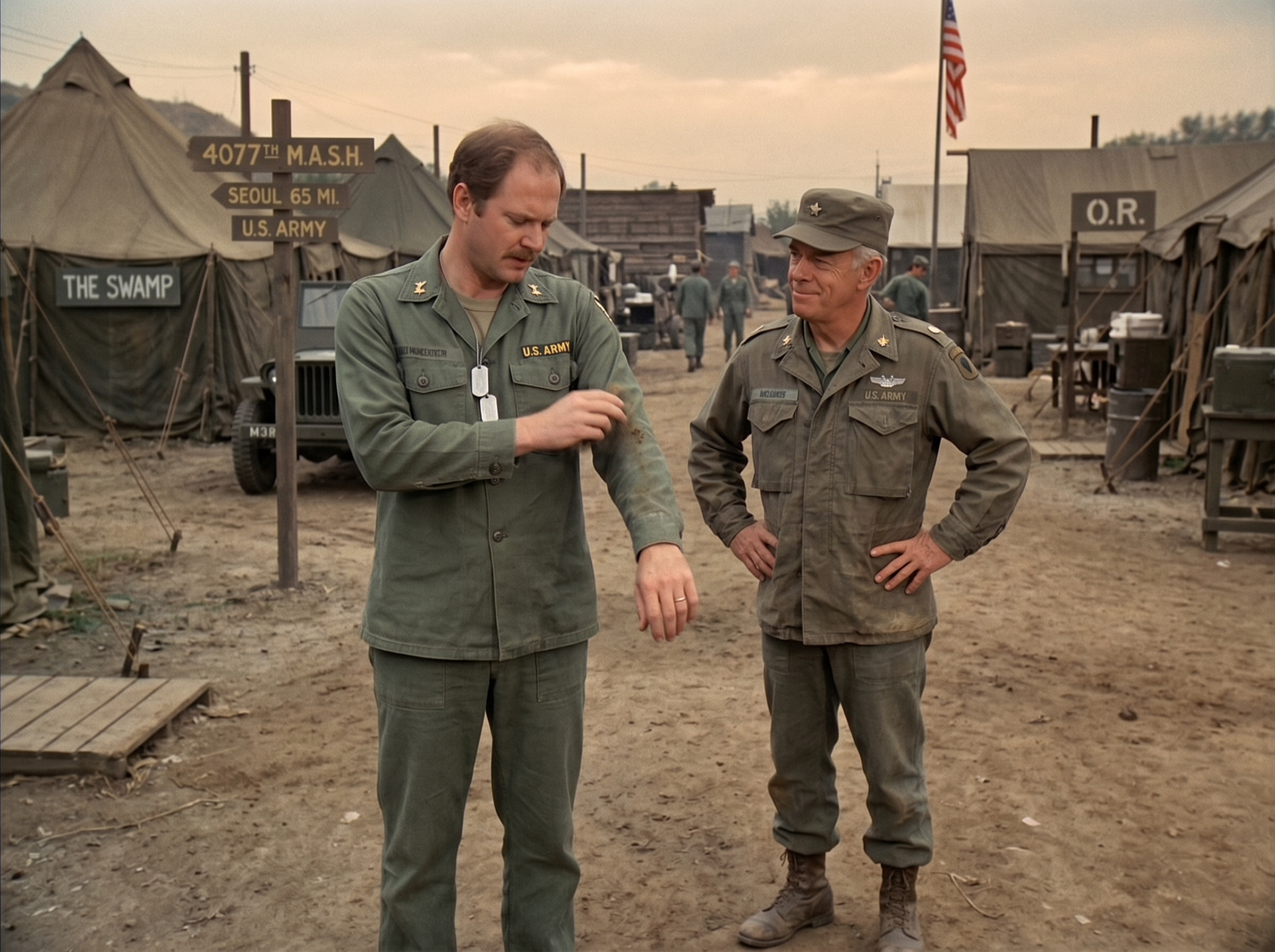
Charles stood squarely in the middle of the compound, just steps away from the wooden signpost that mockingly pointed the way back to civilization. His face was set in a mask of wounded pride and restrained, vibrating irritation.
With precise, frantic flicks of his long fingers, he was attempting to banish an offensive, muddy smudge from the pristine fabric of his left sleeve.
“It is abhorrent,” Charles muttered to no one in particular, his brow furrowed as he brushed at the stubborn stain. “A man should not have to fight a war against the very geology of the country he is stationed in.”
He had only been trying to cross the compound. That was all. A simple, dignified stroll from post-op back to the dubious sanctuary of The Swamp. But a supply jeep had chosen that exact moment to careen past, hitting the single remaining puddle from yesterday’s brief, useless rain shower and launching it directly at his arm.
Colonel Sherman Potter happened to be walking out of the clerk’s office at that precise moment.
Potter stopped, planting his dusty boots firmly in the dry earth. He rested his hands on his hips, his posture grounded and relaxed. He didn’t say a word at first. He just stood there in his faded field jacket and cap, watching his finest, most insufferable surgeon wage a losing battle against a spot of mud.
A dry, knowing smile began to tug at the corners of Potter’s mouth. It was a look of pure, fatherly amusement.
“Careful there, Major,” Potter finally drawled, his voice carrying easily over the low hum of the camp. “You rub any harder, you’re going to hit bone.”
Charles froze. He slowly turned his head, his eyes narrowing defensively as he caught the Colonel’s grin. The humiliation of being caught looking foolish only fanned the flames of his exhaustion.
“This is not a matter for levity, Colonel,” Charles clipped, his voice rising. The polished veneer cracked just a fraction, revealing the bone-deep fatigue underneath. “Look at this! This is not merely dirt. It is the slow, systematic, unrelenting erasure of every standard of civilized life I hold dear!”
Charles gripped his sleeve, his chest heaving. The frustration of a hundred endless surgeries, a thousand sleepless nights, and the crushing weight of the war suddenly focused entirely on that single brown stain.
“I refuse,” Charles snapped, his voice trembling with a sudden, raw intensity. “I absolutely refuse to let this desolate wasteland turn me into one of its permanent fixtures!”
Potter’s smile didn’t vanish, but it softened around the edges. The dry amusement faded into something much quieter, something deeply observant and profoundly kind.
He had seen that look in men’s eyes before. In two previous wars and countless muddy encampments, Potter had watched strong men break over a misplaced letter, a cold cup of coffee, or a spot of mud on a boot.
It was never about the coffee, and it was certainly never about the mud.
It was about the sheer, crushing weight of holding oneself together when everything else around you was falling apart.
Potter took a slow, deliberate step forward, his boots crunching softly on the dry earth. He didn’t pull rank. He didn’t offer a platitude about the hardships of military service. He simply stood beside Winchester, looking down at the same offending patch of dirt.
“It’s a stubborn country, Charles,” Potter said, his voice dropping to a gentle, conversational rumble. “Seems like every time you manage to brush a piece of it off, the wind blows two more right back in your face.”
Charles stiffened, his fingers pausing in their frantic assault on his sleeve. He was prepared for a reprimand. He was prepared for a folksy anecdote about Potter’s days in the cavalry. He wasn’t entirely prepared for the quiet solidarity in the older man’s tone.
“It is insidious,” Charles replied. The venom had noticeably drained from his voice, leaving only a hollow weariness behind.
He looked down at the smudge, his shoulders sagging a fraction of an inch beneath his loose green fatigue shirt. He let his hand drop to his side, surrendering to the stain. The silver dog tags resting against his chest clinked softly in the warm breeze.
“But it feels as though the harder I try to keep it out,” Charles whispered, almost to himself, “the deeper it settles into the fabric.”
Potter nodded slowly. His eyes tracked past Charles, looking toward the dusty path that led to the O.R. tents. The canvas walls were quiet now, but they both knew what awaited them inside. They both knew the kind of stains that didn’t wash out with soap and water.
“You’re a brilliant surgeon, Major,” Potter said softly, turning his gaze back to Charles. “One of the absolute finest I’ve ever had the privilege to command. And when you’re standing over a table in there, up to your elbows in the worst this war has to offer, you don’t care a lick about how pristine your gloves are. You just do the work.”
Charles looked up, meeting Potter’s steady, clear eyes.
“The dirt out here?” Potter continued, gesturing vaguely to the vast, beige compound. “It’s just real estate. It doesn’t mean you’re losing your grip, Charles. It just means you’re standing on the ground.”
The silence stretched between them, comfortably heavy. The frantic, nervous energy that had been radiating from Winchester slowly dissipated into the hazy afternoon air.
Charles looked back down at his sleeve. The dirt was still there. It was ugly. It was uncivilized. But suddenly, it didn’t feel like a personal failure anymore. It just felt like Korea.
He let out a long, shuddering breath, the kind that carried weeks of unexpressed exhaustion with it. He reached up and, with a final, much gentler brush of his fingertips, smoothed the wrinkled fabric of his shirt.
“I suppose,” Charles murmured, his voice regaining a touch of its usual aristocratic cadence, though softer now, “that certain environmental concessions must be made in the field.”
Potter chuckled. It was a warm, rumbling sound that seemed to settle the dust around them. He reached out and clapped a heavy, reassuring hand on Charles’s un-smudged shoulder.
“That’s the spirit, Major,” Potter smiled, the dry amusement returning to his eyes. “Tell you what. You’ve fought a valiant battle today. Why don’t you come by my tent?”
Charles raised a skeptical eyebrow. “To do what, precisely? Admire your collection of horse tack?”
“To have a drink,” Potter replied smoothly, entirely ignoring the barb. “I managed to procure a bottle of something that vaguely resembles scotch. It’s not exactly the Ritz, but it’s guaranteed to wash the dust out of your throat.”
Winchester hesitated. The instinct to retreat to the isolation of his cot, to put on his headphones and drown out the war with Mozart, was strong. But the hand on his shoulder was warm, and the offer was genuine.
He looked at Potter, recognizing the rare gift of quiet fellowship being extended to him in the middle of a war zone.
“Colonel,” Charles said, a faint, genuine smile finally breaking through his weary expression. “Under the current, tragic circumstances… I believe a drink would be highly acceptable.”
Potter gave his shoulder one last squeeze before letting go. “Good man. I’ll pour.”
They turned together, two tired men carrying the immense, silent burden of saving lives, walking side-by-side through the heart of the 4077th. The dust swirled around their boots, settling onto their trousers, claiming its small victory.
Charles Emerson Winchester III didn’t even bother to look down.
Even in a place built on blood and mud, true dignity was found not in a clean uniform, but in the quiet grace of standing together in the dirt.