A Simple Grace in the Mess Tent
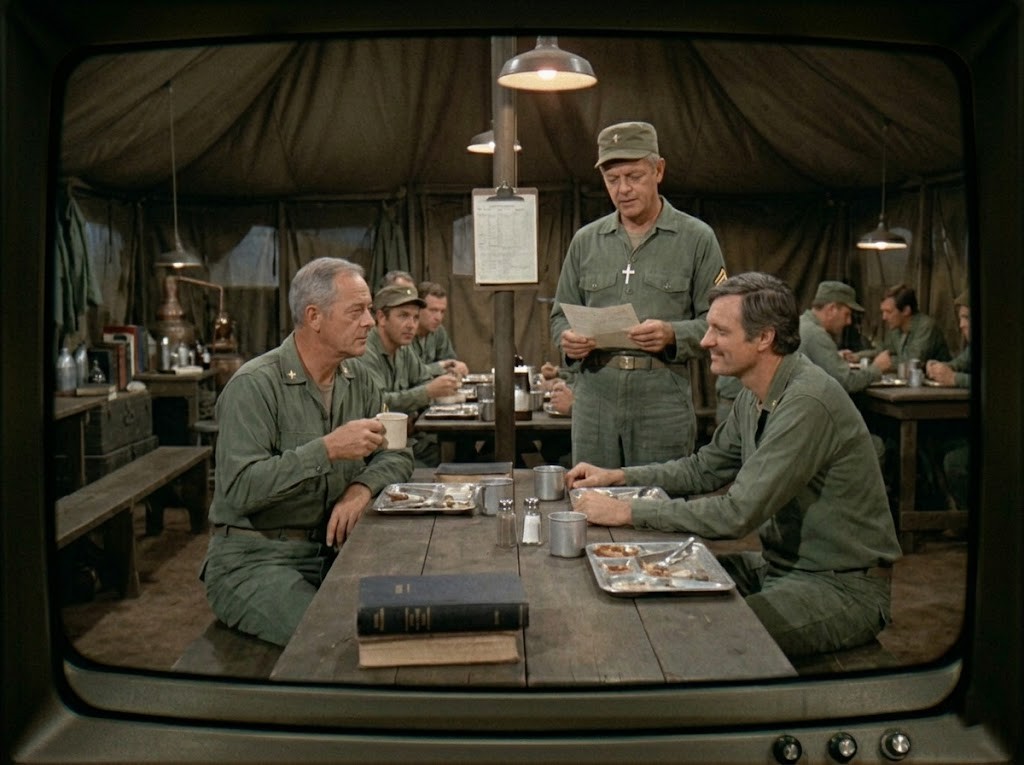
The steam rising from the metal tray didn’t smell like food, not really. It smelled like survival, boiled twenty minutes past its expiration date, served under a canvas roof that leaked whenever the Korean skies turned grey.
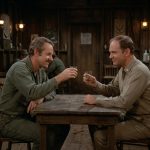
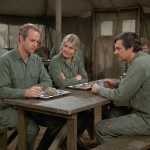
Colonel Potter stared down at his chipped white mug, his fingers wrapped around the ceramic as if looking for a warmth that the coffee itself couldn’t provide. Across the rough wooden table, Hawkeye sat back, a rare, quiet smile playing on his lips, his eyes tired but soft.
Between them lay an old, black-bound book, its spine weathered by years of handling, a silent anchor in a room full of clattering trays and low, rumbling conversations.
It had been a brutal forty-eight hours in the OR. The kind of shift that left your hands shaking and your mind drifting back to places where the air didn’t smell like ether and burnt oil. The mess tent was mostly quiet now, populated only by the stragglers who were too exhausted to sleep and too hungry to care about the taste of the creamed chipped beef.
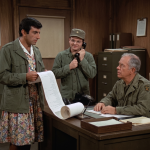
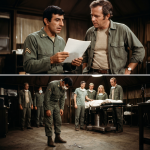
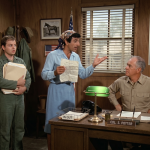
Father Mulcahy stood over them, a folded piece of paper in his hands, his brow furrowed as he looked down at the scribbled handwriting. His silver cross caught the pale light of the bare bulb hanging from the tent pole, a small glint of something bright in a room dominated by olive drab.
“I must admit, Colonel,” Mulcahy said, his voice carrying that familiar, gentle lilt, “the grammar leaves something to be desired, and the handwriting suggests the author was either in a great hurry or riding in the back of a bouncing jeep.”
Potter took a slow sip of his coffee, his expression unreadable behind his gray mustache. “Just read it, Father. After the day we’ve had, I think we could all use a little something from home, even if it’s written by a private who can’t spell ‘blessing’ correctly.”
Hawkeye leaned forward, his elbows resting on the table, his usual sharp-tongued barbs replaced by a quiet, expectant curiosity. In the background, the other men at the distant tables shifted, their own conversations dying down as they caught the shift in the room’s energy.
Mulcahy cleared his throat, adjusting his glasses as he began to read the letter sent by a young soldier’s mother from Iowa, a woman who had simply wanted to thank the doctors who saved her boy.
But as Mulcahy reached the second paragraph, his voice caught, the words halting on his tongue.
The silence in the mess tent stretched out, suddenly heavy, broken only by the distant, rhythmic thud of artillery miles away over the ridges. Hawkeye’s smile faded just a fraction, his eyes narrowing with concern as he looked up at the chaplain.
“Father?” Hawkeye asked softly, the dry wit completely gone from his voice. “Did she ask for a refund on the appendectomy?”
Mulcahy managed a small, watery smile, shaking his head as he looked down at the paper. “No, Pierce. Not at all. She writes… she writes that her son returned home last week. He walked through the front door just as they were sitting down for Sunday dinner.”
The chaplain took a breath, his fingers tightening slightly on the edges of the page. “She says he didn’t say much about the war. But before they ate, he asked to say the grace. And he used the exact words you told him, Colonel, the night he was brought into admissions.”
Potter looked down at the old book on the table, his hand resting on the cover. A deep, fatherly warmth settled into the lines of his face, the fierce, protective colonel softening into the man who missed his own family farm more than he ever let on.
“He remembered,” Potter murmured, his voice thick but steady. “I’ll be damned. The kid actually listened to an old man’s rambling.”
“We all listen, Sherman,” Hawkeye said quietly, reaching out to tap the edge of Potter’s coffee mug with his own spoon. “We just pretend we don’t so you won’t get a swelled head. It’s a medical precaution.”
A low chuckle went around the table, the tension breaking as quickly as it had formed. Even Mulcahy let out a soft laugh, wiping a stray tear from his cheek before carefully folding the letter and slipping it into his shirt pocket.
Across the tent, the ambient noise of the 4077th began to pick up again—the clink of forks, the gruff laughter of tired corpsmen, the distant shout of Klinger arguing with someone about supply forms. The war was still out there, just beyond the canvas walls, waiting for the next chopper to arrive.
But inside the tent, under the warm, yellow glow of the single light bulb, the fatigue didn’t feel quite so heavy anymore. They had saved one, and that one had made it all the way back to a Sunday dinner table in Iowa.
Potter took another sip of his lukewarm coffee, looking across at Hawkeye, then up at Mulcahy.
“Well,” the Colonel said, his dry, steady tone returning as he tapped the table. “Don’t just stand there airing out the tent, Father. Sit down and tell us what else she wrote before Pierce tries to convince me this coffee is actually fit for human consumption.”
Sometimes, in the middle of nowhere, a little piece of home is the only medicine that really works.