The Toledo Express Never Arrives
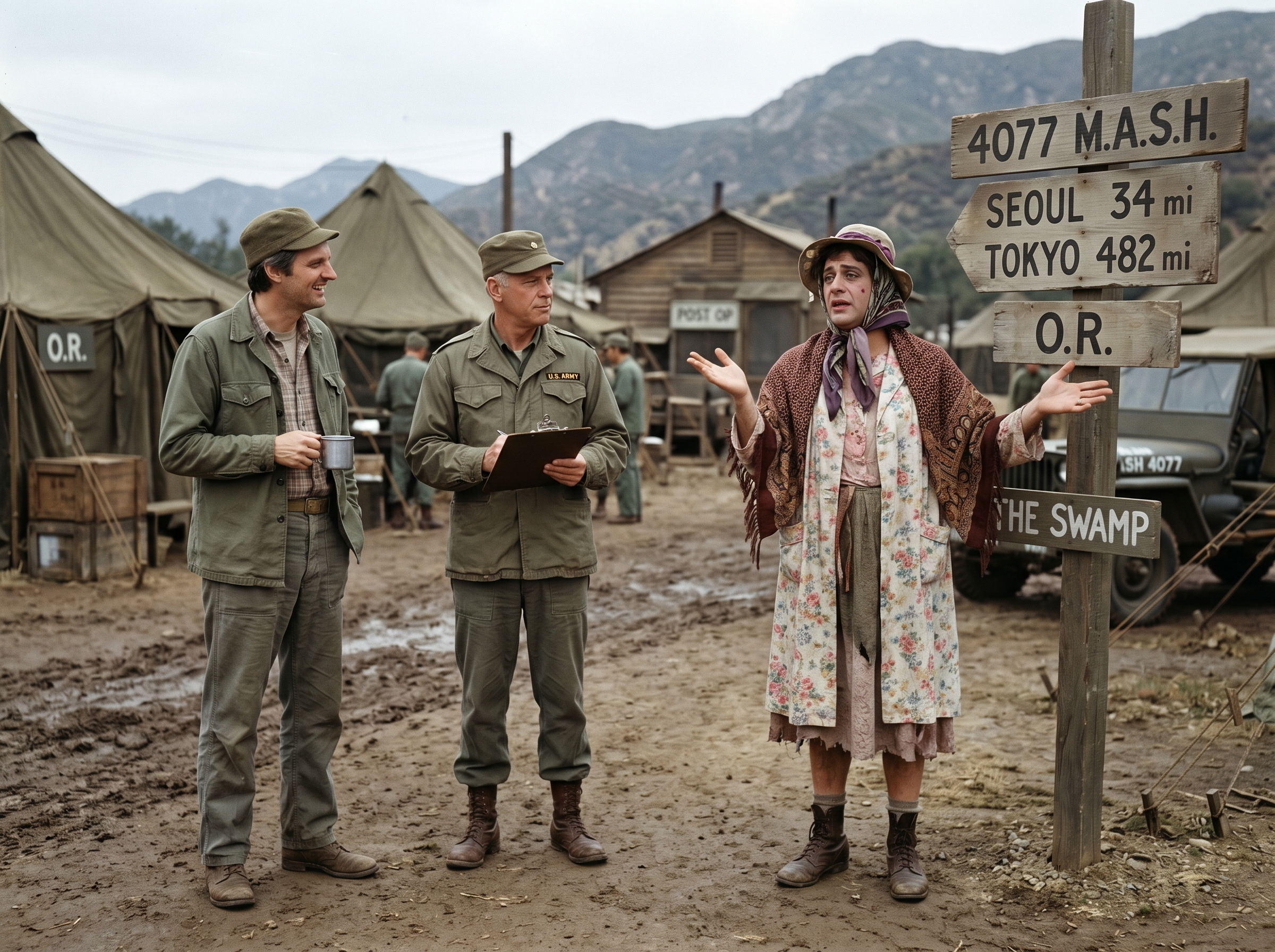
It was a quiet Tuesday afternoon in the 4077th, which was often the most dangerous kind of afternoon.
When the choppers stopped coming and the operating room went dark, the silence had a way of pressing down on the camp. The adrenaline evaporated, leaving nothing but dust, canvas, and the nagging reality of being halfway across the world from everything that mattered.
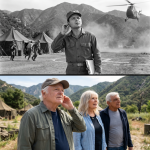
Hawkeye Pierce was doing his best to ignore the quiet. He stood near the center of the compound, leaning casually against the wooden signpost that pointed the way to places they couldn’t go. His posture was relaxed, hands shoved deep into his worn fatigue pockets, a quick, spontaneous smile playing on his lips.
He was smiling because Maxwell Klinger was making an entrance.
And as always, Klinger did not disappoint.
He came marching down the dirt path with grand gestures and an air of deeply wounded dignity. Today’s ensemble was a masterpiece of eccentric theatricality. He wore a brightly patterned, fringed bohemian shawl draped over an impossibly loud, floral prairie dress.
To top it off, he had a wide-brimmed felt hat pulled dramatically low over one eye.
He stopped right next to the signpost, striking a pose of profound, tragic waiting. He looked like an actress who had been abandoned at a train station in a silent movie.
“Don’t tell me,” Hawkeye said, his voice dripping with playful amusement. “You’re waiting for the three-fifteen stagecoach to Toledo. I have to warn you, the baggage fee for the shawl is exorbitant.”
“Laugh if you must, Captain,” Klinger declared, lifting his chin proudly. “But this is the exact outfit my Aunt Sophie wore when she successfully flagged down a cross-country zeppelin. I am simply awaiting my aerial transport.”
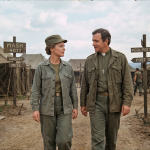
Before Hawkeye could fire back another joke, the screen door of the clerk’s tent creaked open. Colonel Sherman Potter stepped out into the faded canvas tan palette of the afternoon.
Potter stood calmly, holding a tin cup of coffee. He surveyed Klinger’s floral dress with a look of dryly amused, weary wisdom. It was the look of a man who had seen two world wars and thought he had seen it all, right up until he took command of the 4077th.
“Corporal,” Potter said, his voice a slow, steady drawl. “Unless that zeppelin is carrying a cargo of extra bandages and a case of good Kentucky bourbon, I suggest you clear the landing zone.”
“Colonel, please,” Klinger said, pressing the back of his hand to his forehead in a theatrical swoop. “Can you not see the desperation of a stranded civilian? I am practically fading away into the Korean dust.”
Hawkeye chuckled, pushing himself off the signpost. “He’s got a point, Colonel. He’s down to his last three floral prints. It’s a humanitarian crisis.”
Klinger spun around to deliver a blistering, dramatic rebuttal. He reached into the deep pocket of his dress, presumably to pull out a lacy handkerchief to dab at his dry eyes.
Instead, his fingers pulled out a crumpled, heavily creased piece of paper.
It was a letter from home.
The moment Klinger looked at the wrinkled envelope, the grand theatrical illusion shattered. His shoulders dropped. The wounded dignity vanished, replaced by a sudden, very real, and very quiet devastation.
He stared at the letter, completely forgetting the dress, the zeppelin, and the joke. His voice caught in his throat, and the dusty breeze suddenly felt a lot colder.
The silence that fell over the signpost wasn’t the bored silence of a slow Tuesday. It was the heavy, unspoken silence of three men who knew exactly what homesickness looked like.
Hawkeye’s playful smile vanished instantly. He took a step forward, his anti-authoritarian swagger melting into genuine concern.
Potter didn’t say a word at first. He just took a slow sip of his coffee, his eyes softening as he watched his company clerk stare at the crumpled paper.
“Klinger?” Hawkeye asked gently, his voice low. “You okay? Did they run out of hot dog casings at Tony Packo’s?”
Klinger didn’t look up. He just rubbed his thumb over the return address.
“It’s from my mother,” Klinger said. His voice wasn’t theatrical anymore. It was small, tired, and painfully sincere. “My little sister, Marie. She got married yesterday.”
Hawkeye shoved his hands deeper into his pockets, nodding slowly. “That’s wonderful news, Max. You should be celebrating.”
“She wore my mother’s veil,” Klinger continued, staring right through the dirt floor of the compound. “They had the reception at the parish hall. My uncle played the accordion. There was a fountain of punch.”
He finally looked up, looking back and forth between Hawkeye and Potter. The ridiculous floral dress suddenly looked incredibly heavy on his shoulders.
“I was supposed to give the toast,” Klinger whispered. “I practiced it before I got drafted. I had jokes. Good ones. And I wasn’t there. My baby sister got married, and her big brother is standing in a dirt pile in Korea wearing a prairie dress.”
The humor of the situation had completely completely drained away. It was the hardest part of the war—not the blood, and not the noise, but the quiet realization that the world back home was spinning on without them.
Hawkeye looked up at the wooden signpost. Toledo: 6,824 miles. It had never looked so far away.
He didn’t try to use wit to deflect the pain. He knew when a joke wouldn’t fix the room.
“They missed you, Klinger,” Hawkeye said softly. “I guarantee you, right in the middle of that reception, somebody raised a glass of that cheap punch to you.”
Potter stepped forward, the weary wisdom in his eyes turning into a warm, fatherly tenderness. He walked right up to Klinger, completely ignoring the ridiculous outfit.
“In the First World War,” Potter said, his voice a steady, comforting rumble, “I missed my wife’s thirtieth birthday. In the Second World War, I missed my daughter’s high school graduation. It eats at you. It feels like you’re a ghost haunting your own family.”
Klinger looked at the Colonel, his dark eyes wide and vulnerable. “Does it ever stop feeling like that, sir?”
“No, son. It doesn’t,” Potter said honestly. “But you have to remember why you aren’t there. You’re here, holding this camp together, making sure these doctors can put boys back together so they can go home to their sisters’ weddings.”
Potter reached out and placed a firm, grounding hand on Klinger’s shoulder. It was a gesture of profound respect, completely at odds with the bohemian shawl beneath his fingers.
“Your sister knows where you are, Max,” Potter said gently. “And I’d bet my last cigar she’s prouder of you right now than she is of the groom.”
Klinger blinked hard, swallowing the lump in his throat. He looked down at the letter one more time, then carefully folded it and tucked it into his breast pocket, close to his heart.
He took a deep breath. The raw grief began to recede, replaced by the resilient, stubborn spirit that kept Maxwell Klinger going day after day.
He stood a little taller, adjusting his wide-brimmed felt hat with a return of his wounded dignity.
“Thank you, Colonel,” Klinger said quietly.
“Don’t mention it,” Potter replied, stepping back and taking another sip of coffee. The dry, practical commander was back. “Now, Corporal, while I admire your commitment to high fashion, I suggest you go put on a uniform. Or at least something that doesn’t clash with the dirt.”
Klinger managed a small, brave smirk. “Yes, sir. I believe I have a tasteful beige pantsuit that meets regulations.”
As Klinger turned and began to march back toward his tent, the grand, theatrical sway returned to his walk. He was going to be okay.
Hawkeye let out a slow breath, the familiar, relaxed posture returning to his shoulders. He looked over at Potter.
“You know, Colonel,” Hawkeye smiled softly. “For a regular army man, you give a pretty good toast yourself.”
Potter offered a wry, half-smile. “Just telling the truth, Pierce. Now, don’t you have a still to tend to? We have a wedding to celebrate.”
Hawkeye grinned, pushing off the signpost. “I’ll mix up my finest vintage of Swamp gin. We’ll make it taste exactly like Toledo.”
As the two men walked off toward the Swamp, the dusty camp felt just a little bit warmer. The war was still waiting for them, and home was still thousands of miles away. But in the shadow of the wooden signpost, they weren’t entirely alone.
They were an ocean away from their blood relatives, but under the dusty Korean sun, the 4077th was the only family they needed.