The Price of Tea in Korea
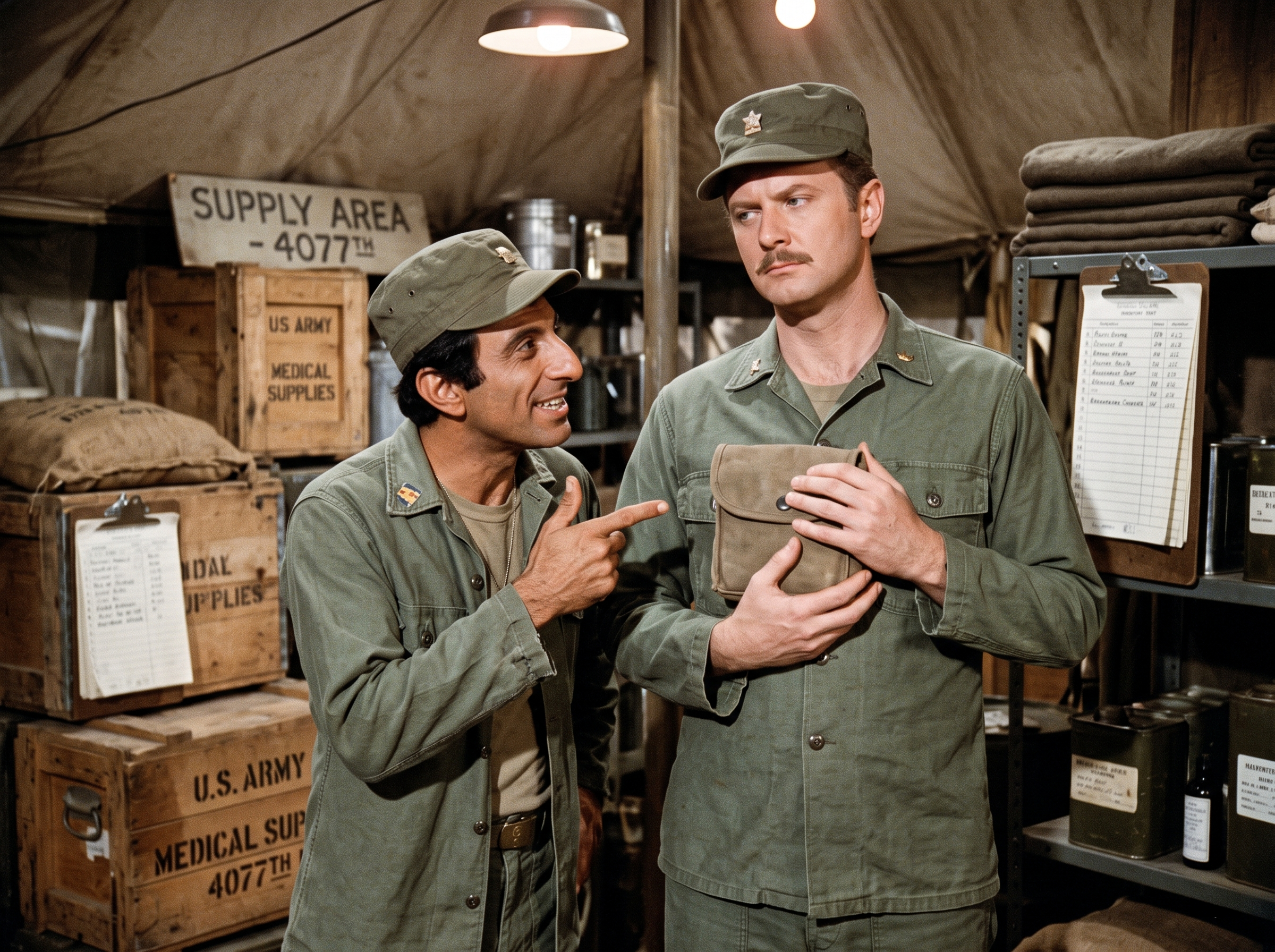
The 4077th Mobile Army Surgical Hospital was entirely built on two things: canvas and desperation.
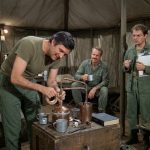
When the operating room was quiet, that desperation usually found its way into the supply tent. It was a dusty, cramped museum of military monotony. The air always smelled faintly of mildew, iodine, and dry earth. Wooden crates stamped with faded black ink reading “US ARMY MEDICAL SUPPLIES – 4077TH” were stacked haphazardly against the walls. Canvas bags slumped in the corners like exhausted soldiers waiting for a bus that would never come. Stacked, folded wool blankets sat on metal shelves beside an endless row of inventory clipboards.
It was an entirely unglamorous place, lit only by the soft, dim, warm glow of a single overhead camp light. Yet, on this particular Tuesday afternoon, it was the site of a high-stakes international negotiation.
Major Charles Emerson Winchester III stood in the center of the cramped aisle. His posture was rigidly upright, his spine locked in a posture of complete, controlled superiority. He wore his standard green fatigue shirt and cap, but he wore them as if they were tailored tweed. Pressed firmly against his chest, clutched in both hands with protective, almost frantic care, was a small, unlabelled canvas pouch.
His face was a masterpiece of refined, reluctant participation. He looked down his nose, caught somewhere between absolute disdain and helpless desire.
Corporal Maxwell Klinger stood inches away. He wasn’t wearing a velvet gown or a feather boa today. He was dressed in standard, lived-in army greens, matching his major. But Klinger didn’t need a dress to command a room. He leaned in close, bringing his street-smart, Toledo-bred confidence right into Winchester’s personal space.
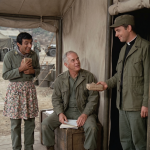
Klinger extended a single hand, pointing a finger directly at the canvas pouch against the major’s chest. A lovable, knowing grin spread across Klinger’s face. It was the smile of a man who held all the winning cards in a deck he had personally stacked.
“There it is, Major,” Klinger said, his voice a low, theatrical whisper. “Just like I promised. Authentic, unblended, First Flush Darjeeling tea. Sourced directly from a British supply officer who has a terrible weakness for American jazz records.”
Charles did not relax his grip on the pouch. He held it as if it were a fragile artifact from a lost civilization. “I must admit, Corporal, I harbored severe doubts regarding your ability to procure something of this… pedigree.”
“O ye of little faith,” Klinger chuckled, tapping the pouch lightly with his index finger. “When Maxwell Q. Klinger says he can get the goods, he gets the goods. You’re holding the finest tea leaves in the entire Korean peninsula.”
Charles closed his eyes for a brief second, inhaling the faint, earthy aroma seeping through the canvas. For a moment, the dull metal racks and the canvas walls faded. He wasn’t in a war zone. He was sitting in his leather wingback chair in Boston, the fireplace roaring, a silver teapot on the table.
He opened his eyes, immediately masking his relief with a veneer of dry authority. “Very well, Klinger. It is acceptable. I will wire the agreed-upon thirty dollars to your bank account in Toledo by the end of the week.”
Charles turned slightly, preparing to make his grand exit with his prize.
“Hold it right there, Major,” Klinger said, stepping sideways to block the narrow aisle between the medical supply crates. The knowing grin faded into a look of serious business.
Charles paused, raising an eyebrow. “Is there a problem, Corporal? I assure you, my family’s bank has never bounced a check.”
“The thirty dollars was the price yesterday, Major,” Klinger said, crossing his arms over his chest. “Today, the market shifted. The price has gone up.”
Charles stiffened, pulling the pouch even tighter against his chest. “Are you attempting to extort an officer of the United States Army over a bag of shrubbery?”
“It’s not extortion, Major. It’s supply and demand,” Klinger replied smoothly. “And I don’t want your money.”
Charles looked at him, genuine confusion breaking through his haughty facade. “You don’t want my money? Then what, pray tell, could a man of your… unique economic standing possibly want from me?”
Klinger took a deep breath, the hustler’s swagger dropping for just a fraction of a second. “I need a favor. A personal, Winchester-sized favor.”
The silence in the supply tent stretched out, interrupted only by the distant, rhythmic hum of the mess tent generator.
“A favor?” Charles repeated, tasting the word as if it were spoiled milk. “I am a thoracic surgeon, Corporal, not a genie in a bottle. What sort of favor?”
Klinger uncrossed his arms and rubbed the back of his neck. The dim, faded light caught the genuine exhaustion in his eyes. Behind the jokes, behind the dresses, behind the constant schemes to get a Section 8, Klinger was just as tired as the rest of them.
“I need you to write a letter, Major,” Klinger said quietly. “To my mother.”
Charles blinked, completely derailed. “You want me to write to your mother? What on earth for? Have you finally exhausted your own supply of fabricated maladies?”
“No,” Klinger sighed, looking down at his worn boots. “It’s not about me being crazy. It’s… well, my Ma, she worries. She worries a lot. I write to her and tell her I’m fine, but she doesn’t believe me. She thinks I’m living in a ditch, dodging bullets twenty-four hours a day.”
“A fairly accurate assessment of our current geography, wouldn’t you say?” Charles noted dryly.
“Yeah, but she doesn’t need to know that!” Klinger looked back up, his eyes pleading. “I told her I got promoted. I told her I was the personal aide-de-camp to one of the most brilliant, high-society doctors in the whole army. I told her I was indispensable. That I was doing important work. Clean work.”
Charles stared at the corporal, the reality of the request sinking in.
“I need a letter from you, Major,” Klinger continued, his voice earnest. “On that thick, cream-colored, fancy stationery you keep locked in your footlocker. The stuff with the little crest at the top. I need you to write to my mother, Mrs. Fatima Klinger, and tell her that her son Maxwell is a vital asset. That he’s safe. That he’s doing a good job.”
Charles looked down at the small canvas pouch in his hands. He thought about the rich, complex flavor of the tea inside. He thought about the comfort it would bring him. Then he looked at the man standing in front of him.
They were worlds apart. A Boston aristocrat and a Toledo street kid. They had nothing in common, no shared history, no overlapping social circles. If they had passed each other on a street back in the States, Charles wouldn’t have even blinked.
But here, in this dusty, canvas purgatory, the lines of the world were blurred. They were just two men, thousands of miles from home, trying to find a way to survive the crushing weight of the war.
“Corporal,” Charles began, his voice surprisingly soft. “Are you asking me to completely fabricate a military record for the sake of a Toledo housewife’s peace of mind?”
“I’m asking you to help a guy out, Major,” Klinger said simply. “You want your Boston tea party. I want my Ma to sleep through the night. Seems like a fair trade.”
Charles stood motionless for a long time. The harsh reality of the camp faded into the background. He recognized the desperate, quiet dignity in Klinger’s request. It was the same desperate dignity Charles himself used every day to keep from falling apart. It was a request born of love, wrapped in the guise of a back-alley hustle.
Slowly, the rigid tension in Charles’s shoulders began to melt. He didn’t smile, but the hard, haughty edge left his eyes.
“Very well, Klinger,” Charles said, his tone returning to its normal, measured cadence. “However, I have conditions.”
Klinger’s face lit up, the confident grin returning instantly. “Name ’em, Major.”
“First,” Charles said, raising a finger. “I will not lie. I will not state that you are my ‘aide-de-camp,’ as that is a gross violation of military truth. I will, however, state that you are a resourcefully unique individual whose… unorthodox methods frequently benefit the camp’s morale.”
“I’ll take it!” Klinger nodded eagerly.
“Second,” Charles continued, his eyes narrowing slightly. “I will write this letter using my secondary stationery. The linen blend, not the heavy cardstock. I reserve the family crest for blood relatives and members of the symphony board.”
Klinger laughed, a genuine, warm sound that filled the cramped tent. “You drive a hard bargain, Major. But it’s a deal.”
Charles finally relaxed his death grip on the canvas pouch, tucking it neatly under his arm. He adjusted his collar, regaining his composed, aristocratic aura.
“See that my footlocker is undisturbed while I draft this correspondence, Corporal,” Charles said, turning toward the flap of the tent. “And Klinger?”
“Yeah, Major?”
Charles paused at the exit, looking back over his shoulder. The soft, dusty light framed him against the dark canvas. “Your mother has every right to be proud. Your ability to source this tea is nothing short of miraculous. Good day.”
As Winchester pushed through the tent flap and disappeared into the dusty compound, Klinger stood alone among the medical supplies. He smiled, pulling a clipboard off the rack. It was a small victory, quietly won among the crates and blankets.
In a place that stripped away everything they knew, sometimes the greatest comfort was found not in what they kept for themselves, but in what they were willing to give to each other.