The Last Symphony of a Tuesday Night
The mud outside the tent was thick enough to swallow a Jeep, but inside, the air tasted only of stale coffee, old paper, and the peculiar, desperate scent of sanity trying to hold its ground.
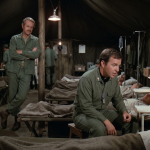
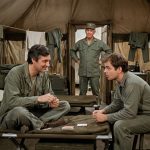
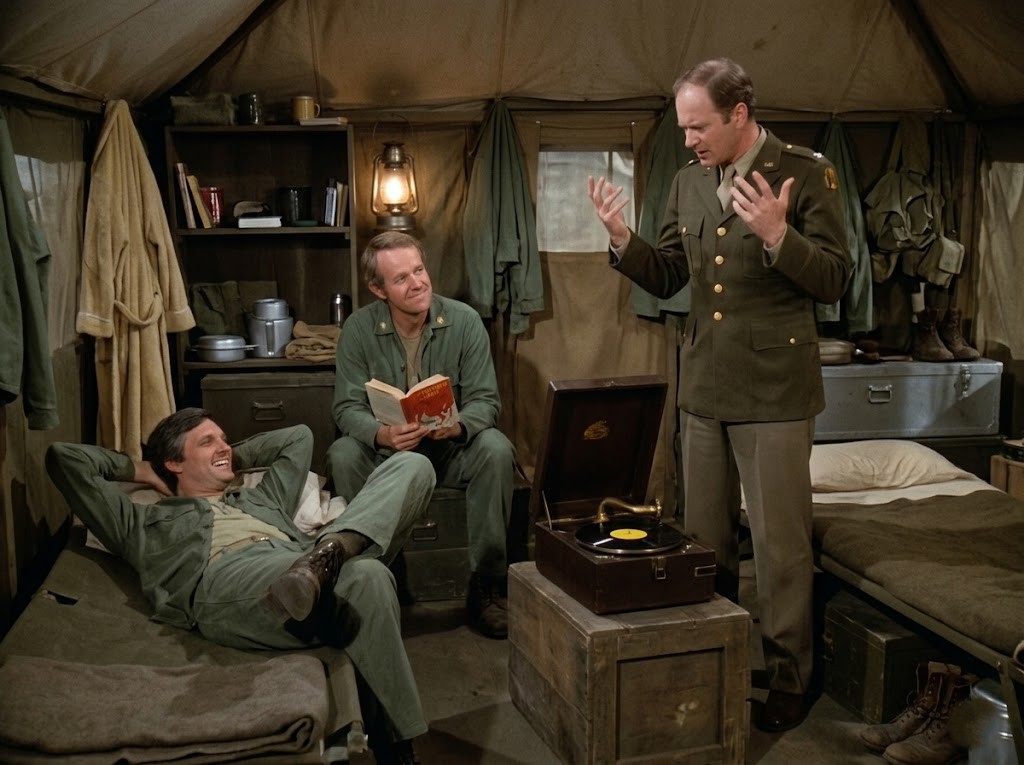
Hawkeye lay on his bunk, hands behind his head, his eyes tracing the canvas ceiling as if reading the constellations of a world far removed from Korea.
Across from him, B.J. sat perched on a crate, his face softened by the dim glow of the lantern.
He was holding a worn, dog-eared paperback, but his thumb hadn’t turned a page in ten minutes.
Between them sat the phonograph—a clunky, beautiful wooden box that looked entirely out of place in a war zone.
Major Winchester stood over it, his posture impeccable even in the cramped confines of the tent.
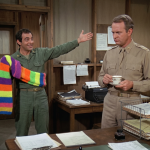
He was gesturing broadly, his hands carving shapes into the air as he lectured the room on the precise brilliance of a Mozart concerto, his voice dripping with the cultivated impatience of a man who felt he was casting pearls before swine.
“It is not merely a sequence of notes, gentlemen,” Winchester insisted, his brow furrowed in genuine, aristocratic agitation. “It is a structural inevitability! It is the articulation of human longing through the mathematical perfection of sound.”
Hawkeye let out a low, amused huff, shifting his gaze from the ceiling to the Major.
“Charles, it’s a record player, not a direct line to the divine. You’re giving me a headache, and I’m already on my third one today.”
B.J. just smiled, a quiet, knowing look that usually preceded one of his gentle deflections.
“I think it’s nice, Charles,” B.J. said softly, his voice cutting through the tension. “It’s a break from the usual soundtrack of distant artillery.”
Winchester sighed, a sharp, ragged sound of profound annoyance, and turned back to the needle, his hand hovering over the delicate machinery.
Suddenly, the needle skipped, emitting a harsh, screeching scratch that tore through the room like a jagged knife.
The music died mid-note, leaving a silence so heavy and sudden that it felt like the floor had dropped out from under them.
Winchester froze, his face turning a shade of pale that had nothing to do with the dim lighting.
He looked down at the spinning, silent record, his fingers trembling, and for a fleeting, terrifying second, the refined mask of the Boston aristocrat completely crumbled.
“Oh, no,” Winchester whispered, the arrogance replaced by a hollow, childlike vulnerability.
He reached out to touch the arm of the player, then pulled his hand back as if the machine had suddenly become radioactive.
“I… I had that record shipped from home. It was the only copy in the camp. Perhaps the only copy in the entire peninsula.”
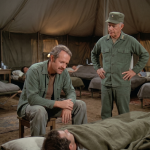
Hawkeye sat up, his playful smirk vanishing.
He saw the way Winchester’s shoulders slumped, the way he suddenly looked like a man who had lost his last tether to a life of dignity and beauty.
B.J. didn’t say a word; he simply stood up, crossed the floor, and gently placed a hand on the phonograph’s lid.
“It’s just a scratch, Charles,” B.J. said, his tone grounded and steady, devoid of his usual wisecracks. “It’s not the end of the world.”
“Isn’t it?” Winchester snapped, though the fire had gone out of him. “In this godforsaken place, when something beautiful breaks, it stays broken.”
Hawkeye stood up, joining them at the crate.
He looked at the record, then at Winchester, seeing the silent, desperate panic of a man who was terrified that he was losing his identity, piece by piece, to the unrelenting grind of the 4077th.
“Move over, Sargent Pepper,” Hawkeye muttered, pushing his way into the small circle.
He picked up a small, fine-tipped needle from the shelf and leaned in, his hands steady despite the exhaustion etched into the lines around his eyes.
“What are you doing?” Winchester demanded, though he didn’t pull away.
“Giving you a bit of medical advice,” Hawkeye replied. “Sometimes, you have to perform a little surgery on the things that keep you human.”
For the next ten minutes, nobody spoke.
The tent was quiet, save for the rhythmic, distant thud of the generator outside.
Hawkeye worked with the precision of a surgeon, his brow furrowed, his entire focus narrowed down to the tiny, microscopic groove on the black vinyl.
B.J. held the lantern closer, casting a warm, amber light over the scene, while Winchester watched with bated breath, his hands clasped tightly behind his back.
Finally, Hawkeye carefully repositioned the needle.
He looked at Winchester, nodded once, and lowered the arm.
The music swelled again—a soaring, triumphant swell of strings that filled the cramped tent, pushing back the shadows and the exhaustion.
Winchester let out a breath he seemed to have been holding for an eternity.
He didn’t thank them—that wasn’t his way—but he straightened his tie, smoothed his uniform, and leaned back against the support pole, his eyes closing as he surrendered to the music.
B.J. sat back down on the crate, picking up his book, while Hawkeye returned to his bunk, once again staring at the ceiling.
They were three very different men, caught in a place they never wanted to be, listening to a dead composer speak to them across time.
There was no talk of the war, no talk of the surgery they had performed that morning, and no talk of the letters from home that hadn’t arrived.
There was just the music, the warmth of the lantern, and the quiet, unspoken realization that they were the only ones keeping each other from drifting away entirely.
It wasn’t much, but in the heart of the 4077th, it was everything.
The war would still be there tomorrow, but for this moment, they were home.