A Dash of Silk and a Mountain of Tired
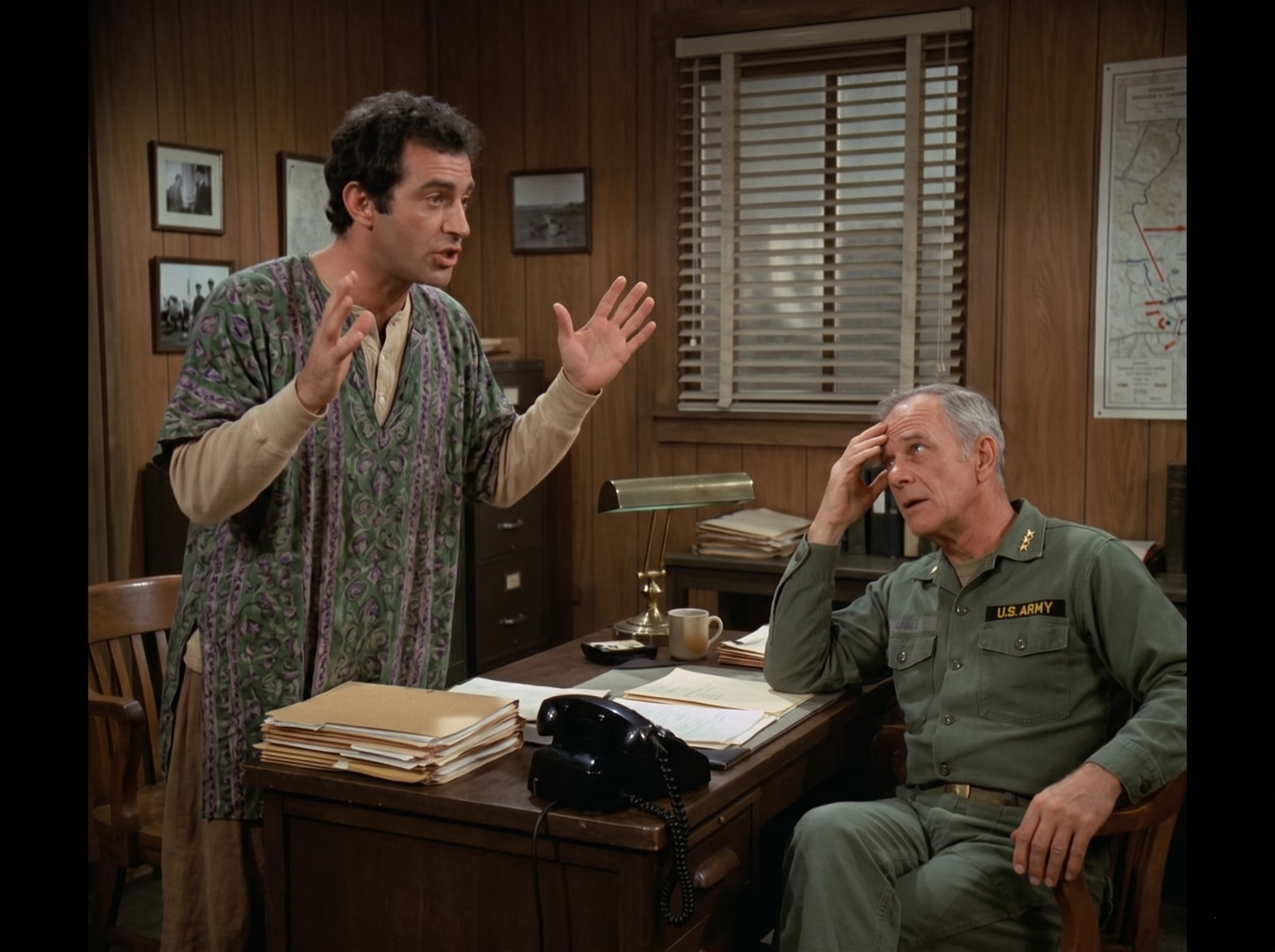
If the mud of Korea could talk, it would surely tell you about the times it met a feather boa and lost. Or the time it was confronted by a 3-star general and the most elaborate pair of hoop earrings north of the 38th parallel. The setting is the small, wood-paneled office of Colonel Sherman T. Potter. The air conditioning, if you can call the rusty oscillating fan that, is mostly moving around the humidity and the faint scent of antiseptic from the neighboring O.R. Radar O’Reilly has just delivered another stack of requisitions and incoming orders, leaving a teetering mountain of paper to compete with the vintage telephone and the empty coffee mug on the Colonel’s desk. Potter himself, seen in his crisp olive-drab uniform with the faint shimmer of general’s stars on his collar, sits with one elbow on the desk, his fingers massaging his temple. He’s a mountain of tired, but he’s the anchor. He’s seen it all, twice.
Then there is Maxwell Klinger. He is standing over the desk, hands spread wide, a picture of earnest desperation. Today’s outfit is a particular piece of work, a silky, patterned dashiki-style tunic in emerald and purple, worn over a beige long-sleeve tee. His dark, curly hair is in its peak, non-regulation form. He looks like a magician trying to conjure an explanation that might stick.
“I’m not asking for *much*, Colonel, I swear it on my Uncle Abdul’s mustache,” Klinger says, his gaze fixed on Potter. “Just three days. Three little days of leave, and I will personally paint the entire Motor Pool with the finest camouflage *and* organize the morale movie collection.”
Potter’s eyes, heavy with the weight of commanding an undermanned, overworked field hospital, barely shift. The hand on his head stays put. “Klinger, I’m listening, which is more than I can say for my left ear after the last artillery barrage. But what I’m hearing is that you want to go to Seoul to meet ‘a person who understands silk textiles,’ when I have fifty new arrivals due by sundown and a shortage of penicillin that is giving Father Mulcahy night sweats.”
“But Colonel! This person can revolutionize the supply chain! These tunic patterns aren’t just *patterns*, they are blueprints for textile efficiency that could… well, maybe they could…” Klinger’s voice cracks slightly, the bluff wavering. He’s not a supply genius. He’s a homesick Toledo kid who uses fabric to fight the crushing grayness.
Potter finally lowers his hand, fixing Klinger with a direct, compassionate look that cuts through the silliness of the garment. “Corporal, we all want a blueprint out of here. But if I let you go, who tells the families of the fifteen soldiers arriving today that their sons will have to wait for care because my head orderly is in Seoul, talking silk? Is that the message we want to send, son?”
Klinger opens his mouth to respond, to continue the dance of words, but for the first time, he looks past his own cleverness. He sees the utter exhaustion in Potter’s face, the slight tremor in his hands, and the mountain of unread papers that represent real lives in limbo. The silence in the office becomes heavy and thick, stretching tight, and Klinger’s large brown eyes begin to glaze with the realization of the true cost of his request, his expression shifting from persuasive plea to a quiet, heartbreaking understanding that there are no magic blueprints, just the endless grind. He looks ready to crumble, his hands dropping slowly, as the shared exhaustion of the entire 4077th seems to settle in his soul.
Potter watches Klinger, whose shoulders are now slumped beneath the vibrant weight of the dashiki. The flamboyant enthusiasm has evaporated, leaving behind a young man who just realized he’s not fighting a war against the brass, but alongside them against despair. The silence stretches a little longer, the only sound the faint *crrr-ick* of the window blinds in the hot wind and the distant, constant rumble. Potter lets him feel the weight of it.
Then, the Colonel’s face softens, a flicker of understanding passing across it. He remembers a younger version of himself, a soldier who once tried to get out of the trenches of the Somme by claiming to have seen a white rabbit that knew the way to Paris. Fear and fatigue make soldiers do a lot of strange, creative things to keep their sanity intact.
Potter leans forward and, with agonizing slowness, uses his index finger to physically push the entire, towering stack of requisitions to the very edge of the desk, just inches from the empty coffee mug. The gesture is small, but it commands Klinger’s full attention.
“Klinger,” Potter says, his voice losing its steely edge, becoming almost conversational. “You know I need you here. I need every set of hands, and I need every pair of crazy earrings you can dream up, because frankly, it gives the patients something to look at besides their own IV lines. But I’m also not blind. I can see that this… ‘textile blueprint’ thing is your white rabbit.”
Klinger looks from the desk to the Colonel, confused.
Potter taps the mountain of papers. “I can’t send you to Seoul, son. Not with this. Not with what’s coming. But I *can* do something else. Take the next three nights *off*. You are officially excused from all clerical duties from now until Friday morning. I want you to go into the Swamps. No, I mean *go* there, don’t just walk through it. Sit down. Tell Hawkeye and B.J. about the time you met a person who understood silk. Actually, don’t tell them. Just drink their terrible gin, listen to their bad jokes, and remember what it’s like to have a friend on either side of you. Get some damn sleep. And then come Friday morning, I want you right back here in my office, dressed like an orderly, and ready to tackle this paper monster.”
Klinger is utterly stunned. He has been in Colonel Potter’s office dozens of times, requesting leave, pleading for transfer, showing off new wigs, and receiving lectures. He expected a flat no, a reprimand, or at best, a ‘we’ll see.’ He didn’t expect to be heard, not on this level. He looks down at his hands, then up at Potter, and his expression is raw. The tears that were held back by the high point of tension finally prickle.
“You… you mean that, Colonel? You just want me to… to rest?”
“It’s a direct order, Corporal. If you disobey it, I will be forced to give this dashiki to Father Mulcahy, and I don’t think his sermons have enough jazz to pull it off.” Potter’s mouth twitches into a tired, almost invisible smile. “Take the nights. Recharge your battery. Your country needs you, but more importantly, your friends need you, and *you* need to remember that you’re a person, not just a set of funny clothes for the military circus.”
Klinger swallows hard, trying to keep his dignity. He straightens his tunic, the green and purple shimmering one last time. He snaps a precise, proper salute, not theatrical this time, but real. The expression on his face is still a mix of fatigue and gratitude, a quiet acknowledgment of the grace he’s been shown.
“Yes, sir. Thank you, Colonel. For the order. And… for the advice. I’ll make sure the gin is chilled.”
Potter nods, already letting his hand drift back to his temple. The office door closes, and the only sound is the rustle of the blinds. The moment was brief, just a few minutes in a day that will be fifteen hours long. But for Klinger, as he walks out into the relentless Korean heat, the air feels just a tiny bit lighter. The mountain of paper is still there, the war is still there, and the fatigue is still there. But the found family of the 4077th, with its father figure who sees the man inside the crazy tunic, is there too. And that is what makes all the difference.
Sometimes the best medicine isn’t found in a bottle, but in a three-night prescription for rest, delivered with heart, humor, and one very tired salute from a good man who truly cared.