The Quietest Sanctuary in Korea
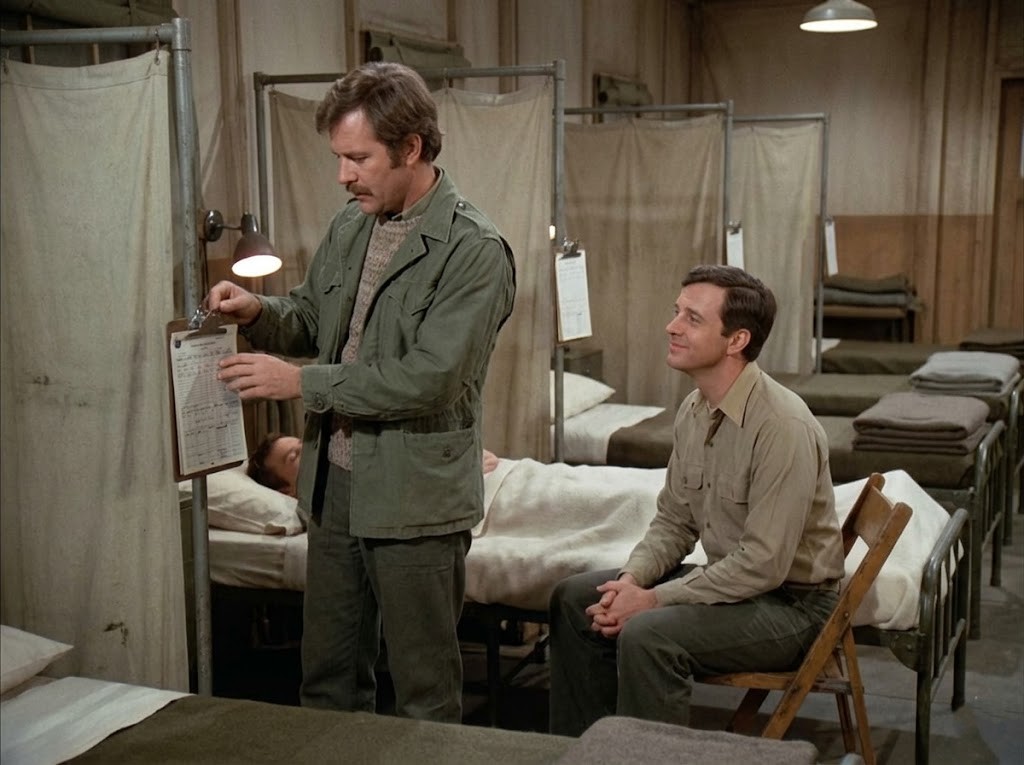
There is a specific kind of silence that only falls over the 4077th after a thirty-hour session in the Operating Room. It isn’t a peaceful silence, not exactly. It is the heavy, aching quiet of sheer physical exhaustion, where every step feels like wading through wet cement and the smell of antiseptic seems permanently stained into your skin.
In the post-op ward, the only sounds were the soft, rhythmic breathing of recovering boys and the occasional squeak of a wet boot on the linoleum. The canvas partitions hung limp, shielding the wounded from the harsh glare of the bare overhead bulbs.
Captain B.J. Hunnicutt stood by one of the cots, his green field jacket still damp from the morning drizzle. His hands, usually so steady with a scalpel, felt stiff and clumsy as he reached for the clipboard hooked onto the metal partition frame.
He unclipped it with a metallic snap that sounded like a gunshot in the quiet room. His brow furrowed as his eyes scanned the neat, handwritten numbers on the chart.
A few feet away, sitting on a weathered wooden folding chair, Father Mulcahy watched him. The priest’s fatigue was visible in the slight slump of his shoulders, but his face held that patient, enduring serenity that seemed to defy the entire peninsula of Korea. He had his hands clasped loosely in his lap, waiting.
“How is he, Beej?” Mulcahy asked, his voice barely above a whisper.
B.J. didn’t answer right away. He traced a finger down the temperature column, his mustache twitching slightly as he re-read the last entry from the night shift nurse.
The boy in the bed behind B.J. was Private Danny Miller, a nineteen-year-old from a small farm in Iowa who had spent the last three days fighting a stubborn post-operative infection. He was a sweet kid who had spent his conscious hours talking about his mother’s peach cobbler and asking if anyone had seen his missing left boot.
B.J. sighed, his shoulders dropping an inch lower. “His fever spiked again an hour ago, Father. It’s sitting right at 104.”
Mulcahy’s gentle smile didn’t fade, but his eyes darkened with a familiar, localized grief. “He was so certain this morning that the rain would bring the fever down. He told me rain always cools the cornfields back home.”
“Rain doesn’t do much for a septic abdomen, Padre,” B.J. said, his tone carrying that dry, defensive edge that doctors use when they are running out of medical options and losing their grip on hope. “We’ve given him every drop of penicillin we can spare without depriving the rest of the ward. Now, it’s just up to his own body. And frankly, his body has had a hell of a week.”
B.J. flipped the page on the clipboard, his eyes narrowing as he checked the fluid intake. Suddenly, his thumb froze on the edge of the board.
He stared intensely at the chart, his chest catching as he noticed a sudden, erratic dip in the scribbled notations from the last fifteen minutes. He quickly stepped closer to the cot, dropping his hand onto the boy’s pale, sweat-slicked forehead.
The heat radiating from the young soldier’s skin was alarming, but it was the shallow, rapid catch in the boy’s breathing that made B.J.’s heart drop into his stomach.
“Father,” B.J. said, his voice dropping all of its casual fatigue, replaced instantly by a sharp, cold urgency. “Get Hawk. Right now.”
Father Mulcahy was off the wooden chair before B.J. could even finish the sentence. The quiet vacuum of the post-op ward was shattered as the priest moved with the practiced agility of a man who spent his life running toward emergencies, his boots drumming a frantic rhythm against the floorboards as he burst through the door into the compound.
Left alone, B.J. leaned over the bed, his fingers pressing firmly against Danny’s wrist. The pulse was a frantic, fluttering thing, like a trapped bird beating its wings against a cage.
“Come on, Danny,” B.J. muttered, his voice cracking slightly. “Don’t you dare quit on me. Not over a fever. Your mom is waiting on that peach cobbler, remember?”
The boy didn’t stir. His eyelids fluttered, showing only the whites of his eyes, and a low, ragged moan escaped his lips.
Within ninety seconds, the door swung open again. Hawkeye Pierce stumbled in, his purple bathrobe thrown over his scrubs, his hair a wild, uncombed mess. Behind him came Radar, holding a fresh tray of sterile syringes, his large eyes wide with anxiety.
“What do we got, Beej?” Hawkeye asked, his usual banter completely absent. He was instantly at the other side of the bed, his stethoscope already pressed to the boy’s chest.
“Lungs are filling up,” B.J. said rapidly, his fingers adjusting the IV drip. “The infection is shifting gears. If we don’t get this fever down in the next ten minutes, his heart isn’t going to take the strain.”
For the next hour, the small corner of the ward became a battlefield of a different kind. There were no artillery shells or incoming choppers, just the quiet, intense desperation of three men and a scared farm boy.
They packed the boy in ice, the cold cubes melting rapidly against his burning skin. Hawkeye administered a secondary cardiac stimulant while Radar stood by, silently anticipating every instrument and wipe B.J. needed, acting as the quiet, efficient extension of the doctors’ wills.
Throughout it all, Father Mulcahy stood just outside the canvas partition. He didn’t crowd the doctors. He knew his place, and he knew his limitations.
Instead, he stood with his hands tucked into his sleeves, his eyes closed, offering up a quiet, steady stream of prayers that blended into the background noise of clinking glass and heavy breathing. He prayed not with theatrical grandness, but with the simple, urgent language of a friend asking a favor for a neighbor.
Gradually, the frantic energy in the room began to slow. The rapid, terrifying gasp of the boy’s breathing settled into a deeper, steadier rhythm.
B.J. kept his fingers on the pulse point, counting the beats in his head. Eighty-two. Eighty. Steady.
He slowly pulled his hand away and wiped his damp forehead with the sleeve of his field jacket. He looked across the bed at Hawkeye, who let out a long, whistling breath and leaned back against the metal frame of the neighboring partition.
“I think the Iowa cornfields just got their rain,” Hawkeye whispered, a faint, exhausted smirk returning to his face. “Nice catch, Beej. I’m going back to bed before my brain completely liquefies.”
Hawkeye patted B.J. on the shoulder and shuffled out, Radar following closely behind with the empty tray, looking immensely relieved.
The silence returned to the post-op ward, but it was a different kind of silence now. It was lighter. The heavy, oppressive weight had lifted, replaced by the soft, clean feeling of a crisis averted.
B.J. walked back over to the clipboard hanging on the partition. He carefully turned the page back, picking up a pen to note the stabilization of the vitals. His hands were still tired, but the stiffness was gone.
Father Mulcahy stepped back inside the partition, moving quietly so as not to disturb the sleeping boy. He sat back down on the wooden folding chair, looking up at B.J. with that same warm, indefatigable smile that had carried the 4077th through a hundred bad nights.
“You look like you could use a cup of coffee, B.J.,” the priest said softly.
B.J. looked down from the clipboard, a genuine, tired smile finally breaking through his mustache. He looked at the priest, then back at the boy who was now sleeping peacefully under a light blanket.
“Father,” B.J. said, clipping the board back onto the frame with a much gentler click. “Right now, I think I could drink an entire pot of that battery acid Klinger calls coffee. But only if you join me.”
Mulcahy nodded, his smile widening. “It would be my absolute privilege, Captain.”
They stood together for a brief moment in the dim light of the ward, two tired men bound by a war they didn’t want, finding a quiet sanctuary in the simple fact that for one more night, a boy from Iowa was going to make it home.
In the mud and chaos of Korea, the greatest victories were the ones that happened in absolute silence.