Post-Op Silence and a Steel Man
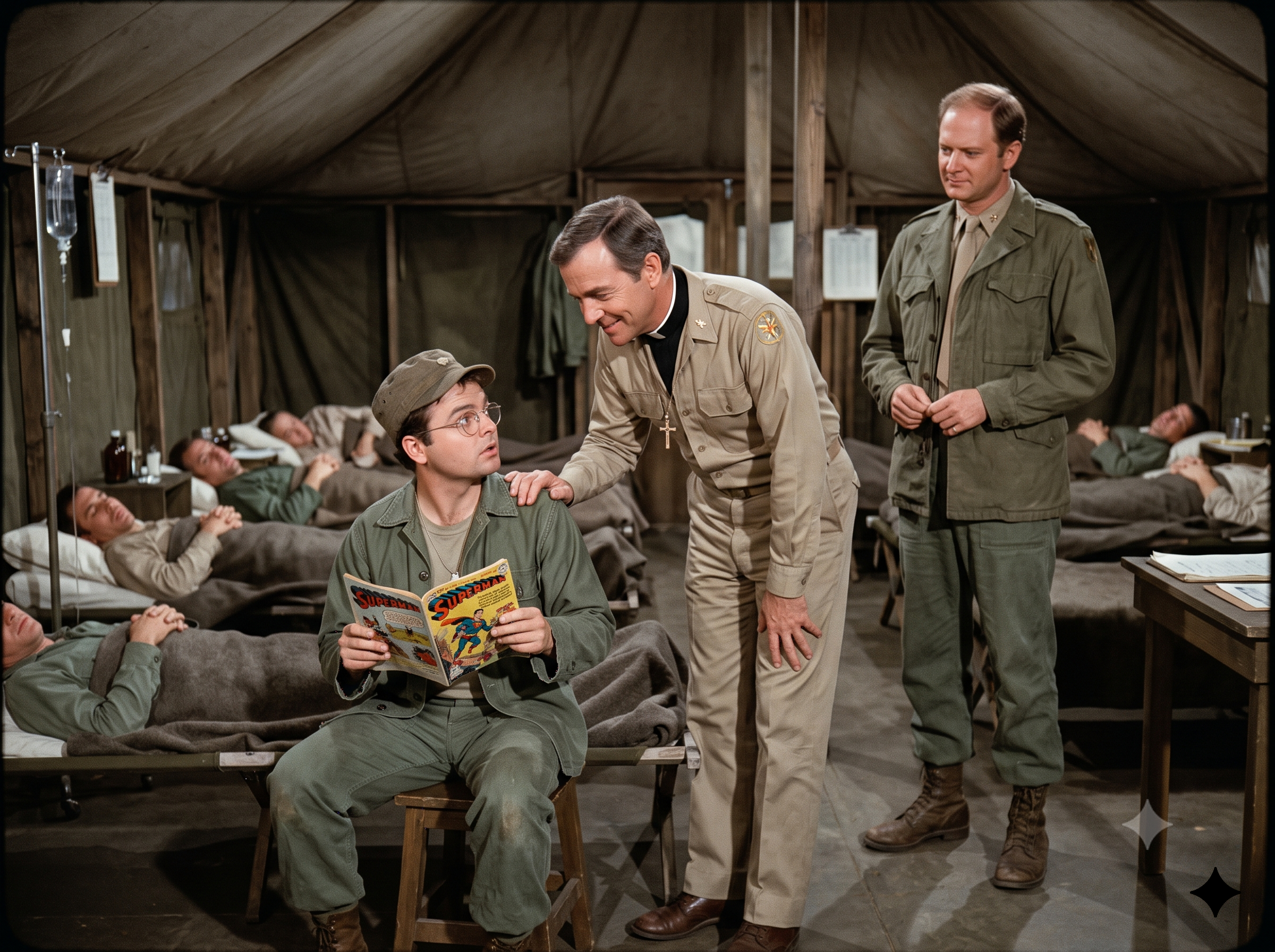
The silence in the Post-Op ward was heavier than a wet canvas tent in November. It was a dense, weary quiet, filled only by the rhythmic hum of life from dozens of sleeping patients. Occasionally, an IV drip would whisper or a tired body would shift under rough blankets.
In the middle of this stillness sat Corporal Radar O’Reilly. He was perched on a small wooden stool, his expression one of earnest, wide-eyed focus. His glasses were pushed up slightly on his nose, and he was completely absorbed.
Radar held a brightly colored Superman comic book, dated January 1952. His right hand rested on his knee, his posture surprisingly innocent amidst the surrounding machinery of war. His brow was furrowed, not in fear, but in deep concentration on the panel he was reading.
His nervous energy was palpable. He’d been sitting there for an hour, his small frame almost hidden beside the cot. This specific spot felt safer than the swamp. Closer.
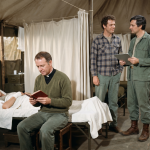
Standing just to his side was Father John Mulcahy. He was leaning forward, a warm, soft smile gracing his face. His right hand rested gently on Radar’s shoulder, a silent gesture of support and comfort. He didn’t speak, but his compassion filled the space around him.
Mulcahy watched Radar reading. He saw not a grown man in uniform, but a boy looking for solace. It was the same kind of earnestness he saw in the faces of soldiers when he offered them spiritual comfort. He understood the need for a hero, even one made of four-color ink.
Behind them stood Major Charles Emerson Winchester III. He maintained his impeccable, refined posture, looking down at Radar with a complex expression. It was a mix of sarcasm and controlled observation, but with an underlying hint of engaged compassion that he would never openly admit.
His hands were casually linked. To Charles, this scene was preposterous. “Reading a graphic novel to the afflicted? Only in this godforsaken swamp,” he thought to himself. Yet, he couldn’t quite bring himself to make a caustic comment or look away. The sheer innocence was fascinating.
Radar continued to read, his eyes moving across the pages. “…and then Superman flies in with the Green Lantern. And with a huge ‘KRASH!’ he smashes the evil scientist’s laboratory!” He slightly stumbled over some of the action-packed sound words.
The three of them stayed perfectly still, focused on the small event. The light from the bulbs was dim and tungsten-warm, creating soft shadows across the tents walls and their tired faces. No one else in the ward moved or seemed to notice them.
Suddenly, a cot in the near background shifted. A soft groan echoed through the ward. It was barely a whisper, but it sounded deafening in the silence. Radar’s eyes went wide. Mulcahy’s smile froze. Winchester took a sharp, almost imperceptible intake of breath.
For a brief, agonizing second, everything held. The tension was an invisible cord that pulled tight. Radar stopped mid-sentence, his heart hammering in his chest. Was someone awake? Would they be reprimanded? Had they made a noise? The three men waited, their gazes frozen on the source of the sound. The silence was back, and this time, it held a different kind of weight.
The rustle didn’t continue. The soft groan was just that—a noise in sleep, a weary body shifting in a dream. The relief in the small circle was so profound they almost sighed in unison. It was as if they had all been holding their breath for minutes, not seconds.
Father Mulcahy gave Radar’s shoulder another gentle squeeze, a silent affirmation that it was okay to breathe again. Radar’s eyes went back down to the comic, the nervous wide-eyed stare replacing the absolute stillness of before. He had been so sure they were about to get caught.
He managed a shaky, nervous little chuckle. “Gee, I thought that was Colonel Potter for a second, Father. He’s always telling me I read too many of these things.” He leaned slightly back, exhaling.
Mulcahy smiled softly, his hand remaining on Radar’s shoulder. “The good Colonel has his ways, Radar. But comfort comes in many forms. And hope can sometimes be found on the simplest of pages.” He spoke with quiet conviction.
Major Winchester adjusted his collar, a slight, refined hmph that hid a very subtle relief of his own. He was not, of course, worried about getting caught. He was simply concerned with decorum. “A brief interruption in the narrative is hardly cause for panic, Corporal. Although your dramatic delivery does lend itself well to an interruption.” He couldn’t help himself.
But his eyes betrayed him. The hidden humanity on his face was clear. He had seen the way Radar was reading, the sheer, innocent need for a moment of quiet focus. And he saw the profound tenderness of Father Mulcahy’s presence. It was the found-family warmth that he found so peculiar, so alien to his world, and yet, somehow, essential here.
The four-color Superman comic book seemed more than just a cheap comic now. It was a lifeline. It was a moment of connection to a world that was fast, clear, and where the line between good and evil was never blurry. Where heroes were powerful, and they always won.
Radar finished the page. He didn’t read it to a specific patient, but he read it for everyone in that Post-Op ward. The tired men in the cots around them. The doctors. The nurses. And especially for himself.
“I think I’m almost done, Father. Superman just saved Metropolis again.” Radar said, his voice quiet. The earlier nervous concentration was gone, replaced by a quiet sense of satisfaction.
Mulcahy gave a soft chuckle, but it wasn’t dismissive. “A worthy victory. We can all use a reminder that good can overcome, can’t we?“
Charles made a small, thoughtful sound, though it was probably closer to a refined cleared throat. “The enduring popularity of such a Paragon is… quite fascinating, psychologically speaking. The need for a hero when reality is far from simple.” He would never call it simple.
The comic was finished. Radar slowly closed the colorful book. He carefully folded it and tucked it back inside his field jacket. He sat for another minute, looking at the floor of the ward. The quiet returned, but it didn’t feel quite as heavy now.
It was a bittersweet but profoundly human moment. The shared worry, the hidden relief, the open tenderness, and the sophisticated skepticism that couldn’t hide genuine care. It was the heart of the 4077th.
Mulcahy finally removed his hand from Radar’s shoulder and gave him a final nod of reassurance. Radar got up from his stool and moved back towards the main administrative area. Winchester, with a final, dignified glance around, moved away.
The tent was back to its quiet state. But in that one cot, for a few minutes, a man of steel had made the Post-Op ward feel just a little bit safer, and a little bit more full of hope, a reflection of the small prayers that are spoken with a heart full of compassion and a few colorful pages. The image holds that peace. The knowledge that even in a war zone, heroes can be found in the most unexpected, four-color ways.
They say hope can be found anywhere, even inside a worn-out comic book and the silent prayer of a good friend.