A Quiet Assessment in the Dust
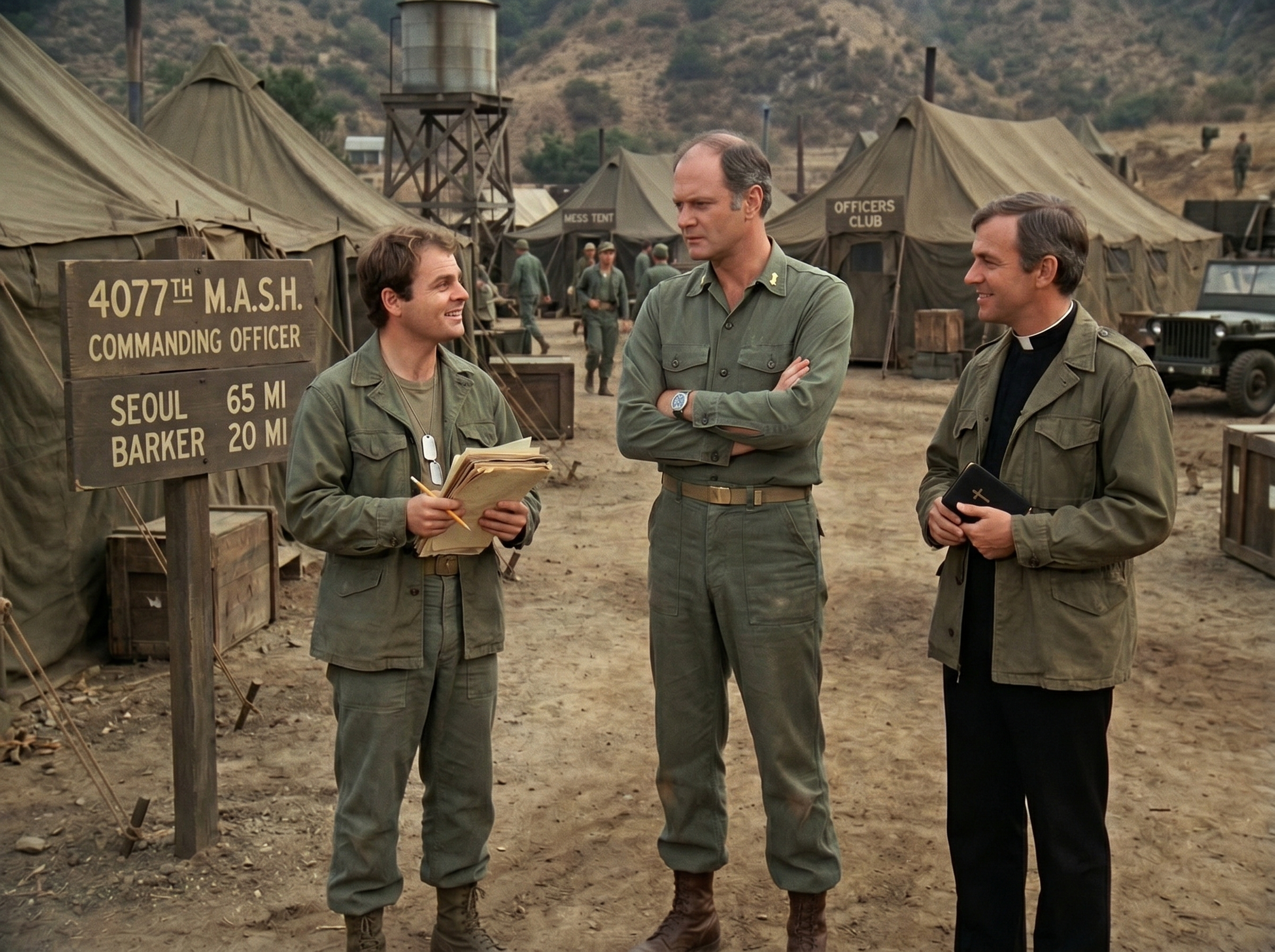
The dust of the 4077th had a way of settling into everything. It coated the olive-drab canvas of the tents, gathered in the grooves of the wooden signposts, and seemed to weave itself into the very fabric of the people stationed there. On a rare, quiet Tuesday afternoon, the outdoor compound was still. The medevac choppers were silent, the operating room was scrubbed, and the war felt, for a brief and precious moment, like a distant rumor.
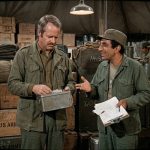
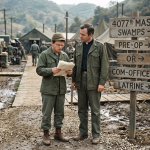
By the wooden signpost that proudly pointed the way to Seoul and Barker, Corporal Walter “Radar” O’Reilly stood his ground. He wore his slightly oversized green jacket, his dog tags resting against his plain undershirt. In his hands, he nervously clutched a thick, disorganized stack of manila folders and dog-eared papers.
Radar was smiling. It was an earnest, hopeful, and entirely terrified smile.
Standing directly in front of him, looking distinctly out of place in the middle of a Korean dirt path, was Major Charles Emerson Winchester III. Charles stood with immaculate, controlled posture, his arms crossed tightly over his chest. Even in rumpled Army fatigues, Charles carried himself as though he were wearing a bespoke tweed suit in a Boston drawing room.
Charles was looking down at the young corporal. One aristocratic eyebrow was raised in a look of profound, refined irritation.
“Let me be perfectly clear, Corporal,” Charles said, his baritone voice dripping with polite condescension. “I am a surgeon. I am an officer. I am not, however, a patron of whatever amateur theatrical production or farm-animal husbandry project you are currently peddling.”
“It’s not a project, Major,” Radar said, his voice squeaking just a little. “It’s an official requisition form. Sort of.”
A few feet away, Father Francis Mulcahy stood quietly observing the interaction. The chaplain held a small, black-bound book in his hands. He wore his standard issue field jacket over his clerical collar. A soft, genuine smile played on his lips.
Father Mulcahy knew exactly what was happening, and he was immensely, gently amused by the contrast between the two men.
“An ‘official requisition’ form,” Charles repeated, tasting the words as if they were spoiled caviar. He leaned forward slightly, his eyes narrowing at the messy stack of papers in Radar’s hands. “O’Reilly, I have read the Army manual. Cover to cover, in an agonizing fit of boredom last month. There is no official form for a ‘Voluntary Morale and Infrastructure Assessment.'”
Radar swallowed hard, his grip tightening on the papers and the chewed yellow pencil he held ready. He had typed the form himself that morning on Colonel Potter’s typewriter.
“Well, sir,” Radar stammered, looking up at the imposing major. “It’s a new directive. From I Corps. Very top secret. It’s an assessment, sir. A voluntary one. But highly recommended.”
Charles let out a long, theatrical sigh. He uncrossed his arms and pinched the bridge of his nose. “Corporal, I am fatigued. I have spent the last three days up to my elbows in the tragic results of human folly. Do not insult my intelligence by asking me to fund your latest scheme to buy grape Nehi by the barrel.”
“It’s not for Nehi, sir!” Radar said, his farm-boy earnestness breaking through his nervous facade. He held the clipboard out a fraction of an inch further. “It’s for the orphans, Major.”
Charles froze. His eyes flicked from the clipboard to Radar’s desperately hopeful face. The tension in the dusty air suddenly shifted, growing heavier, quieter, and deeply uncertain.
“The orphanage roof collapsed yesterday, sir,” Radar continued softly, losing all his bureaucratic bluffing. “Father Mulcahy told me. They need fifty dollars for corrugated tin before the monsoon rains start. I’m asking all the officers to pitch in.”
Charles stared at the boy. He slowly lowered his hands. His face darkened into a hard, unreadable expression. He stepped closer to Radar, his voice dropping to a dangerously quiet register.
“Corporal,” Charles whispered softly. “Are you attempting to extort a field grade officer of the United States Army with forged documents?”
Radar physically shrank back. His knuckles turned white around the clipboard. He looked frantically toward Father Mulcahy for help.
Father Mulcahy immediately stepped forward, his gentle amusement vanishing, replaced by genuine concern. He knew Charles could be fiercely protective of his dignity, and he didn’t want Radar to suffer for trying to do a good deed.
“Now, Major,” Father Mulcahy said soothingly, placing a gentle hand on Charles’s elbow. “Please, don’t be harsh with the boy. Walter was merely trying to be helpful. I assure you, I knew nothing of this… creative administrative effort.”
Charles looked at the chaplain. He saw the deep, lingering exhaustion in Father Mulcahy’s eyes. He saw the fraying cuffs of the priest’s jacket, and he knew, without a doubt, that Mulcahy had likely given his last dollar to the very same orphans weeks ago.
Then, Charles looked back at Radar. The young man looked like he was about to face a firing squad, yet he stubbornly refused to lower the clipboard.
For a long, agonizing moment, the only sound in the compound was the distant, lonely wind rattling the canvas of the mess tent.
“Father,” Charles said finally, his tone entirely unreadable. “Am I to understand that your… flock… is currently exposed to the elements?”
“Well, yes, Charles,” Father Mulcahy admitted quietly, looking down at his small book. “The Sisters are doing their best with canvas tarps, but it won’t hold if the rains come in earnest. But truly, we will manage. The Lord provides.”
“The Lord,” Charles replied dryly, “is notoriously slow with building materials.”
Charles reached out and snatched the clipboard from Radar’s trembling hands. He glared at the poorly typed form. There were three misspellings in the first paragraph alone.
“This is an outrage, O’Reilly,” Charles muttered, shaking his head. “The spelling of ‘infrastructure’ is a crime against the English language. And the formatting is nothing short of a tragedy.”
“I’m sorry, sir,” Radar whispered, looking at his boots. “I was typing fast.”
Charles held out his other hand. “Give me the pencil, Corporal.”
Radar quickly handed over the chewed yellow pencil. Charles looked at it with profound disgust, holding it between two fingers as if it were contaminated.
“I am a Winchester,” Charles announced to the dusty air, his voice regaining its usual aristocratic volume. “We do not participate in voluntary assessments. We do not pitch in.”
He placed the clipboard against the wooden signpost. He pressed the pencil to the paper.
“However,” Charles continued, speaking clearly as he wrote. “I find the concept of children singing off-key in the rain to be incredibly grating on my nerves. It disrupts my appreciation of Mozart.”
Radar watched in stunned silence. Father Mulcahy smiled again, a warm, knowing light returning to his eyes.
Charles signed his name with a flourish. He then reached into the breast pocket of his green shirt and pulled out a crisp, neatly folded piece of paper. It was a cashier’s check from a Boston bank.
He handed the check and the clipboard back to Radar.
Radar looked down at the paper. His eyes widened. It wasn’t fifty dollars. It was substantially more. Enough for a roof, new blankets, and perhaps a decent stove.
“Major…” Radar breathed, looking up in sheer shock. “Sir, this is…”
“A bribe, Corporal,” Charles interrupted sharply, pointing a stern finger at Radar. “I am simply purchasing an investment in my own peace and quiet. You will ensure that those children remain completely silent and out of my sight. Do I make myself clear?”
“Yes, sir!” Radar beamed, a massive, brilliant smile breaking across his dusty face. “Loud and clear, sir. Total silence. Best roof money can buy.”
“See that you do,” Charles sniffed. He adjusted his collar, his immaculate posture returning in full force.
He turned to the chaplain. “Father. I expect you to oversee this construction. I will not have my funds squandered on substandard Korean tin.”
“Of course, Charles,” Father Mulcahy said, his voice thick with quiet emotion. “I will personally guarantee the quality of the tin. And… thank you. You are a very kind man.”
“Nonsense, Father,” Charles scoffed, turning on his heel. “I am simply a man who values proper acoustics. Good day to you both.”
Charles Emerson Winchester III walked away, his head held high, looking every inch the Boston aristocrat as he navigated the muddy, rutted path of the 4077th.
Radar stood by the signpost, staring at the check in his hand. He let out a long, shaky breath. “Gosh. He really is something, isn’t he, Father?”
Father Mulcahy looked after the departing major. He hugged his small black book to his chest, the warmth of the moment chasing away the chill of the camp.
“Yes, Walter,” Father Mulcahy said softly. “He truly is.”
The wind blew through the compound again, kicking up a small cloud of dust, but for a moment, the war felt a million miles away.
In the middle of the madness, the finest moments of grace were often hidden behind a neatly folded check and a stubbornly gruff exterior.