The Smell of Peppermint and Gin in the Mud
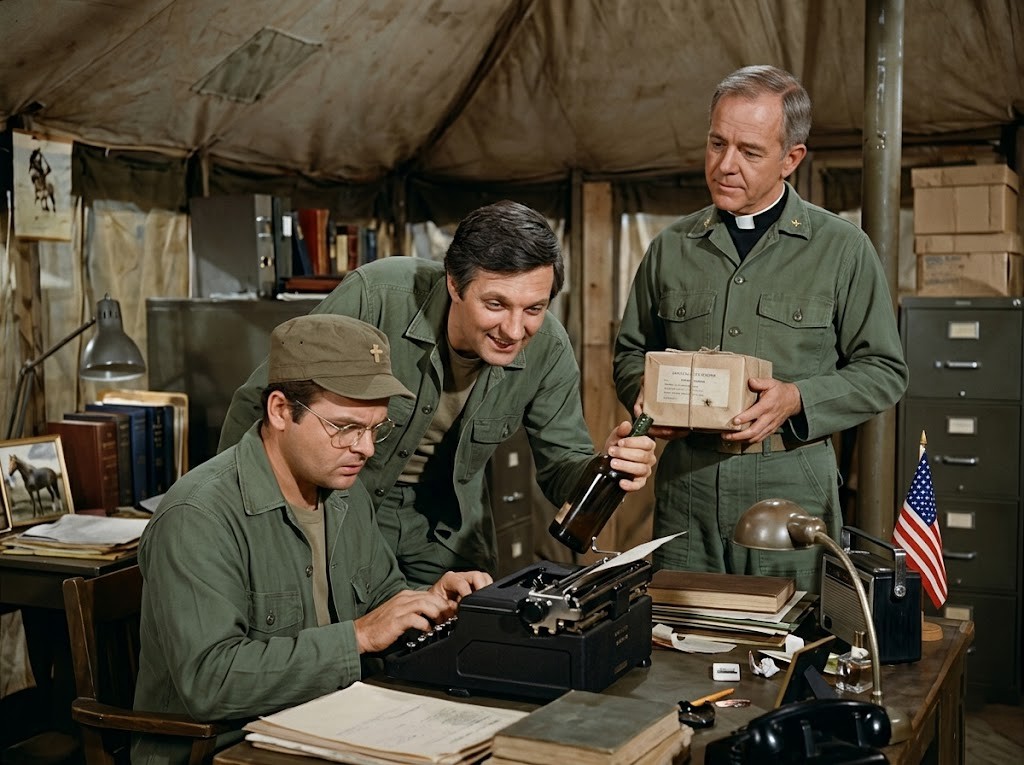
The rhythmic clack-clack-clack of Radar’s typewriter was the only thing keeping the silence at bay.
The afternoon sun was beating down on the canvas roof of the Colonel’s office tent. It created a strange, golden haze that smelled of old paperwork, dry earth, and desperation.
You could almost feel the collective fatigue of the entire 4077th weighing down on that tent. It was a found-family, forged in the fires of endless shifts, now just waiting for the next bus of wounded.
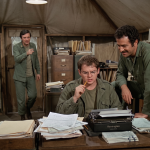
Radar O’Reilly was glued to his chair, sweat beading on his upper lip. His glasses were sliding down his nose, and he was furiously pecking away at a supply manifest.
“He’s got it, doesn’t he?” Hawkeye Pierce’s voice was too loud, too sharp for the stillness. It arrived before he did.
Hawkeye practically spilled into the tent, wearing that grin that was part medicine-show barker, part tired surgeon just needing a laugh. He looked right over Radar’s shoulder.
But Hawkeye wasn’t empty-handed. His left hand was holding, quite casually, an open glass bottle of dark, questionable liquid. It looked like the kind of bootleg spirit that could either cure you or make you forget you needed curing.
He wasn’t drinking it. He was just… holding it. Like a talisman against the reality outside the tent flaps. His eyes were bright, playful, and completely focused on the second figure in the tent.
Father Mulcahy was standing near the filing cabinet, observing the scene with that quiet, infinite patience. He looked like he was about to give the bottle a priestly blessing just to neutralize it.
Mulcahy had his own bundle to worry about. It was a modest brown cardboard package, held carefully in both hands. It was the same package Hawkeye had been trailing him about since the morning mail run.
Radar tried to ignore them, focusing on the manifest. But he could *feel* Hawkeye’s grin. It was radiating warmth and potential trouble.
Hawkeye had that specific look he got when he was about to deliver a truly terrible pun or a profound truth, and he hadn’t decided which one it was yet.
“Tell me the truth, Father,” Hawkeye said, leaning in toward Mulcahy with mock seriousness. “Are you holding out on us?”
Mulcahy just smiled, a small, weary curve of his lips. “Captain Pierce, I assure you, this is simply a small gift from my sister. The convent back in Maine.”
“Ah, the convent,” Hawkeye nodded, tapping the liquor bottle against his palm. “Where the only thing stronger than their faith is their peppermint candy, right?”
“It is, indeed, peppermint,” Mulcahy conceded, his voice gentle. He glanced at the package in his hands as if he could see through the cardboard. “Sister Theresa sends it every autumn. It reminds me… of the cold, crisp air. And the changing leaves.”
The tension in the room was delicate, like old lace. Radar was typing, trying to ignore them. Hawkeye was holding alcohol in the Colonel’s office. And the Father was guarding a secret box of sugar.
It was a standoff of small comforts. A quiet battle over who got to have a fleeting moment of peace.
“So we have a choice,” Hawkeye said, his voice dropping to a theatrical whisper. “The liquid warmth in my hand, which may, in fact, be kerosene…” He looked at the bottle thoughtfully.
“Or,” Hawkeye continued, looking at Mulcahy. “The solid warmth of peppermint, which you are holding onto like a life raft in a sea of bad coffee.”
The three men stood locked in that silent, complicated triangle of friendship and fatigue. The sound of the typing continued, but now it was slower, as if Radar was listening with his fingers.
It was an everyday scene. A small, forgettable moment in a very long war. But the air in the tent felt suddenly fragile.
This wasn’t about gin or candy. This was about home. It was about the distance—in miles and memory—that separated this dusty tent from the simple things that once defined who they were.
“Come on, Father,” Hawkeye urged, his voice softening slightly. “What’s inside? For the morale of the entire staff. A small mercy.”
Father Mulcahy hesitated. He looked at Radar, then at Hawkeye. He seemed to make a decision.
He raised the package slightly, ready to say more. His eyes held a quiet, meaningful look. It was the look he gave when he was about to explain a complex moral paradox in the middle of pre-op.
Just then, the sound of heavy boots hitting the wooden planking outside stopped everyone cold. A familiar, commanding shadow fell across the doorway. Radar froze, his fingers hovering over the keys.
Colonel Potter had arrived. And Part 1 ends right there, as the door begins to open.
Colonel Potter didn’t just walk into a room; he commanded it, even when he was just looking for a cup of coffee. He was an officer who understood that his authority rested not on fear, but on wisdom and a genuine care for his unit.
His eyes swept the tent in a single second, cataloging everything. Radar, frozen at the typewriter. Hawkeye, holding contraband. Mulcahy, with his precious package.
Potter’s face remained a mask of dry, experienced calm. He looked like a man who had seen everything twice and was ready for a third viewing. He didn’t yell. He didn’t issue commands. He just stood there.
“Gentlemen,” Potter said, his voice like dry gravel. It was the longest silence of their lives.
Hawkeye, never a man to be silent for long, used his wit like a shield. He held up the bottle in a small salute. “Welcome to the… uh… inventory control seminar, Colonel. We were just comparing the viscosity of Father Mulcahy’s faith against the chemical composition of this local anti-freeze.”
Potter’s gaze shifted to the bottle. He stared at it for a moment, then back at Hawkeye. There was no anger in his eyes, just an infinite exhaustion.
“And what did you determine, Captain?” Potter asked, his voice unexpectedly quiet. He wasn’t playing along. He was just tired.
Hawkeye looked at the bottle, then at Mulcahy. His smirk, usually so easy and confident, suddenly felt fragile. The humor evaporated, leaving behind only the fatigue and the shared, silent acknowledgement of why they were all here.
“We determined, Colonel,” Hawkeye said, his voice dropping an octave, “that the anti-freeze wins in viscosity, but loses terribly in soul-saving ability.”
Radar released a small, shaky breath he didn’t know he was holding. He pushed his glasses back up his nose and stared at his typewriter, the manifesto forgotten.
Mulcahy stepped forward, breaking the silent truce. He didn’t try to hide the package. He held it up, offering it.
“Actually, Colonel,” Mulcahy said, his voice steady. “We were discussing the virtues of memory. This package arrived from my sister’s convent. Peppermint sticks. Sister Theresa believes they have curative properties for the spirit.”
Potter looked at the package. A small, almost invisible softening came to his face. He nodded once, a gesture that was more fatherly than officer-like.
“I have no doubt she is correct, Father,” Potter said.
Mulcahy smiled and placed the package gently on Radar’s desk, right beside the typewriter. “Radar, perhaps you could assist with the distribution to the staff? It will do more good than this manifest.”
Radar looked at the package as if it were a fragile bird. He was still processing the fact that he wasn’t going to get yelled at.
“Uh, yes, Father. Absolutely. I can type a memo about the curative properties, I suppose,” Radar said, his voice finding its footing.
Hawkeye, in a rare act of quiet contrition, placed the bottle of questionable alcohol on Potter’s desk. He didn’t joke this time.
“Here’s to the spirit, in all its forms,” Hawkeye murmured. “Both the kind you drink and the kind you can only dream about.”
Potter didn’t touch the bottle. Instead, he reached for the peppermint sticks on Radar’s desk. He picked up the entire bundle, holding it for a moment, letting the sweet, clean smell fill the humid air of the tent.
“They smell like autumn in Missouri,” Potter said. He didn’t even realize he had said it out loud. He was lost in a memory, the simple scent connecting him to a world that felt impossibly far away.
The tent was quiet. It wasn’t the silence of fear, but the shared silence of nostalgia. For a moment, they weren’t in Korea. They were all back home, separated by hundreds of miles but united by a shared longing.
Potter then began to unwrap the twine, his movements methodical and slow. He broke the first stick of peppermint, the sound of the snap loud and clear.
“This is the sort of medicine we all need,” Potter said, handing a piece of the red-and-white-striped candy to the Father.
Mulcahy took the peppermint with a small, grateful nod. He looked at the candy like it was a sacred relic. “A taste of simplicity,” he said, and he popped it into his mouth.
Hawkeye received his piece next. He didn’t say anything witty. He just took it and held it. He was looking out the tent door, past the mud, past the endless tents, past the war itself.
“The convent doesn’t make bad candy, Father,” Hawkeye said quietly, his gaze fixed on the distance. “It might just cure me of my cynical soul yet.”
Radar, of course, was typing again, but his heart was in it now. He was typing the letters of appreciation, a letter from the Father to the convent, thanking them for a gift that was more valuable than penicillin.
Potter took the last piece, popping it into his mouth and leaning against his desk. He looked at the three men. The tension, the humor, the quiet reflection—it was all part of the daily life of the 4077th.
“Alright, gentlemen,” Potter said, his voice regaining its command, but with a softer edge. “We’ve had our moment of spiritual fortification. Now let’s get back to the business of keeping these kids alive.”
The clack-clack-clack of the typewriter resumed, faster now, a steady rhythm of work and purpose. Hawkeye began to pace, his mind shifting back to medicine. Father Mulcahy went back to the paperwork on his own desk.
The scent of peppermint remained in the warm air, mingling with the old canvas and paper. It was a fleeting, sweet reminder that even in the mud of Korea, a taste of home, a shared memory, and the loyalty of a found family could make the long days bearable.
In the end, it wasn’t the booze or the candy that saved us, but the shared quiet moment that reminded us who we were.