The Floral Requisition
The 4077th Mobile Army Surgical Hospital ran on three very specific forms of fuel: lukewarm black coffee, terrible jokes, and a truly staggering amount of military paperwork.
It was a quiet Tuesday afternoon, or at least, what passed for quiet in the middle of a war zone. The dust was settling over the compound, painting the tents, the jeeps, and the people in endless shades of tired beige and canvas tan. In the distance, the faint, rhythmic thumping of chopper blades was thankfully absent.
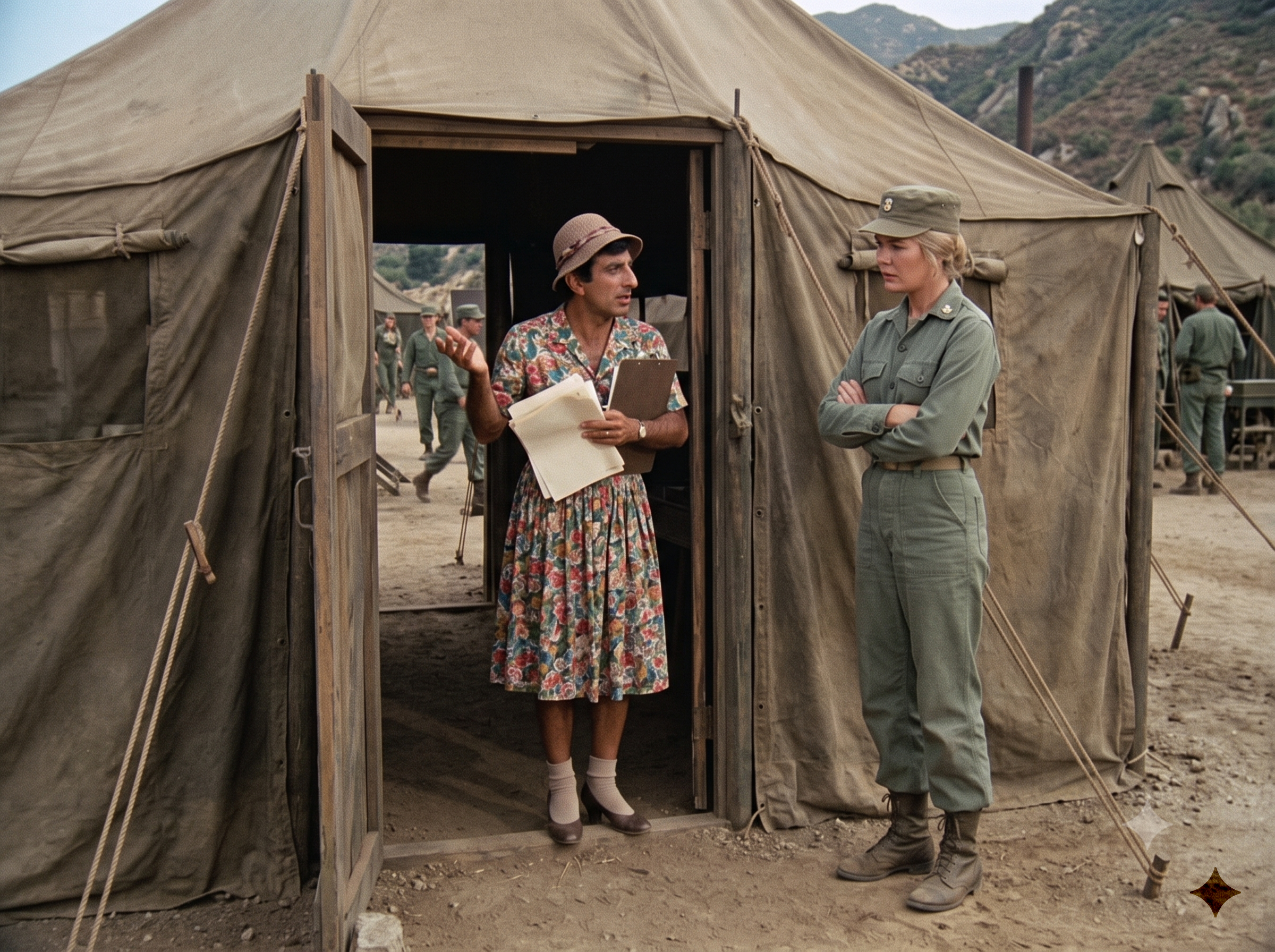
Major Margaret Houlihan stood just outside the doorway of the nurses’ tent, trying to steal a rare, three-minute moment of peace. Her green fatigues were dusty, her blonde hair was tucked neatly under her cap, and her arms were crossed tightly against her chest. Her face was set in a familiar mask of controlled exhaustion.
She was a regular army nurse trying to hold the line in a camp that actively defied military order every single day. She was bone-tired. They had been in surgery for eighteen hours straight the night before, and all she wanted was to close her eyes without seeing the harsh glare of the overhead lamps.
Then, right on cue, the absolute antithesis of military order appeared in her doorway.
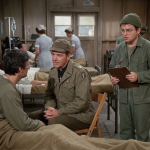
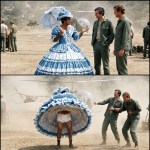
Corporal Maxwell Klinger didn’t just walk into a scene; he manifested into it. Today, his grand entrance involved a vibrant, ankle-length floral summer dress that looked like it had been stolen from a Midwestern Sunday social. To top it off, he wore a woven straw hat pulled slightly low, and a pair of sensible, practical flats perfectly unsuited for the Korean dirt.
But it wasn’t the outfit that made Margaret narrow her eyes and sigh. It was the wooden clipboard he was clutching to his chest like a wounded bird.
“Major Houlihan,” Klinger began, his voice dripping with theatrical, exaggerated tragedy. “I come to you a broken woman. A victim of the cruel, unfeeling machinery of the United States Army.”
Margaret didn’t uncross her arms. She kept her posture rigid, projecting the stern, unyielding authority that had earned her the famous nickname. But right now, beneath the armor, she just felt tired.
“I don’t have time for a matinee today, Klinger,” she said, her voice sharp but lacking its usual biting edge. “The OR is backed up, my nurses are exhausted, and I am not signing another requisition for a sequined feather boa from Tokyo.”
Klinger gasped, throwing his free hand into the air in a magnificent gesture of profound offense.
“A feather boa? Major, you wound me to my very core. You insult my dignity, my fashion sense, and my current plight.” He stepped closer, the bright floral fabric swishing loudly against the dusty canvas of the tent flap. “This is a matter of basic human rights. A formal grievance against the narrow-minded quartermaster down in Seoul.”
He thrust the clipboard forward, holding it out with a look of tragic, unyielding defiance.
Margaret stared at him, caught somewhere between utter exasperation and a grudging respect for his relentless commitment to the bit. She really didn’t want to play this game today. She just wanted to go inside, sit on a cot that didn’t sag straight to the floorboard, and close her aching eyes.
“Whatever wild scheme this is, Klinger, take it to Captain Pierce. He has an endless appetite for your nonsense.”
“Captain Pierce is a civilian in a uniform, Major,” Klinger countered, his tone suddenly dropping its theatrical pitch just a fraction. “This requires the signature of a regular army officer. Someone with actual authority. Someone with… clout.”
Margaret hesitated. That was a new tactic. With a heavy, dramatic sigh that carried the weight of three back-to-back surgical shifts, she finally uncrossed her arms and snatched the clipboard from his hands.
“If this is a request to be sent back to Toledo because you’re suddenly allergic to khaki, I am putting you on latrine duty for a month.”
She looked down at the typed forms attached to the board. She prepared herself for the punchline, for the absurd claim of madness, for the inevitable headache.
But as her eyes scanned the top line of the document, the sharp reprimand died completely in her throat. Her eyes widened slightly, and she darted a look back up to Klinger’s face, searching for the joke.
There was no joke.
Margaret stared down at the clipboard in her hands, her professional mask slipping just a fraction of an inch.
The paperwork was an official military supply requisition form, stamped, dated, and formatted with perfect army precision. But it wasn’t a grievance. It wasn’t a rambling request for a psychiatric discharge.
The top line, typed neatly in black ink, read: “Emergency Requisition: Heavy-Duty Theatrical Canvas, Wool Linings, and Structural Supports for USO Production.”
Margaret frowned and read further down the page. The requested dimensions for the “structural supports” were an exact, to-the-inch match for the broken, splintering frames of the cots in the nurses’ tent. The “wool linings” requested were actually high-grade military thermal blankets, cleverly disguised on paper as costume materials for a winter play.
And the “heavy-duty canvas”? It was the exact yardage needed to finally patch the gaping, drafty holes in the roof of the post-op ward.
She read the list a second time to be sure. Every single item on the page was something her nurses desperately needed to survive the brutal incoming Korean winter. These were the exact supplies the regular army supply chain had repeatedly denied them for weeks, claiming shortages and prioritizing combat units over medical staff.
Margaret looked up slowly. Klinger was still standing there in his floral summer dress, one hand resting indignantly on his hip, the absolute picture of wounded dignity. But beneath the brim of his straw hat, his dark eyes were entirely serious.
“Klinger…” she started, her voice unusually soft, devoid of its usual military bark. “What exactly is this?”
“It’s an absolute outrage, is what it is, Major,” Klinger announced loudly, projecting his voice for the benefit of anyone walking past the tent. “The supply depot in Seoul refuses to respect the delicate artistic needs of the 4077th. How am I supposed to stage a convincing production of ‘A Streetcar Named Desire’ without proper winter staging materials?”
He took a half-step closer to her. When he spoke again, he lowered his voice so only she could hear the truth beneath the act.
“The supply sergeant down there is a massive theater nut, Major. He absolutely won’t authorize medical blankets. Says there’s a strict shortage.” Klinger gave a small, knowing, distinctly Toledo shrug. “But he’ll bend over backwards to support the arts for the boys at the front. All he needs is a senior officer’s signature to verify that the requisition is for official camp morale.”
Margaret stood perfectly still, letting the dusty wind tug gently at the edges of her cap. She looked at the man standing in front of her in a ridiculous, ill-fitting dress.
She thought about her nurses shivering through the night on broken cots, huddling together for warmth. She thought about the absurd, exhausting lengths they all had to go to just to survive this terrible war. The sheer madness of it all constantly threatened to overwhelm her.
But right here, right now, the madness was working in their favor.
A sudden, thick lump formed in her throat. It was a wave of fierce, unexpected affection for this strange, chaotic camp and the deeply flawed, wonderful people in it. She quickly swallowed it down. Major Margaret Houlihan, regular army, did not cry in front of enlisted men.
“Corporal,” Margaret said, clearing her throat and letting her tone return to a crisp, authoritative snap. “This form is highly irregular.”
“Yes, Ma’am,” Klinger replied instantly, his face a perfect, unblinking mask of innocence. “Great art is rarely regular.”
“If Colonel Potter finds out we are falsifying official army supply requests for… theatrical productions… there will be hell to pay.”
“I will take full responsibility, Major. I will gladly face the firing squad. I’ll even write a beautiful, tragic monologue about it.”
Margaret looked down at the typed clipboard one last time. She reached into the breast pocket of her dusty green fatigues and pulled out her silver fountain pen. With a swift, decisive motion, she uncapped it and pressed the pen to the paper, signing her name boldly at the bottom of the page.
Major Margaret Houlihan, Head Nurse.
She handed the clipboard back to him, keeping her expression firmly and professionally neutral.
“See to it that your ‘staging materials’ are delivered directly to the nurses’ tent upon arrival, Corporal. We will… store them for you securely. Until your production is ready.”
Klinger took the clipboard, holding it gently. A genuine, warm smile broke through his theatrical pout, softening the harsh lines of his tired face.
“Thank you, Major. The global theater community owes you a great debt.”
He turned to leave, his floral skirt swishing heavily over the dry dirt path.
“And Klinger?” Margaret called out.
He paused mid-stride, glancing back over his shoulder. “Yes, Major?”
A tiny, barely visible smile played at the very corners of Margaret’s mouth. “Next time you try to pull a fast one on a regular army officer, make sure your slip isn’t showing.”
Klinger gasped, genuinely scandalized this time. He quickly dropped his hand, smoothing down his skirt and adjusting the hem with frantic, offended movements.
“A true gentleman would never point that out in mixed company, Major!” he huffed. He tipped his woven straw hat in an exaggerated, sweeping bow.
With a final dramatic sigh, he marched away down the dusty compound path, a bright splash of floral color against the endless, drab army canvas.
Margaret stood in the canvas doorway and watched him go. She crossed her arms against her chest again, but this time, the heavy tension in her shoulders was completely gone. She took a deep, steadying breath of the dry Korean air.
It was a terrible place, full of terrible noise, exhaustion, and endless heartbreak. But as she turned back into the dark tent, knowing her nurses would finally sleep warm by next week, she realized something profound.
She wouldn’t want to be anywhere else in the world.
Sometimes the greatest heroes of the 4077th didn’t wear shining armor; they wore floral prints and a fierce, unspoken loyalty to their own.