The Weight of a Dial Tone
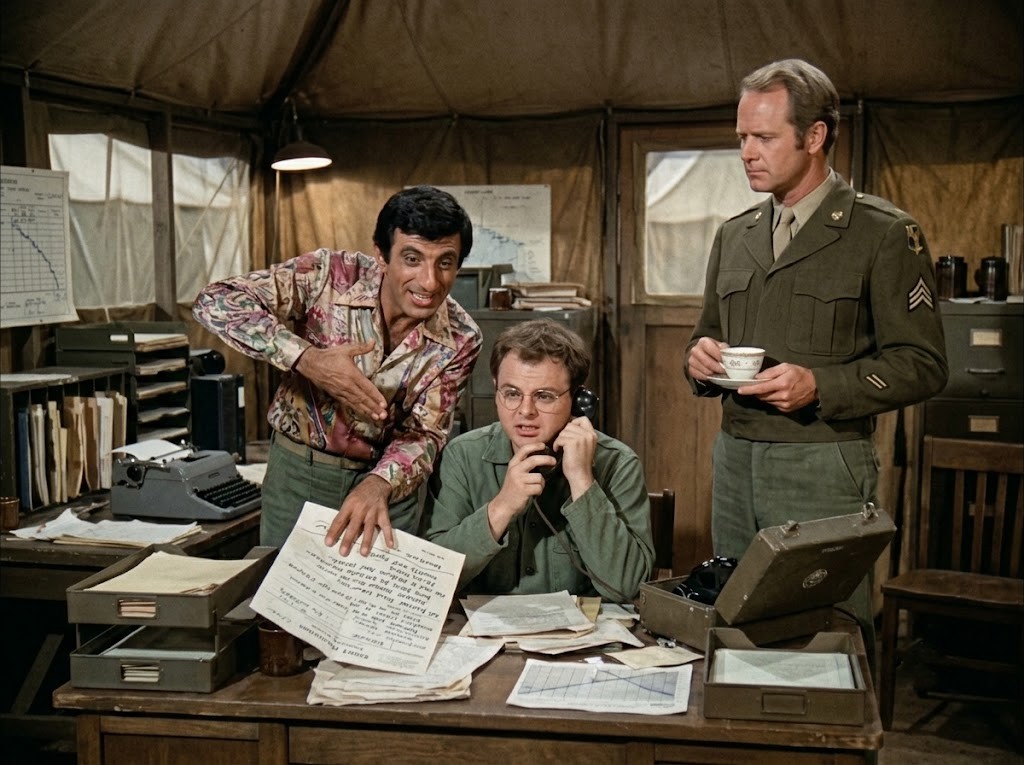
The line between Tokyo and the 4077th was always held together by little more than copper wire and Radar O’Reilly’s sheer willpower. Some days, the static was so loud you could hear the curvature of the earth. On this particular Tuesday, the static felt heavy, carrying a silence that nobody in the clerk’s office wanted to interpret.
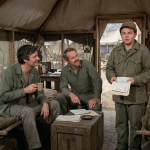
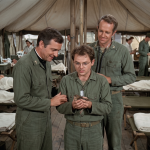
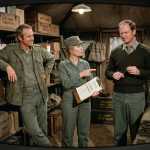
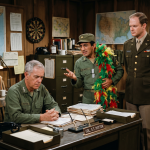
Radar sat hunched over his desk, the black telephone receiver pressed so hard against his ear his knuckles were turning white. His eyes, usually wide with innocent wonder, were fixed on a crumpled manifest sheet.
Beside him, Klinger leaned in, his usual theatrical bravado replaced by an anxious, hovering energy. Today he wasn’t in a gown; he wore a loudly patterned, multi-colored silk shirt, gesturing wildly at the fine print on the page as if his hand movements could somehow guide the signal across the sea.
Standing just on the other side of the desk was B.J. Hunnicutt, looking remarkably composed in his clean olive drabs, holding a fragile porcelain teacup and saucer. But B.J.’s steady gaze wasn’t on his tea. It was locked on Radar’s face, watching for the slight twitch of the lip or the drop of the jaw that signaled bad news.
The whole camp had been waiting three weeks for this specific shipment. It wasn’t penicillin, and it wasn’t fresh plasma—the regular supply lines handled those with standard military indifference. This was a single crate from San Francisco, misrouted three times through the labyrinth of the Army Service Forces. Inside were hand-drawn cards, taped-up recordings of familiar voices, and small, irreplaceable fragments of home meant for a dozen different homesick souls.
“Come on, Radar, talk to me,” Klinger whispered, his voice uncharacteristically low. “Is the clerk in Seoul still breathing, or did he fall asleep on the ledger again?”
Radar didn’t answer right away. He tapped his finger against the paper, his brow furrowing deeper behind his thick lenses. He squinted at the faded ink on the manifest, trying to connect the numbers typed by a bored clerk in California to the reality of a muddy compound in Korea.
B.J. took a slow sip of his tea, the ceramic clinking softly against the saucer. “What’s the word, Radar? Did it make it to the docks at Incheon, or are Peg’s letters currently floating somewhere near Midway?”
Radar held up a single, trembling finger, silencing the room. The faint, rhythmic *crackle-pop* of the long-distance line leaked out of the earpiece, sounding like dry leaves burning in an autumn wind.
Suddenly, Radar’s expression hardened. His eyes darted from the paper up to B.J., then over to Klinger. The color drained from his cheeks just enough to make the freckles stand out like ink spots.
“Sir,” Radar whispered into the receiver, his voice cracking slightly. “Sir, please don’t hang up. Look at the serial number again. It’s four-zero-seven-seven. We’re the M*A*S*H unit. We’re the ones who…”
He stopped. The voice on the other end said something sharp, loud enough for B.J. to hear the harsh metallic vibration from a foot away. Radar closed his eyes, his mouth dropping open as the line suddenly went dead with a cold, flat click.
—
The silence that followed a dropped military line was a specific kind of torture. It wasn’t just the absence of sound; it was the sudden, violent reminder of how many thousands of miles of ocean lay between a canvas tent and everything that mattered.
Klinger froze mid-gesture, his hand hovering over the desk like a stopped clock. “Radar? Don’t look at me with those orphan eyes. Tell me he didn’t just hang up on you.”
Radar slowly lowered the receiver but didn’t put it back on the cradle. He looked at the manifest sheet in his left hand, his fingers tightening until the paper groaned. “He said the crate was marked redundant. He said it was left on the tarmac during the rainstorm on Monday.”
B.J. set his teacup down on the edge of the desk with a precise, deliberate care that hid the sudden knot in his stomach. “Left on the tarmac? Radar, those are paper recordings. If they got wet, the cardboard backing turns to mush. The tape stretches.”
“I know, Beej,” Radar said softly, looking down at his boots. “I told him. I told him there were photographs in there. I told him Captain Hunnicutt has a little girl who drew a picture of a pony that’s supposed to be in that box.”
The office felt incredibly small just then. The typewriter sat silent in the corner, a half-typed morning report sticking out of the roller like a white flag. Outside, the distant hum of a generator kept time with the heavy thumping of their own hearts.
Klinger straightened up, pulling at the collar of his flamboyant shirt. The humor had drained completely from his face, leaving behind the street-smart kid from Toledo who couldn’t bear to see his friends take another hit. “Listen to me, kid. You ring ’em back. You tell ’em you’re calling on behalf of Colonel Sherman T. Potter, and if that crate isn’t on the next jeep out of Seoul, the Colonel will personally fly to Tokyo and turn their supply depot into a bowling alley.”
“I can’t, Klinger,” Radar mumbled, his voice thick. “The switchboard in Seoul is jammed up with tactical reports. It took me four hours just to get this line.”
B.J. walked around the desk, placing a hand gently on Radar’s shoulder. He could feel the tension radiating through the young sergeant’s olive-drab jacket. “Hey. Look at me, Walter.”
Radar looked up, his eyes swimming slightly behind his spectacles.
“You did everything you could,” B.J. said, his voice dropping into that warm, steady register that had calmed a hundred bleeding men on the operating table. “We all know how hard you fight for us. If the army found a way to drown a box of memories in a rainstorm, that’s on them. It’s not on the kid from Iowa.”
Radar swallowed hard, nodding, though his shoulders remained slumped. He carefully placed the receiver back onto its black cradle, the finality of the sound echoing through the tent.
Just then, the screen door banged open. Hawkeye Pierce slouched into the office, his purple bathrobe trailing in the dust, a half-eaten piece of toast in his hand. He looked at the three of them—Klinger still holding his breath, B.J. standing guard over Radar, and Radar looking like he’d just lost his best friend.
“Well, aren’t we a cheerful portrait of military optimism,” Hawkeye said, taking a bite of the toast. “What happened? Did the Pentagon pass a law outlawing sarcasm? Or did Winchester finally find a mirror he didn’t like?”
“The San Francisco crate,” Klinger said quietly. “It got soaked on the runway in Seoul. The letters from home are probably paper mache by now.”
Hawkeye stopped chewing. The easy, cynical grin vanished from his face, replaced by that quiet, fierce exhaustion that always lurked just beneath his wit. He looked at B.J., whose eyes gave a tiny, defeated flick toward the floor.
Hawkeye walked over, tossed the remainder of his toast into the wastebasket, and leaned his hip against Radar’s desk. He didn’t offer a joke. He just reached out and tapped the rim of Radar’s eyeglasses, pushing them gently back up the bridge of the boy’s nose.
“You know,” Hawkeye said, his voice surprisingly soft, “my father once wrote me a letter during my residency. He dropped it in a puddle right outside the Crabapple Cove post office. By the time it got to me in Boston, half the ink was washed away. I could only read every third word.”
Radar blinked up at him. “What did you do, Captain?”
“I invented the rest,” Hawkeye said, a faint, bittersweet smile touching the corners of his mouth. “And frankly, the version I made up was much more poetic than anything my old man actually wrote. He probably just wanted to tell me the tractor broke again.”
B.J. let out a short, breathy laugh, the tension in the room finally fracturing. He picked his teacup back up, the porcelain warm against his palm. “So what you’re saying, Pierce, is that I should just assume Peg wrote me a twenty-page sonnet about the joy of fixing the kitchen plumbing?”
“Exactly,” Hawkeye said, clapping B.J. on the back. “And Radar here will write a formal complaint to the United States Army stating that their rain lacks proper military discipline.”
Radar managed a small, genuine smile, pulling his manifest closer and folding it neatly into his pocket. He looked around at the three men surrounding his desk—the actor from Ohio, the father from California, and the cynic from Maine. They were thousands of miles from where they belonged, living in a swamp under canvas tops, but looking at them, Radar realized the mail hadn’t really been lost at all.
Everything that mattered was already sitting right here in the room.
Sometimes the best reminders of home weren’t the ones that arrived in a box, but the ones standing right beside you in the mud.