The Toledo Loophole and the Canvas King
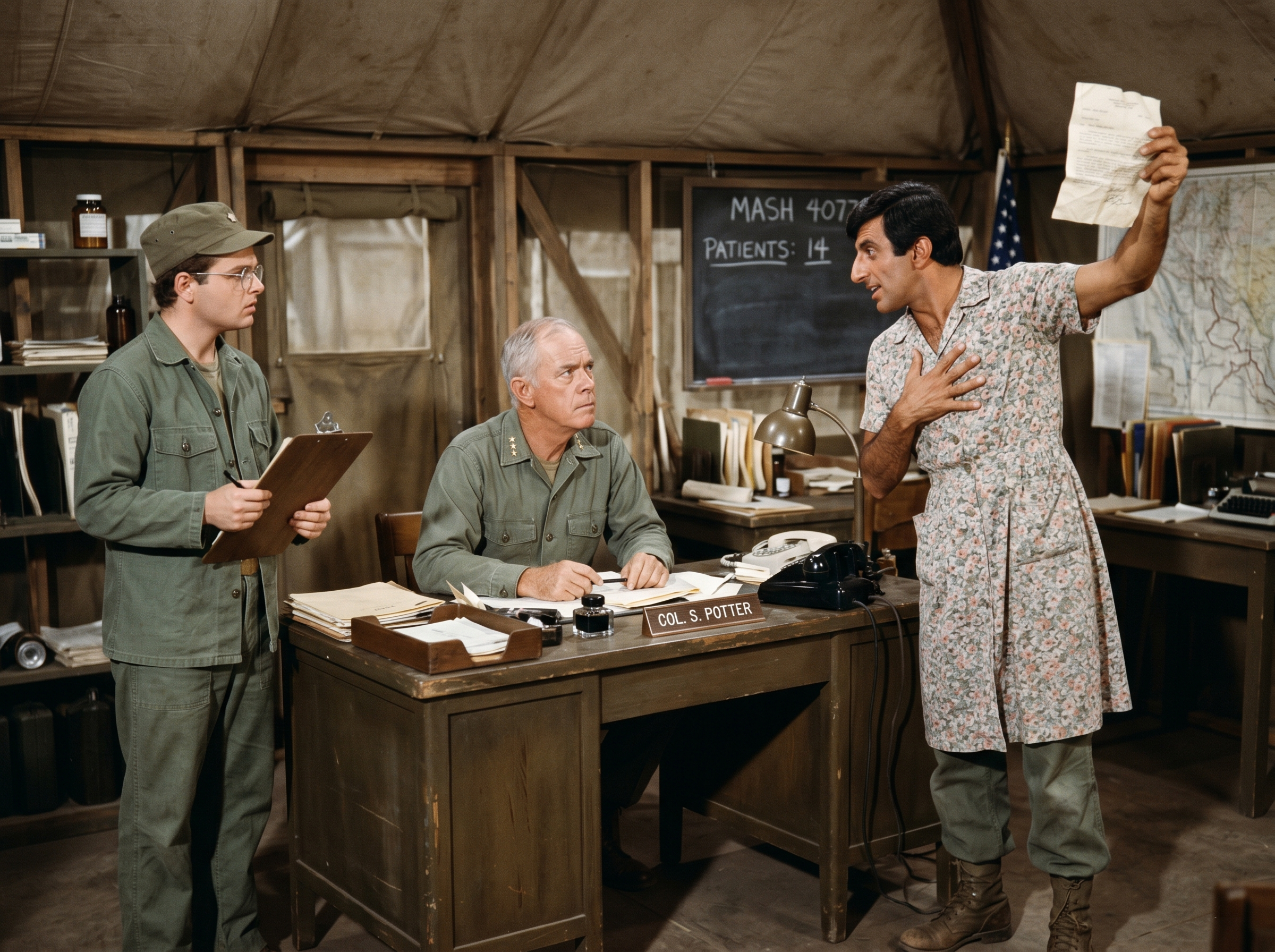
The war took a rare, suspicious breather on a quiet Tuesday afternoon, leaving the 4077th with the dangerous luxury of silence. Inside the commanding officer’s tent, the chalkboard on the wooden wall told the whole story in white dust: MASH 4077 – PATIENTS: 14.
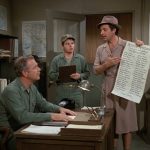
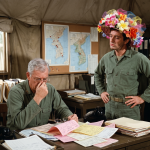
It was the kind of slow, dragging day that made the crushing homesickness creep in around the edges of the camp. Colonel Sherman T. Potter sat anchored behind his heavy wooden desk, staring down a stack of requisition forms that made even less sense than the conflict outside. The soft, warm light of the practical desk lamp spilled over his olive-drab uniform and the scattered paperwork.
Beside the desk, Radar O’Reilly stood at attention, a clipboard clamped firmly to his chest like a wooden shield. Radar was radiating his usual earnest, nervous energy, quietly waiting for the Colonel to finish signing the morning reports.
The heavy peace of the office lasted exactly as long as it took for Maxwell Klinger to burst through the door.
Klinger did not just enter a room; he arrived like a touring theater company with a cast of one. Today, his wardrobe of choice was a modest, floral-print housecoat, worn proudly and without a hint of irony over his standard-issue olive trousers and dusty combat boots.
He marched right up to the front of Potter’s desk, planting his feet wide. In Klinger’s right hand, he held a single piece of paper high in the air, waving it like a flag of desperate surrender. His left hand was pressed dramatically to his chest, directly over his heart, as if trying to keep it from leaping out of his body.
“Colonel, sir!” Klinger announced, his voice trembling with manufactured, operatic grief. “I have here a document that will tear at the very fabric of your soul. A tragedy of bureaucratic oversight!”
Potter didn’t blink. He didn’t sigh. He simply leaned back in his wooden chair, his face settling into a perfect mask of stern, fatherly exasperation. He had commanded troops in two previous wars, but nothing in the Army manual prepared an officer for a corporal from Ohio wearing a tea dress.
“Lay it on me, son,” Potter said gently, his voice dry as hardtack. “What fresh legal nightmare has the great state of Ohio unleashed upon the United States Army?”
Radar adjusted his glasses, looking anxiously between the Colonel and the Corporal. He gripped his clipboard tighter, his eyes wide, fully invested in whatever madness Klinger was about to unleash.
“It is a sworn affidavit, Colonel,” Klinger proclaimed, his dark eyes wide with comic pride. “Straight from the municipal courts of my beloved hometown. It turns out, by a freak twist of zoning laws and the untimely passing of a long-lost great-uncle, I am the sole remaining heir to a defunct, dangerously unstable roller rink.”
Klinger took a deep, theatrical breath, preparing for his grand finale.
“The Toledo Roller-Dome is the beating heart of the community, sir! Couples fall in love to the organ music! Troubled youths find purpose in the snack bar! The law is clear. The military cannot legally retain a roller-rink baron when civic infrastructure is at stake! I must be discharged immediately, before the youth of Toledo are forced to skate on substandard hardwood!”
Klinger held the paper out, vibrating with dramatic intensity, waiting for the commanding officer to realize he had finally been beaten by the municipal bylaws of the Midwest.
The silence that followed in the small canvas office was thicker than the mess tent’s powdered eggs. The only sound was the distant hum of a jeep motor and the steady, rhythmic ticking of Potter’s pocket watch.
Radar looked down at his clipboard, intensely studying a blank form, pretending he wasn’t holding his breath. He always admired Klinger’s bravery, even when it bordered on complete, court-martial-worthy insanity.
Colonel Potter sat perfectly still. He let his eyes travel slowly from the scuffed combat boots, up the muddy green trousers, past the delicate floral print of the housecoat, and finally to Klinger’s desperate, hopeful face. The boy was an absolute lunatic, Potter thought, but he was their lunatic.
“A roller rink, Klinger,” Potter said, his voice flat but carrying a deep, hidden affection.
“The Toledo Roller-Dome, sir,” Klinger nodded enthusiastically, refusing to drop his hand from his heart. “A veritable palace of recreation. Without my immediate civilian oversight, the entire business empire will crumble into dust.”
Potter let out a slow, heavy breath. He reached out his hand over the desk, past the heavy glass inkwell and the black rotary field phone.
“Let me see this ironclad legal document, son.”
For a fraction of a second, the theatrical bravado flickered. Klinger hesitated, his hand trembling slightly as he lowered the paper and handed it across the desk. The grand performance was ending, and the harsh reality of the 4077th was waiting right behind the curtain.
Potter adjusted his glasses and looked at the paper. It was written in smudged blue ink on the back of a mimeographed mess tent menu. The handwriting was unmistakably Klinger’s own frantic, looping scrawl.
Potter looked up. He didn’t shout. He didn’t threaten Klinger with the stockade. He just looked at the young man standing in front of him. Beneath the ridiculous dress and the wild stories, Potter saw exactly what he always saw: a tired, scared kid who was three thousand miles away from everything he loved.
The humor slowly drained from the room, replaced by a quiet, heavy tenderness. They were all just trying to survive the madness of this war, and Klinger’s method just happened to involve a lot more chiffon than the regulations allowed.
“This is a very impressive document, Max,” Potter said softly, deliberately using Klinger’s first name. “Truly a legal marvel. I’m sure the youth of Toledo are weeping for your return.”
Klinger dropped his hand from his chest. His shoulders slumped, just a fraction of an inch. The comic pride faded into a weary, genuine homesickness that hung heavy in the warm air of the tent.
“I just thought… maybe an economic emergency, Colonel,” Klinger said, his voice losing its theatrical boom, becoming small and deeply human. “A guy can hope, right?”
“A guy has to hope, son,” Potter replied gently. “If we stop hoping, the war wins. But I’m afraid the Army doesn’t recognize roller rinks as critical national defense assets. Not even the ones in Toledo.”
Radar looked up, his nervous tension melting into a soft, sympathetic smile. He knew exactly how Klinger felt. They all did. The ache for home was the only sickness the surgeons couldn’t cut out.
Potter picked up his pen, dipped it in the inkwell, and deliberately signed his name at the bottom of the mess tent menu. He handed it back across the wooden desk.
“File this under ‘Dreams and Schemes’, Corporal,” Potter said, a faint, wry smile touching his lips. “And keep the Roller-Dome in good repair in your head. You’re going to need a place to skate when this miserable conflict is finally over.”
Klinger took the paper gently. He looked at Potter’s signature, then back up at the Colonel. The dignity returned to Klinger’s posture. The crazy charade had failed, but he had been seen, heard, and understood. In a place like the 4077th, that was a victory all on its own.
“Thank you, sir,” Klinger said quietly. He gave a crisp, perfectly executed salute, turned on his heel, and marched out of the office, his floral housecoat swishing softly against his boots.
Potter watched him go, shaking his head with a mixture of amusement and sorrow. He looked over at Radar, who was already teeing up the next stack of entirely pointless Army paperwork.
“Right then, Radar,” Potter sighed, picking up his pen again and grounding himself in the reality of his command. “What’s next on the docket? Have we run out of tongue depressors or did someone misplace a jeep?”
“Just the routine supply requests, sir,” Radar said earnestly, stepping forward to anchor the room once again.
The war was still waiting outside the canvas flaps, loud and cruel and endless. But inside the office, the small, absurd moment of humanity had done its job. It had given them all just enough strength to face the rest of the day.
In a world gone entirely mad, sometimes the only thing that keeps you sane is the ridiculous, beautiful stubbornness of the family you find along the way.