The Bureaucracy of Angels
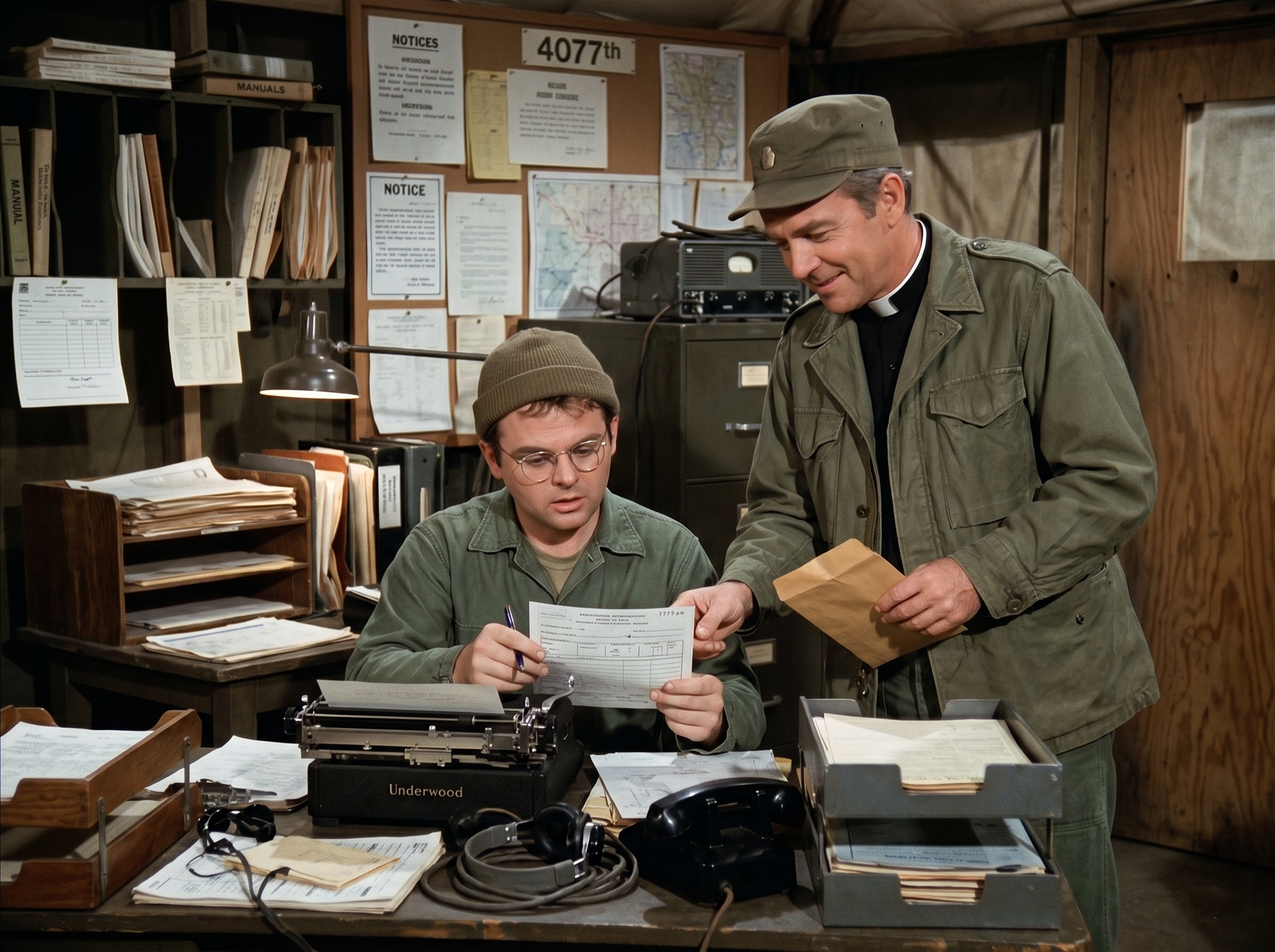
Even in the middle of a war, the most dangerous weapon was often a typewriter.
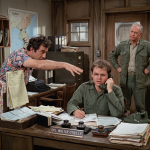
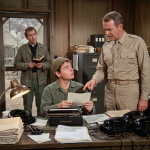
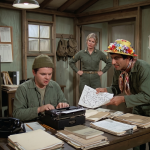
The 4077th Mobile Army Surgical Hospital ran on blood, sweat, and coffee, but it was held together entirely by triplicate forms. Inside the bustling, modestly chaotic clerk’s office, the air was thick with the smell of old canvas, typewriter ribbon, and damp wool. Corporal Walter “Radar” O’Reilly sat hunched behind his wooden desk, a bastion of beige paper and manila folders separating him from the madness of the Korean War.
The clack-clack-clack of his Underwood typewriter had been serving as the heartbeat of the camp all morning. But right now, the machine was silent. Radar was staring at a standard-issue requisition form with a look of profound, nervous confusion.
His brow was furrowed beneath his olive-drab knit cap. He adjusted his round spectacles, bringing the paper closer to his face as if the typed letters might suddenly rearrange themselves into something that made sense.
Standing just across the desk, leaning in with a posture of mild, sincere confusion, was Father John Mulcahy. The chaplain wore his standard fatigue cap and a worn, lived-in green field jacket over his clerical collar. In his hand, he held a small, unsealed brown envelope, his fingers gently resting against the coarse paper.
A soft, warm light from the desk lamp illuminated the space between them, casting long shadows against the wooden notice board behind Radar, where the bold “4077th” sign hung like a tired banner.
“I don’t understand, Radar,” Father Mulcahy said, his voice carrying that familiar, gentle cadence. “I simply submitted the request for the children at the orphanage. Sister Theresa mentioned they were in desperate need of heavy winter socks before the frost sets in.”
“I know, Father,” Radar said, his voice squeaking slightly in its earnestness. He held his pen hovering over the document, terrified to let the ink touch the paper. “I put the request through exactly like you asked. Requisition form 114-B. Clothing, civilian, cold weather, subsidiary.”
“And?” Mulcahy asked, offering a soft, hopeful smile. “Did Quartermaster approve it?”
“Well, that’s the thing, Father,” Radar said, swallowing hard. He looked around the office as if the walls might be listening. “They approved a requisition. But not for socks.”
Mulcahy leaned in a fraction closer, his smile faltering just a bit. “Did they send blankets instead? We could certainly use blankets.”
“No, sir,” Radar replied, his eyes wide behind his thick lenses. He gently tapped the bottom line of the form. “According to this approval stamp from I Corps, you didn’t order heavy winter socks. You ordered three dozen M2 Browning .50 caliber machine guns.”
The soft hum of the camp generator seemed to grow louder in the sudden silence of the office.
Father Mulcahy blinked, looking from the paper down to the small brown envelope in his hand, and then back to Radar. The chaplain’s gentle demeanor was suddenly eclipsed by a profound, moral panic.
“Good heavens,” Mulcahy whispered, clutching the envelope to his chest. “What on earth is a nun going to do with a .50 caliber machine gun?”
“I don’t think she’s supposed to do anything with them, Father,” Radar whispered back, genuinely distressed. “But if I sign this receipt, a convoy is gonna show up here tomorrow with enough firepower to take a hill, and they’re gonna ask me to point them to the orphanage.”
Mulcahy took off his cap, running a hand through his thinning hair. He looked deeply troubled, the mild confusion in his eyes shifting into a profound exasperation with the United States Army. “Radar, you must fix this. We are trying to keep those children warm, not arm them for a localized rebellion.”
“I’m trying, Father,” Radar said, his eyes scanning the endless blocks of bureaucratic text. “But the army doesn’t like to admit it made a mistake. If I just cancel the order, it goes into a void in Seoul. It could take six months to re-file for the socks. By then, it’ll be July, and the kids will be sweating.”
Mulcahy let out a long, weary sigh. It was the sigh of a man who spent his days trying to find God in a place where the devil seemingly handled the paperwork. He rested his hands on the edge of Radar’s desk, looking at the young corporal from Iowa.
Beneath the humor of the situation, Mulcahy felt a sudden, sharp pang of sympathy. Radar was barely out of high school, yet he sat behind this desk every day, a wizard in a knit cap, moving mountains of supplies, managing inflated egos, and keeping a hospital running on sheer willpower and forged signatures.
“What do we do, my boy?” Mulcahy asked softly, his tone shifting from panic to quiet trust. “I leave it in your capable hands.”
Radar bit his lower lip, his eyes darting across the desk. He looked at the stacks of paper, the field phone, the manuals piled high on the shelving unit. His brain was working at a frequency only dogs and supply sergeants could hear.
“Okay,” Radar muttered, almost to himself. “Okay, wait. The machine guns are classified under Ordnance, Class V. But the socks are Quartermaster, Class II. They crossed a wire at the depot in Uijeongbu.”
Radar picked up his pen. His hand was no longer trembling. He was in his element now.
“Father,” Radar said, looking up with a spark of innocent genius. “Do you still have that envelope from the Red Cross? The one with the donation stamps?”
Mulcahy looked at the brown envelope in his hand. “Yes, right here. It’s just the confirmation of the civilian relief funds.”
“Perfect,” Radar said, gently taking the envelope from the chaplain. He placed it next to the terrifying weapons requisition. “If I attach the Red Cross relief code to the Ordnance approval, it creates an invalid conflict in their filing system. The clerk in Seoul will see a request for machine guns meant for an orphanage, realize it’s a court-martial waiting to happen, and panic.”
Mulcahy smiled gently, a look of warm amusement returning to his face. “And we want the clerk to panic?”
“Yes, sir,” Radar nodded earnestly. “Because when an army clerk panics, they revert to the original request to cover their own behind. They’ll scrap the machine guns and push the socks through on an emergency priority just to clear the red ink off their desk.”
Radar swiftly crossed out a block of numbers on the form, forged a set of initials that looked suspiciously like a captain from Supply, and aggressively stamped the paper with a loud, satisfying THWACK.
He slid the paperwork into an outgoing tray and handed the small brown envelope back to the chaplain.
“The socks will be here by Thursday on the morning chopper, Father,” Radar said, leaning back in his chair, suddenly looking very tired but very proud. “Guaranteed.”
Father Mulcahy stood in silence for a moment. He looked at the young boy behind the desk—a boy who should be worrying about prom dates and tractor parts back in Ottumwa, not manipulating military logistics to keep orphans from freezing.
The chaplain felt a swell of profound affection for the corporal. It was a strange, beautiful family they had built in this muddy, blood-stained corner of the world. They were all exhausted, they were all far from home, but they looked out for each other.
Mulcahy reached across the desk and gently placed a hand on Radar’s shoulder. The canvas of Radar’s shirt was rough, but the gesture was as tender as a blessing.
“You know, Corporal,” Mulcahy said, his voice thick with quiet emotion. “The Lord works in mysterious ways. But I am increasingly convinced that when He needs something done quickly, He routes it through your desk.”
Radar blushed deeply, ducking his head and adjusting his glasses. “Aw, it’s nothing, Father. Just… just standard operating procedure.”
“Hardly standard, Radar,” Mulcahy smiled, turning to head toward the door. “Thank you. And bless you.”
As the chaplain stepped out into the noise of the compound, Radar watched him go. The young clerk let out a long breath, picked up a fresh sheet of beige paper, and rolled it into the Underwood typewriter.
The war was still raging just over the mountains, but for today, the 4077th had won a small victory. There would be no machine guns. There would be warm socks.
Radar smiled to himself, his fingers finding the familiar keys, and went back to work.
In a place surrounded by war, the greatest acts of heroism were often written on a typewriter.