The Headlines from Home
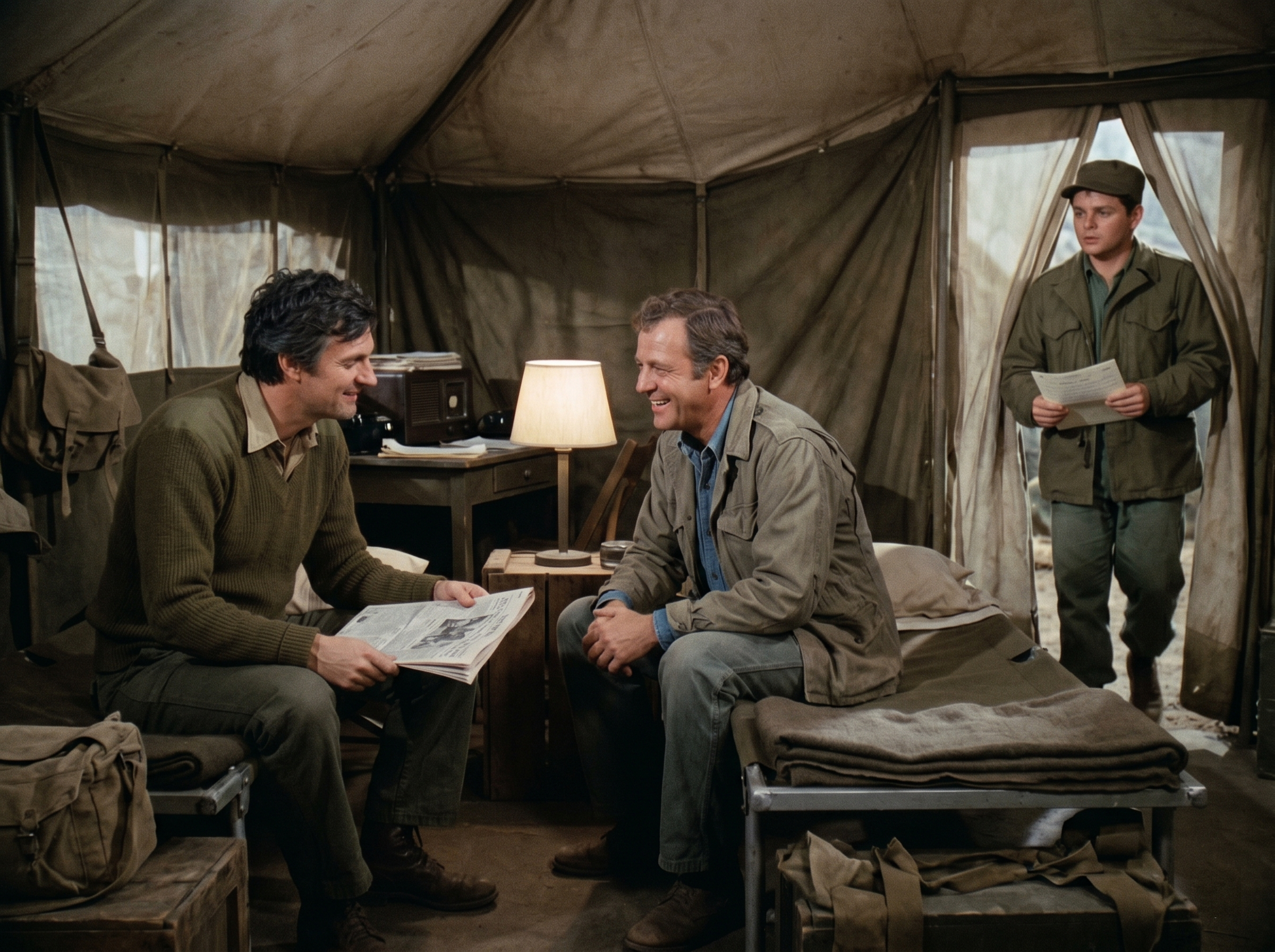
The mud outside the Swamp always found a way inside, but tonight, the cold was the real enemy. It crept through the canvas seams of the tent, smelling of damp earth, diesel fuel, and the faint, unmistakable tang of isopropyl alcohol that clung to everyone’s skin.
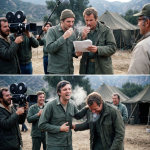
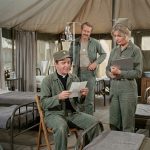
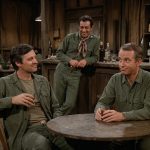
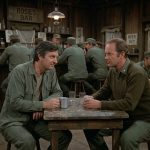
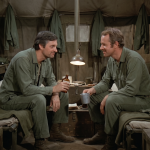
Hawkeye sat on the edge of his cot, his shoulders hunched in his thick olive-drab sweater, his fingers tightly holding a crumpled, weeks-old newspaper. Opposite him, B.J. leaned forward on his own cot, a rare, relaxed smile breaking through the exhaustion etched into his face, his denim shirt open at the collar under his field jacket.
Between them, the small wooden crate served as a makeshift table, supporting a single lamp that threw a warm, amber glow across their faces, carving a small sanctuary of light out of the dark Korean night.
“Listen to this, Beej,” Hawkeye said, his voice carrying that familiar, fast-paced rhythm he used to keep the silence of the war at bay. “The Crab Bagel Bakery in Crabapple Cove just celebrated its tenth anniversary by baking a giant pastry shaped like a lobster. The mayor tried to cut it and broke his ceremonial silver knife.”
B.J. let out a soft snort, his eyes crinkling. “Now that is hard-hitting journalism, Hawk. Did the lobster survive?”
“It’s currently holding hostage three members of the town council,” Hawkeye shot back without missing a beat, a genuine grin spreading across his face as he looked down at the print. “But seriously, look at the date on this thing. It’s nearly two months old. By now, that lobster has probably run for governor.”
For a few beautiful minutes, the distant thud of artillery was replaced by the simple, glorious absurdity of a small-town newspaper. They were two doctors who had spent fourteen straight hours in the post-op tent patching together shattered bodies, but right now, they were just two friends sharing a piece of a world that didn’t involve scalpels or blood.
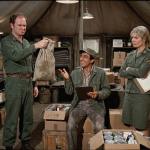
The tent flap suddenly rustled, and the cool night air washed over them. Radar stood in the entryway, clutching a fresh sheaf of official-looking papers against his olive jacket, his cap tilted slightly askew.
He didn’t blurt out his usual announcement, and he didn’t bounce on his heels. He just stood there under the tent opening, looking at Hawkeye with an expression that made the laughter in the room instantly evaporate.
“Pierce,” Radar said quietly, his voice unusually small, even for him. “Colonel Potter needs you in the office. It’s… it’s about a letter that came in the late pouch.”
Hawkeye’s smile froze on his face, his fingers tightening so hard on the edge of the newspaper that the vintage paper began to tear.
The silence inside the Swamp grew so heavy you could hear the faint hum of the desk lamp bulb. B.J.’s smile vanished entirely, his eyes darting from Radar’s solemn face back to Hawkeye, his posture instantly straightening into an alert, protective stance.
“What kind of letter, Radar?” B.J. asked, his tone steady but carrying the sharp edge of a man who knew that bad news in a war zone usually arrived in a neat, official envelope.
Radar swallowed hard, shifting the papers in his arms, his eyes scanning the floor of the tent rather than meeting Hawkeye’s gaze. “It’s from Maine, Captain. The Colonel said it’s from Dr. Pierce’s father’s clinic. He… he wanted me to come get you right away.”
Hawkeye didn’t move for a long moment. The quick-witted, fast-talking surgeon who always had a joke to defuse a crisis was completely gone, replaced by a son who was thousands of miles away from the only person who truly anchored him to the world.
He slowly laid the newspaper down on his lap, his hands trembling slightly as the warmth of the Crabapple Cove stories turned to ice. “My dad,” Hawkeye whispered, the humor entirely drained from his voice, leaving it raw and vulnerable. “He doesn’t write to the Colonel. He writes to me.”
B.J. reached over, his large hand coming down firmly on Hawkeye’s shoulder, offering the quiet, unshakable support that had kept them both sane through the worst of the push. “Go on, Hawk. I’m right behind you.”
Hawkeye stood up slowly, his legs feeling heavy under the weight of a sudden, suffocating dread. He walked past Radar, who stepped aside with a look of profound, tender sympathy that only an innocent kid from Iowa could manage, and stepped out into the dark compound.
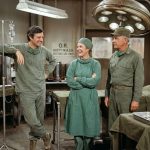
Inside the administrative tent, the atmosphere was thick with the smell of old coffee and mimeograph ink. Colonel Potter wasn’t sitting behind his desk; he was standing by the window, staring out into the dark, his hands clasped behind his back.
When he turned, his weathered face didn’t hold the usual stern authority of a commanding officer, but rather the deep, aching compassion of a father who had delivered too many hard truths in his lifetime.
“Sit down, son,” Potter said softly, gesturing toward the chair in front of his desk, where a single, handwritten letter lay open.
Hawkeye remained standing, his hands shoved deep into his sweater pockets to hide the shaking. “Just tell me, Colonel. Please. Is he…?”
Potter stepped forward, placing a comforting hand on Hawkeye’s arm. “Your father is fine, Pierce. Take a breath.”
The relief that washed over Hawkeye was so violent he actually stumbled back a step, B.J. catching him by the elbow from behind.
“He’s fine,” Potter repeated, his voice gentle. “But his old nurse, Mrs. Global, passed away last week. Your dad wrote to me because he knew if he wrote to you directly while you were in the middle of a heavy casualty influx, you’d spend the whole night worrying about him being left alone at the clinic. He wanted me to break it to you when things were quiet.”
Hawkeye let out a long, ragged breath that sounded halfway between a laugh and a sob. He sank into the wooden chair, burying his face in his hands as the tension finally broke.
Mrs. Global had been the woman who gave him lollipops when he scraped his knees, the one who helped his father keep the small Maine practice running after Hawkeye’s mother died. She was a piece of his childhood, a piece of the home he was terrified was disappearing while he was stuck in this valley.
Potter walked over to his cabinet, poured a small finger of whiskey into a paper cup, and set it in front of Hawkeye. “She went peacefully, Pierce. Your dad said she went to sleep listening to the radio. He wanted you to know he’s doing okay, and he’s got the neighbors helping him out.”
B.J. walked up behind the chair, leaning over to rest a hand on the back of Hawkeye’s neck. “He’s a tough old bird, Hawk. Just like you.”
Hawkeye looked up, his eyes a little bright, but the familiar, defensive spark of wit was slowly returning to his expression. He picked up the paper cup, looking at the cheap liquor, then at Potter, and finally at B.J.
“To Mrs. Global,” Hawkeye said quietly, raising the cup. “The only woman in New England who could look at my father’s handwriting and actually know whether he was prescribing penicillin or ordering groceries.”
“To Mrs. Global,” Potter echoed, nodding his head in respect.
An hour later, the Swamp was quiet again. The lamp was still burning low, casting its warm circle of light onto the dirt floor.
Hawkeye was back on his cot, the old newspaper spread out across his knees once more. He wasn’t reading the jokes anymore; he was just looking at the advertisements for the local hardware store and the notices for the high school bake sales.
B.J. was lying back on his own pillow, his eyes closed, but a gentle, knowing smile played on his lips as he listened to the steady, comforting sound of his friend turning the pages.
The war was still waiting for them just beyond the canvas walls, but inside, under the glow of a single bulb, they had found a way to bring a little bit of home across the ocean, keeping the cold at bay for one more night.
In a place where tomorrow was never promised, the memories of yesterday were the only things that kept them whole.