A Splash of Yellow in a Sea of Olive Drab
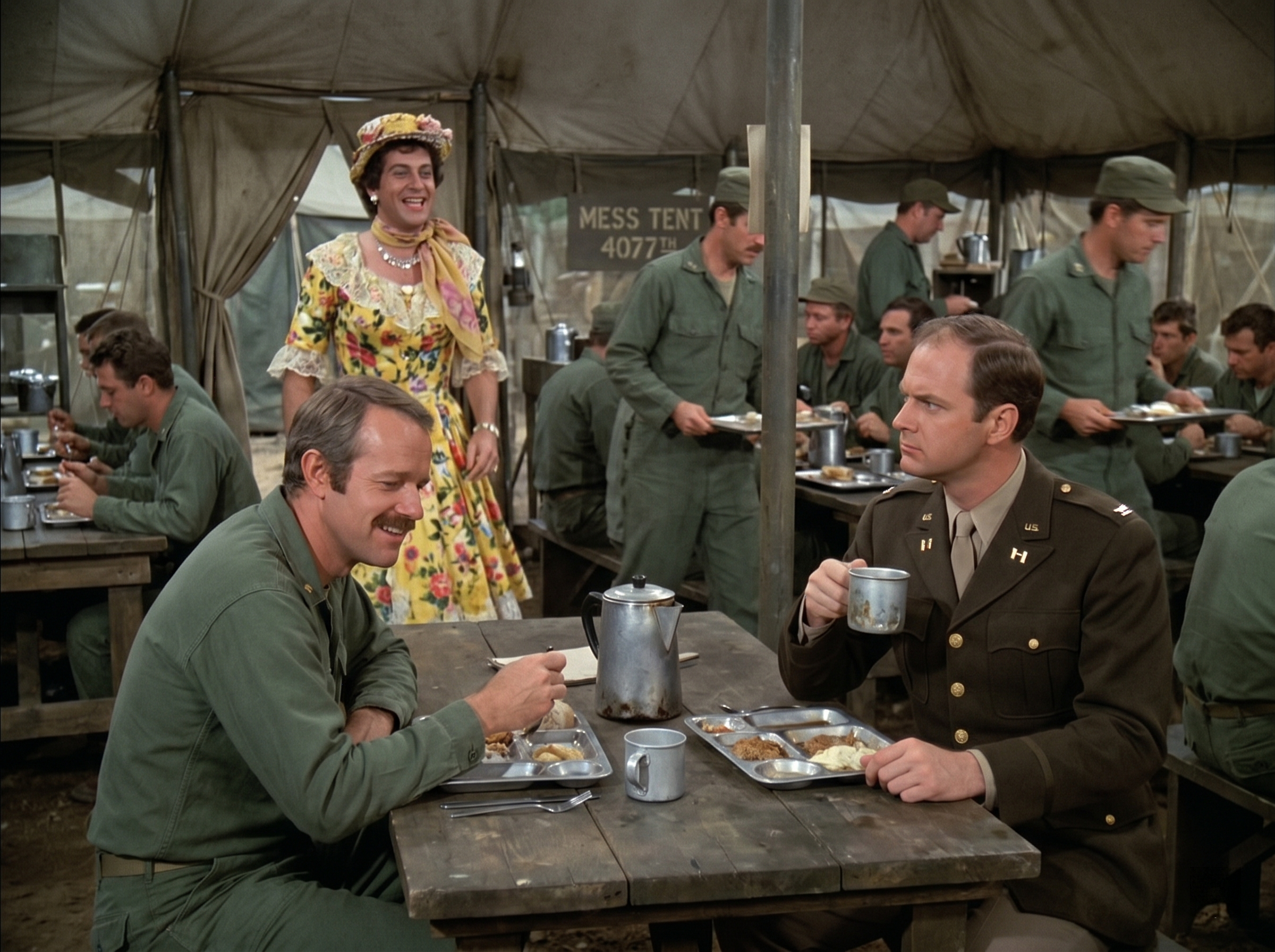
The war didn’t stop for breakfast, but sometimes, if you were incredibly lucky, it paused just long enough for a cup of terrible coffee.
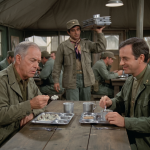
The Mess Tent of the 4077th Mobile Army Surgical Hospital was not a place of culinary delight. It was a practical, canvas-draped cavern of survival. The air was thick with the scent of chicory, damp wool, and whatever mystery meat was being served from the dull metal warming trays. It was noisy, but it was a familiar, comforting noise. Other soldiers in faded green fatigues sat at the long wooden tables, locked in the rhythmic, exhausted routine of people who had seen too much the night before.
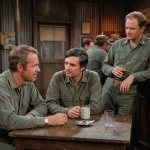
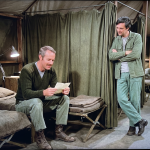
At the foreground table, Major Charles Emerson Winchester III sat as upright as humanly possible on a wooden bench. He wore his officer’s uniform, a desperate, stubborn shield of Bostonian dignity against the surrounding mud. He held his metal coffee mug with both hands, staring ahead as if trying to divine a route back to civilization.
Across from him, Captain B.J. Hunnicutt leaned casually over his own metal tray. B.J. looked like a man who had long ago made peace with the madness. He wore his wrinkled green fatigues, his familiar mustache framing a dry, warm smile of understated support. They had just walked out of an eighteen-hour session in the O.R. Their hands were scrubbed raw. Their souls were bone-tired.
Charles was just inhaling to deliver a precise, multi-syllabic critique of the powdered eggs when the heavy canvas tent flap swung open.
The drab, olive-green routine of the mess hall was instantly shattered.
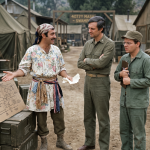
Corporal Maxwell Klinger made his entrance through the doorway. It wasn’t just a walk; it was a theatrical debut. He stood framed against the canvas, wearing a wildly expressive, eccentric, bright yellow dress covered in an aggressive floral print. A lace-trimmed bonnet sat proudly on his head, tied with a cheerful pink scarf. A strand of pearls rested delicately against his chest. His face beamed with absolute, comic pride.
The low hum of the mess tent completely died.
Charles froze. The refined, aristocratic air around him seemed to crackle with sudden electricity. He slowly raised one single, highly educated eyebrow. His face, already drawn from a lack of sleep, tightened into an expression of refined, profound irritation.
The silence in the tent grew heavy. Charles’s grip on his metal mug remained fixed. He took a long, dangerously slow breath through his nose. B.J.’s smile widened, his eyes locked on the Major. The entire room held its breath, waiting for the inevitable, explosive Bostonian storm to break over the beaming corporal in the yellow sundress.
B.J. leaned a little further over his metal tray, resting his arms comfortably on the rough wood of the table. His dry, warm smile didn’t waver. In fact, it grew a fraction wider, settling into an expression of perfect, understated punchline support.
He didn’t say a word. He didn’t have to. B.J. lived for these moments—the tiny, absurd sparks of life that proved they were all still breathing under the weight of the war.
Charles finally moved, the tension in his rigid posture radiating across the simple wooden table. He sat perfectly still, his eyes locked on the yellow floral catastrophe standing by the doorway.
“Corporal,” Charles began, his voice a low, dangerous purr of pure New England condescension. “I have survived sniper fire. I have survived the agonizing drone of Pierce’s ego. I have even survived the sheer, unadulterated tragedy of what this establishment legally classifies as a sausage.”
Klinger took a confident step forward, the bright yellow skirt of his dress swishing with unapologetic flair. “Morning, Major! Captain,” he chirped, offering a beaming smile. “Aunt Shirley’s spring collection. Straight from Toledo. I figure if the brass won’t send me home for being crazy, maybe they’ll send me home for a fashion violation.”
Charles’s raised eyebrow twitched. “Aunt Shirley,” Charles repeated, the words tasting like sour milk in his mouth. “Tell me, Corporal. Does your Aunt Shirley frequently attend garden parties in a combat zone? Or is she simply blind?”
“Oh, she’s a visionary, Major,” Klinger replied without missing a beat, adjusting his pink scarf with a proud tilt of his lace bonnet. “She says yellow brings out the joy in people. Lifts the spirits. Don’t you feel your spirits lifting, sir?”
B.J. finally let out a soft, chest-deep chuckle. “He’s got a point, Charles,” B.J. said gently, his voice carrying the warm, grounded rasp of a man who hadn’t slept in two days. “It’s very festive. The pearls are a nice touch. Really ties the mess tent together.”
Charles shot B.J. a look of absolute betrayal, his lips pressing into a thin, tight line. He looked back at Klinger. He looked at the absurd lace bonnet. He looked at the ridiculous pink scarf.
And then, something barely perceptible shifted in the Major’s rigid posture.
The truth was, they were all drowning. The night before had been a nightmare of mud, blood, and broken bodies. Charles had spent twelve hours fighting to save the leg of a boy who looked no older than eighteen. He had felt the cold grip of despair trying to pull him under. He had walked into this mess tent feeling like a hollowed-out shell of a man, desperate for a quiet moment of dignity that simply did not exist in Korea.
But looking at Klinger—standing there with his chest framed by a delicate yellow bodice and a pearl necklace, grinning like a man who had just conquered the world—the despair couldn’t hold on. It was too stupid. It was too absurd. It was too profoundly, wonderfully human.
Charles would never admit it. He would rather swallow his own stethoscope than confess that this ridiculous corporal in a dress was the only thing keeping his heart beating in rhythm.
Charles slowly adjusted his grip on his metal coffee mug. The irritation on his face hadn’t vanished completely, but it had softened, melting into a quiet, resigned sort of affection that he reserved only for the deeply insane people he was forced to call his family.
“The pearls,” Charles said quietly, his voice losing its sharp edge, “are undeniably fake, Corporal.”
Klinger’s grin widened, practically splitting his face. “Only the best for the 4077th, sir.”
“Indeed,” Charles murmured. He brought the metal rim to his mouth. “However… I suppose the sheer audacity of that yellow fabric is a passable distraction from the grim reality of these powdered eggs. Carry on, Corporal.”
Klinger offered a theatrical nod, the yellow fabric swishing as he prepared to sashay toward the food line where other soldiers in green stood by.
B.J. picked up his fork, his eyes warm and bright. He nudged his metal tray an inch forward. “You’re a soft touch, Winchester,” B.J. said quietly.
Charles didn’t look at him. He just stared straight ahead, clinging to his mug and his dignity. “Eat your eggs, Hunnicutt,” he replied softly. “Before they solidify into something weaponized.”
The mess tent resumed its noisy, clattering rhythm. It was just another morning in the Korean War. A place of exhaustion, fear, and endless mud. But sitting there at that simple wooden table, surrounded by faded green canvas and the absurd flash of a yellow sundress, they were, for one brief, shining moment, exactly where they needed to be.
In a place where everything was broken, the most beautiful remedy was the laughter we didn’t know we needed.