The Blueprint of Home
The mud of Korea has a way of clinging to more than just your boots; it seeps into your soul, making every day at the 4077th feel like a long, grey endurance test. But sometimes, in the space between surgeries, the absurdity of our existence took on a shape that was almost beautiful.
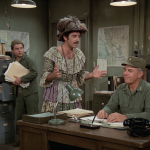
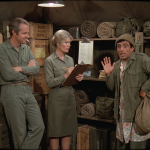
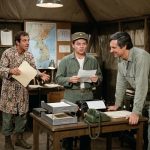
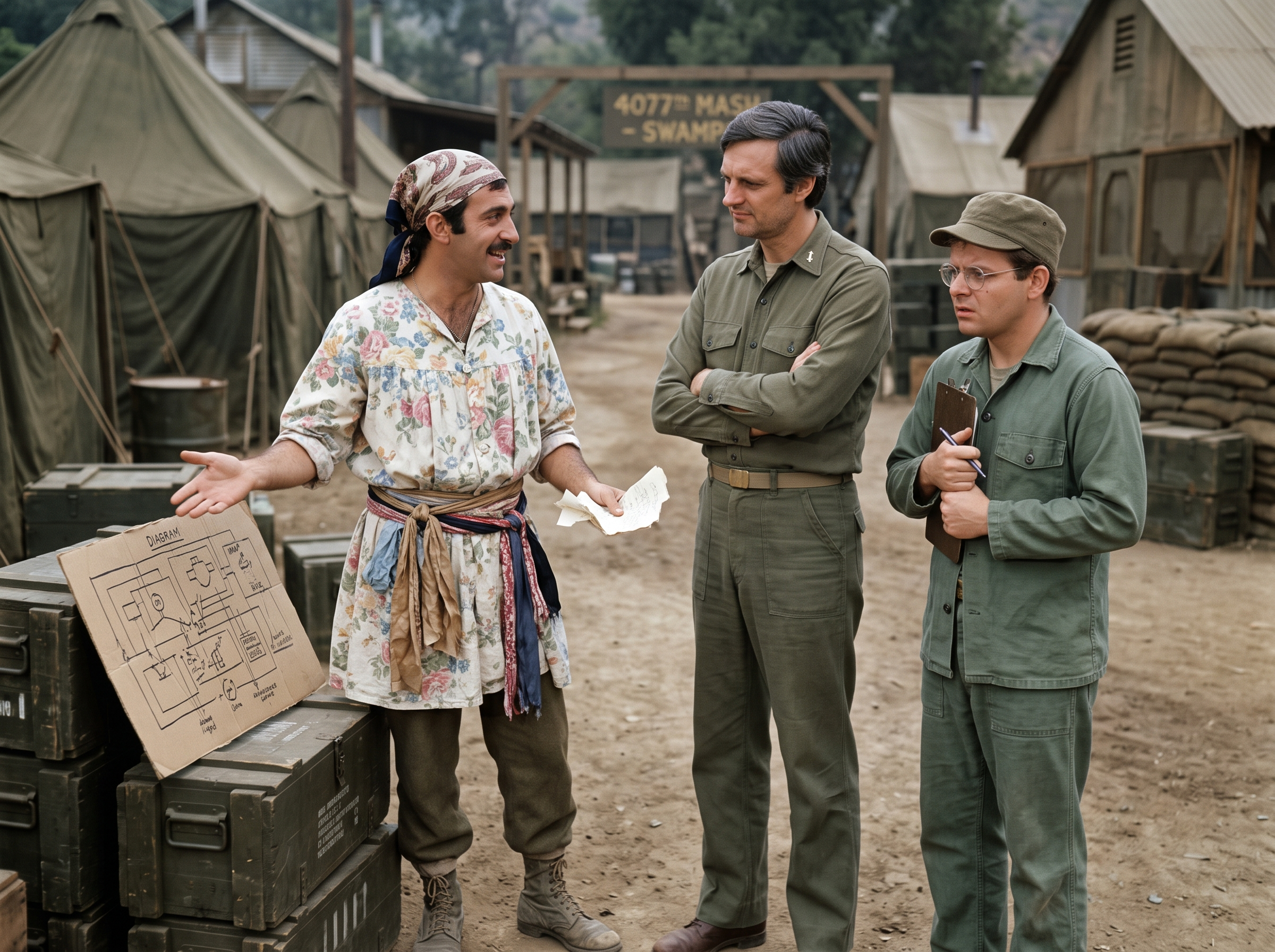
It happened on a particularly stifling afternoon, the kind where the heat made the canvas of the tents sag with exhaustion. Klinger had materialized near the supply crates, wearing a flowered robe that looked like it had been salvaged from a grandmother’s parlor in Toledo. He was gesturing wildly at a piece of cardboard he’d propped up against a stack of crates.
Hawkeye stood beside him, arms crossed, his face a mask of skeptical amusement. He was watching Klinger as if trying to solve a complex equation that only existed in the corporal’s fevered imagination. Radar, meanwhile, stood a few feet back, his glasses perched on his nose, holding a clipboard like it was a shield against the sheer lunacy of the moment.
“It’s not just a sketch, Captain,” Klinger insisted, his voice bright with that trademark, desperate theatricality. “It’s a morale booster. A logistical necessity! It’s the ‘Klinger Culinary and Comfort Integration Plan.’”
Hawkeye tilted his head, his eyes darting from the crude, hand-drawn lines on the cardboard to Klinger’s earnest, mascara-rimmed face. “Klinger,” he said, his voice dropping into that dry, razor-sharp register, “you’re explaining a circuit diagram for a modified jeep engine as if it’s a recipe for a soufflé. Are you trying to fix the truck, or are you trying to bake it?”
Radar let out a soft, nervous huff, his gaze flicking back and forth between the two men. He was clearly worried that the “diagram” might actually be something Klinger had pilfered from the motor pool, something that Colonel Potter might eventually notice was missing. The tension hung heavy in the air, a mixture of stifling heat and the quiet, mounting dread of being caught in another one of Klinger’s schemes.
Klinger took a deep breath, his hands trembling slightly as he clutched a crumpled note, his eyes pleading for a shred of validation. “It’s going to work,” he whispered, his voice losing its theatrical edge, replaced by a sudden, jarring flicker of genuine, raw vulnerability. “I just need you to look at it, Hawkeye. Just look.”
Hawkeye stopped smiling. The silence stretched, long and uncomfortable, as he leaned in, his expression shifting from mockery to a guarded, reluctant concern.
Hawkeye stepped closer, his shadow falling over the cardboard diagram. He didn’t mock the drawing again. Instead, he studied the messy lines—the jumble of arrows and circles that Klinger had labeled with such frantic, desperate hope. It wasn’t a blueprint for an engine, nor was it a recipe. It was a chaotic map of “Home.”
There were little labels scratched in pencil: *Where the mail comes in*, *The patch of shade*, *The spot where the sun hits the coffee pot*. It was a tribute to the tiny, mundane joys that kept them from losing their minds.
“You drew a map of the camp,” Hawkeye murmured, his voice softened by a sudden, weary kindness. “You’re not trying to fix anything, are you? You’re just trying to make it feel like a place instead of a holding pen.”
Radar stepped forward, his nervousness melting into a look of quiet admiration. He looked at the drawing, then at Klinger, his eyes wide. “It’s pretty good, Max,” he said softly. “You got the distance from the mess tent to the swamp just right. It actually… it looks like where we live.”
Klinger blinked, his shoulders dropping. The manic energy that usually defined him seemed to deflate, leaving behind a young man who was thousands of miles from a home he desperately missed. He had used the only materials he had—a scrap of packing box and some charcoal—to try and tether himself to reality.
“I just wanted something,” Klinger said, his voice barely a whisper. “Something to look at when the helicopters start coming in. Something that isn’t blood or mud.”
Hawkeye looked at the diagram, then back at his friend. He reached out and gently straightened the cardboard, adjusting it against the crate so it wouldn’t wobble. He didn’t make a joke. He didn’t offer a sarcastic retort. He just stood there, acknowledging the silent, desperate plea for a moment of normalcy in a world that had none to offer.
Even Radar, usually so prone to pacing and fretting, stood still, the clipboard forgotten at his side. The three of them stood in the dirt, surrounded by the looming tents and the distant, constant hum of the war, bound together by the shared, unspoken weight of their situation.
For a few minutes, the war felt a million miles away. There was no surgery to perform, no triage to manage, no orders to follow. There was just a man in a floral dress showing his friends a drawing of the life they were trying to survive.
As the sun began to dip behind the hills, casting long, softening shadows across the compound, Klinger finally let out a small, tired smile. It wasn’t the grin of a prankster; it was the look of someone who had just been seen.
Hawkeye patted Klinger on the shoulder, a brief, firm gesture of solidarity, before turning back toward the Officers’ Club. He knew that tomorrow would be just as loud and just as cruel as today, but for this one quiet moment, they had built something together.
They had built a memory. And in the 4077th, a memory was the only thing you could truly call your own.
Sometimes, even in the middle of the madness, the most important thing to find is a place to stand, together.