The Care Package from Somewhere Warm
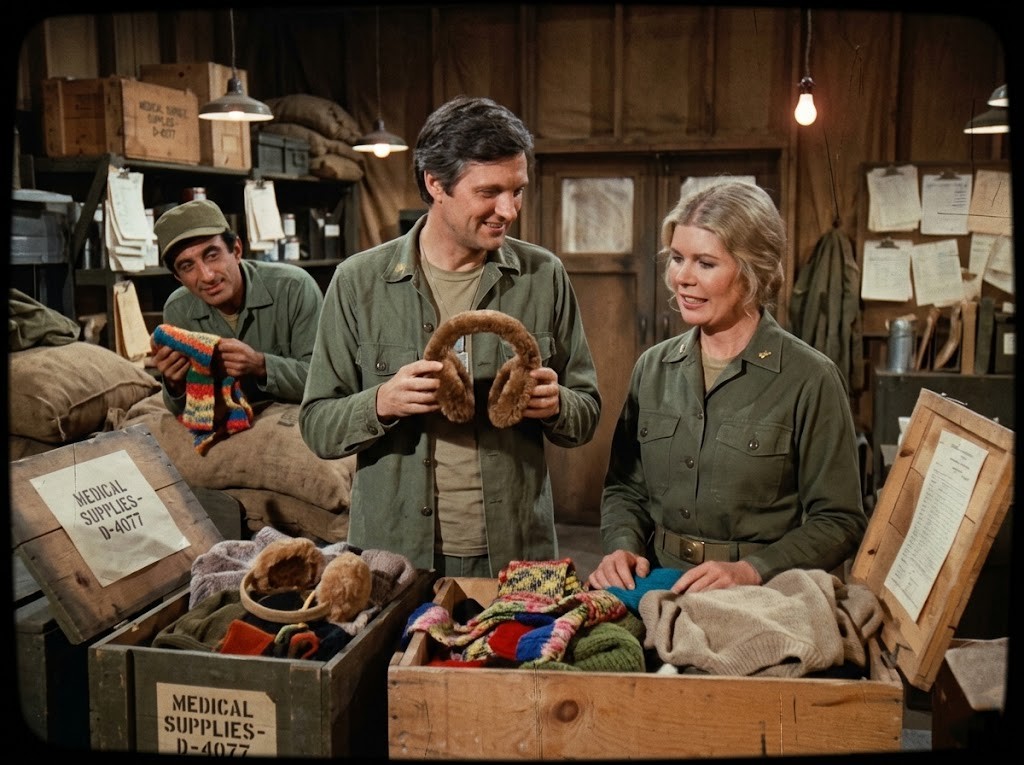
The Korean winter didn’t just bite; it moved into your bones, unpacked its bags, and refused to leave. In the supply tent of the 4077th, the air was always a mix of damp canvas, old dust, and the faint, sweet scent of motor oil.
But today, the room smelled like cedar, mothballs, and home.
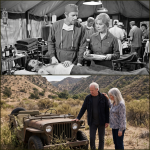
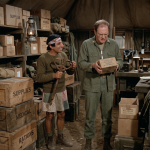
A wooden crate sat open on the table, its lid pried back to reveal a treasure trove of bright, mismatched wool. Hawkeye stood over it, holding up a pair of oversized, furry brown earmuffs as if he had just unearthed the crown jewels. Beside him, Margaret stared into the box, her strict military posture softening just a fraction at the sight of actual comfort. Behind them, Klinger sat perched on a stack of burlap sacks, a colorful knitted scarf already woven through his fingers.
“I think they’re magnificent, Pierce,” Klinger said, his voice unusually quiet as he ran a thumb over the rough yarn. “My aunt Alberto used to knit these back in Toledo. She said if your neck is warm, your soul forgets it’s freezing.”
“Your aunt Alberto was a wise man, Klinger,” Hawkeye cracked, though his eyes remained fixed on the fluffy earmuffs in his hands. He slipped them onto his head, the oversized bands making him look entirely ridiculous. “Look at this. With these on, I can’t hear the generator, I can’t hear the artillery, and if I try really hard, I can almost pretend I’m back in Maine.”
Margaret let out a short, breathy laugh, though her eyes were sharp. “They look ridiculous, Captain. And they’re technically out of uniform regulations.”
“Oh, come on, Margaret,” Hawkeye said, sliding them down to hang around his neck like a furry collar. “Out here, survival is the only regulation that matters. Look at these crates. ‘Medical Supplies,’ they say. But whoever packed this box in the States knew what we really needed.”
The crate had arrived with no military routing numbers, just a handwritten note taped to the inside of the lid. It had come from a church ladies’ auxiliary group in a small town in Ohio—a place none of them had ever visited, full of people they would likely never meet.
Margaret reached into the box, pulling out a thick, cream-colored sweater. It was heavy, knitted with thick cables that spoke of long evenings spent by a fireplace, miles away from the mud of Korea. For a second, her fingers tightened around the wool, her professional armor slipping completely.
“My mother used to knit these,” she murmured, almost to herself. “When the winters got bad in Fort Meade. She’d stay up until midnight, just making sure we had enough layers for the morning parade.”
Hawkeye looked at her, the usual quick-witted joke dying on his lips. There was a rare, vulnerable stillness in the tent, the kind of quiet that only happened when the war accidentally let a piece of the past slip through the front gates.
Then, the heavy canvas door flap whipped open, and a cold gust of wind sent the papers on the clipboard fluttering.
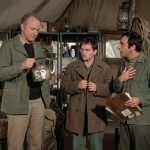
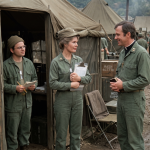
Colonel Potter stepped inside, his brow furrowed, holding a fresh set of casualty reports in his hand. He stopped dead in his tracks, his eyes darting from Hawkeye’s furry neckpiece to the mountain of contraband wool on the table.
The silence in the tent suddenly grew heavy, the warmth evaporating in an instant.
Colonel Potter didn’t say a word at first. He just stood there, the cold air from the compound clinging to his heavy olive-drab coat. He looked at the bright reds, yellows, and blues spilling out of the wooden crates, then at Margaret, who instantly straightened her shoulders, her hand dropping the cream-colored sweater back into the box.
“Care to explain what’s going on here, Pierce?” Potter asked, his voice low and dry. “I thought we were unloading a shipment of penicillin, not opening a boutique.”
Hawkeye cleared his throat, adjusting the earmuffs around his neck. “Well, Colonel, it seems the good citizens of Ohio confused ‘penicillin’ with ‘purl stitch.’ But if you ask me, this stuff fights off the blues a lot better than a needle to the hip.”
Potter walked over to the table, his boots thudding against the dirt floor. He looked down into the crate, his eyes scanning the handwritten note from the ladies’ auxiliary. He reached in, his weathered hand brushing past a bright blue scarf, and pulled out a pair of thick, dark grey woolen socks.
He didn’t speak. He just turned the socks over in his hands, feeling the weight of the wool, testing the thick heel.
“My grandmother used to make these,” Potter said softly, the gruffness leaving his voice. “Kept the damp out. A soldier’s feet are his livelihood out here, Pierce. You know that as well as I do.”
“Exactly, Colonel,” Hawkeye said, his voice dropping its sarcastic edge, replacing it with a quiet sincerity. “We’ve got three nurses down with the sniffles, the OR feels like an icebox between cases, and Klinger’s Toledo soul is on life support. We figured a little distribution of wealth was in order.”
Potter looked at Margaret, who was watching him with a quiet anxiety. He looked back at the box, then sighed, a long, tired puff of air that seemed to carry the weight of the entire camp.
“The regulations say uniform of the day is olive drab,” Potter said, turning the socks over one last time. “But the regulations don’t have to sleep in an unheated tent in the middle of a Korean January.”
He dropped the grey socks back into the box and looked up, a faint, fatherly smirk touching the corners of his mouth. “If I see any of this bright, circus-colored nonsense outside of the tents during inspections, I’ll have Winchester write a report on military decorum that will bore you to tears. Am I making myself clear?”
“Crystal, Colonel,” Hawkeye smiled.
“And Major,” Potter added, looking at Margaret. “That cream-colored sweater looks like it fits the bill for a head nurse keeping her staff from freezing. See that it gets used.”
Margaret’s face lit up with a rare, genuine smile. “Thank you, Colonel.”
Potter nodded once, then looked back at the door. “Now, get these crates cleared out before the rest of the camp realizes we’ve gone soft. And Pierce… if there happens to be another pair of those grey socks in there, see that they find their way to my quarters. My toes think they’re still in Missouri.”
With that, the Colonel turned and stepped back out into the cold, the canvas door snapping shut behind him.
Klinger let out a breath he’d been holding, immediately pulling the striped scarf closer. “The Colonel is a beautiful man, Pierce. Just beautiful.”
“He has his moments,” Hawkeye agreed, finally taking the furry earmuffs off his neck and tossing them gently to Klinger. “Here. Wear these under your helmet. They match your eyes.”
Margaret took the sweater, folding it carefully over her arm as if it were made of silk. “We should make sure the night shift nurses get the scarves first. They’re the ones who really feel the draft.”
“Spoken like a true leader, Margaret,” Hawkeye said, leaning back against the wooden frame of the tent.
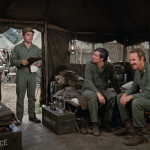
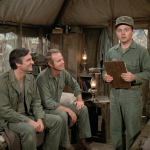
For the next hour, the war outside seemed to fade into the background. There were no incoming choppers, no distant thud of artillery, just three tired people in a drafty supply tent, finding a moment of home in a box of old wool sent by strangers. It was a small victory against the cold, a tiny patch of warmth stitched together by human hands, thousands of miles away.
In the darkest corners of the world, it’s the simplest threads of human kindness that keep us from unraveling.