A Sea of Paperwork at the 4077th
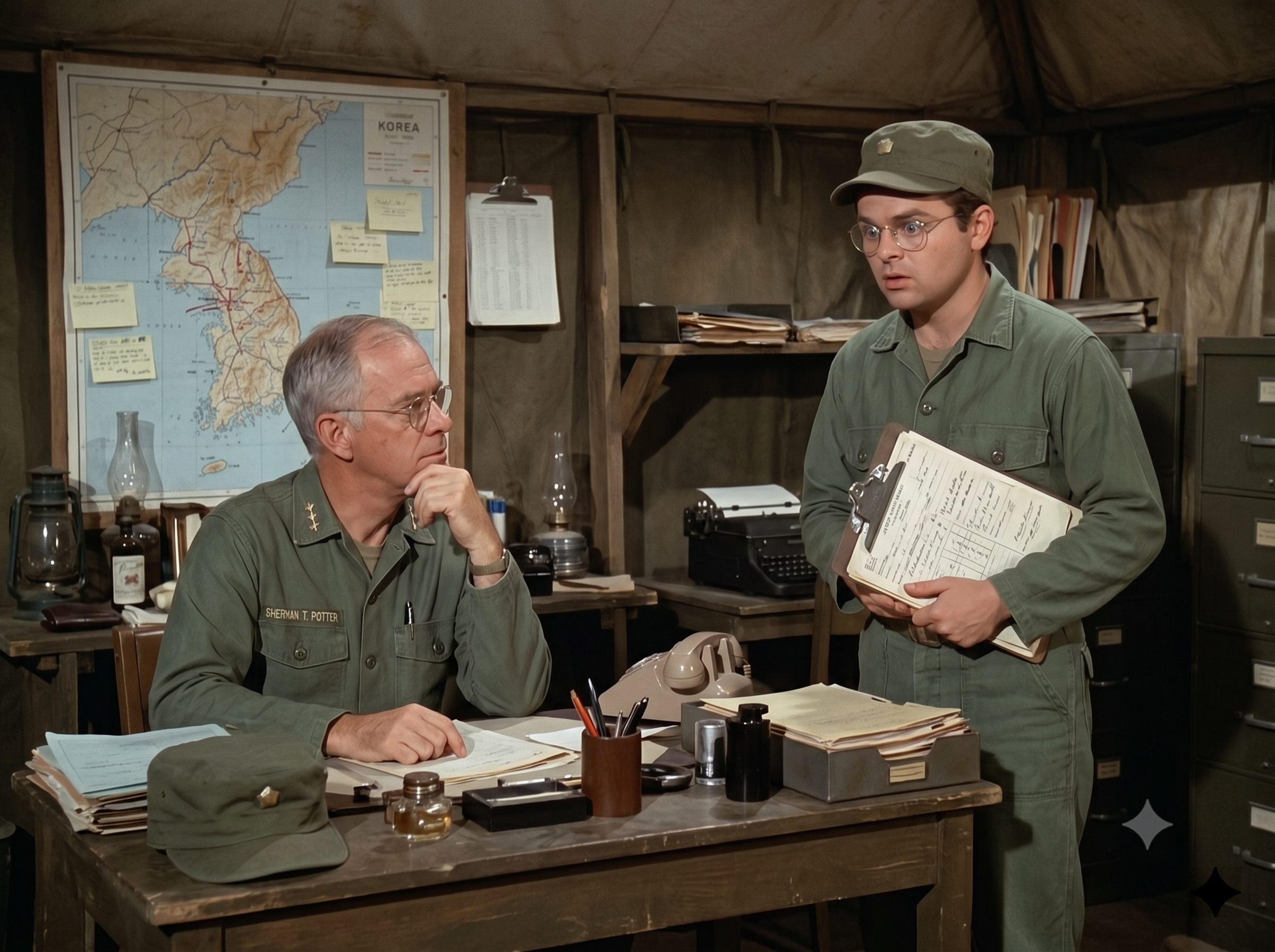
There were two types of quiet at the 4077th Mobile Army Surgical Hospital.
There was the heavy, suffocating quiet that fell over the compound just before the choppers arrived, thick with dread and the smell of impending work.
Then, there was the dull, sticky quiet of a Tuesday afternoon when the war decided to take a brief, humid nap.
Colonel Sherman T. Potter much preferred the latter, though it rarely lasted long.
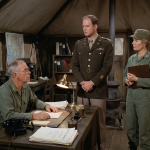
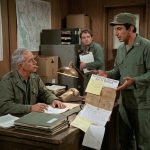
He sat behind his heavy wooden desk, the canvas walls of his office baking in the Korean afternoon sun. The air smelled of dust, old canvas, and the sharp tang of mimeograph ink.
Behind him, a map of the Korean peninsula hung on the wall, a constant, mocking reminder of exactly where they were stuck.
Potter was trying to enjoy a rare moment of peace, mentally composing a letter to his wife, Mildred, when the inevitable interruption arrived.
It didn’t come with the scream of a siren. It came with the timid, familiar squeak of his screen door.
“Enter,” Potter called out, his voice a gravelly rumble.
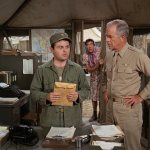
Corporal Walter “Radar” O’Reilly slipped into the room.
Radar didn’t just walk into a room; he seemed to materialize apologetically, always trying to take up as little space as possible.
Today, the young clerk stood stiffly at attention, his olive-drab cap pulled low over his forehead, his round glasses magnifying his wide, anxious eyes.
Clutched tightly to his chest, as if it were a shield against enemy fire, was a battered wooden clipboard.
Potter didn’t need to be a mind reader to know what that clipboard meant. He had spent enough decades in the United States cavalry to recognize the look of a soldier delivering bad news from headquarters.
“What is it, son?” Potter asked, not unsympathetically. “Did I Corps decide we’re using too many bandages again? Or are they rationing the powdered eggs?”
Radar swallowed hard. His Adam’s apple bobbed nervously above his collar. “Uh, neither, sir. It’s… well, it’s a directive. From Supply.”
Radar stepped forward and laid the clipboard on the cluttered desk, navigating carefully around the heavy rotary phone, a glass inkwell, and a stack of manila folders.
Potter leaned forward slightly. He didn’t pick up the paper immediately.
Instead, he rested his chin against his knuckles, staring through his wire-rimmed glasses at the dense, faded type of the Army form.
He read the first paragraph. He blinked. He read it again.
The silence in the tent stretched out, growing thicker with every passing second.
Radar shifted his weight from one foot to the other, his hands nervously twitching at his sides. He looked like a farm boy who had just accidentally backed the family tractor over the prize-winning rooster.
“Sir?” Radar squeaked, unable to bear the silence any longer. “I tried to call Sparky in Seoul to get it straightened out, but he said it came down from General Hammond’s office on a blue form. And you know what they say about blue forms, sir.”
Potter held up a single, authoritative finger.
The babbling instantly stopped.
Potter kept his chin resting on his hand. He didn’t yell. He didn’t sigh. He just stared at the young corporal with a look of dry, patient exasperation that only a man who had survived two world wars could muster.
“Radar,” Potter said, his voice dangerously calm and quiet. “Am I reading this correctly?”
Radar winced, as if the question itself carried a physical weight.
“Technically, sir… yes,” Radar said, his voice dropping to a whisper. “According to the Quartermaster General, due to a clerical error in section 4-G, paragraph 12… the 4077th is no longer classified as a Mobile Army Surgical Hospital.”
Potter didn’t move a muscle. “And what, pray tell, are we classified as?”
“A Class-3 Amphibious Assault Craft, sir,” Radar answered, closing his eyes briefly as he delivered the punchline.
Potter slowly let out a breath. He lowered his hand from his chin and picked up the paper.
He stared at it as if it were a fascinating, incredibly stupid bug that had crawled onto his desk.
“An amphibious assault craft,” Potter repeated, letting the words roll around in his mouth. “In the middle of a landlocked valley. Three miles from the front lines. Surrounded by mountains.”
“Yes, sir,” Radar said earnestly. “And, well, there’s more.”
Potter looked up over the rim of his glasses. “More?”
“Yes, sir. Since we are now officially a Navy vessel, I Corps is demanding our monthly barnacle scraping report by Thursday. And they want to know who you’ve appointed as your First Mate.”
For a long moment, Potter just looked at the boy.
He looked at the sweat beaded on Radar’s forehead, the genuine panic in his eyes, the absolute, unwavering dedication to a job that made absolutely no sense.
The Army was a massive, unfeeling machine that churned out madness on a daily basis. And here was this kid from Ottumwa, Iowa, standing in the middle of a war zone, terrified because he couldn’t find a way to scrape imaginary barnacles off a canvas tent.
The sheer absurdity of it all hit Potter, washing away his irritation.
The exasperation on his face softened into something entirely different. It was a look of deep, fatherly warmth, mixed with a quiet sorrow for the innocence that war so carelessly demanded.
“Corporal,” Potter said gently.
“Yes, Colonel?”
“Do you know what the penalty is for failing to file a barnacle report in the middle of a mountain range?”
Radar blinked, confused by the shift in tone. “No, sir. Is it… is it a court-martial?”
Potter smiled, a small, tired smile that crinkled the corners of his eyes.
He picked up a pen from his desk, unscrewed the cap, and brought the clipboard closer.
“The penalty, son, is absolutely nothing,” Potter said. “Because the United States Army, in all its infinite wisdom, has never figured out how to court-martial a tent.”
Potter began to write with large, sweeping strokes across the bottom of the official blue form.
“We are going to send this back to General Hammond’s office,” Potter continued, his voice finding its familiar, comforting rhythm. “We will inform them that due to heavy enemy mortar fire, our starboard bow has been compromised, and all barnacles were tragically lost at sea.”
Radar’s shoulders finally dropped. A tiny, relieved smile tugged at the corner of his mouth. “Should I sign it as the First Mate, sir?”
“No,” Potter said, signing his own name with a flourish. “You’re too valuable as a company clerk to be demoted to the Navy. File this under ‘S’ for ‘Shenanigans,’ and let Sparky know that if they ask for a manifest, we’re currently hauling a cargo of exhausted doctors and bad coffee.”
Potter handed the clipboard back.
Radar took it, holding it a little less like a shield and a little more like a victory banner. “Yes, sir. Thank you, sir.”
“And Radar?”
“Sir?”
“Get yourself a grape Nehi. And take a breath. You’re doing a fine job keeping this leaky boat afloat.”
Radar beamed, gave a sharp, crisp salute, and hurried out the door, the screen snapping shut behind him.
Potter watched him go. He shook his head, looking back down at the map of Korea. The war was still waiting right outside the canvas. The choppers would eventually return. The madness would continue.
But for now, the captain of the most landlocked ship in the Army picked up his pen and finally went back to writing his letter home.
In a place where nothing made sense, the only thing that kept them sane was each other.