The 4 A.M. Truce
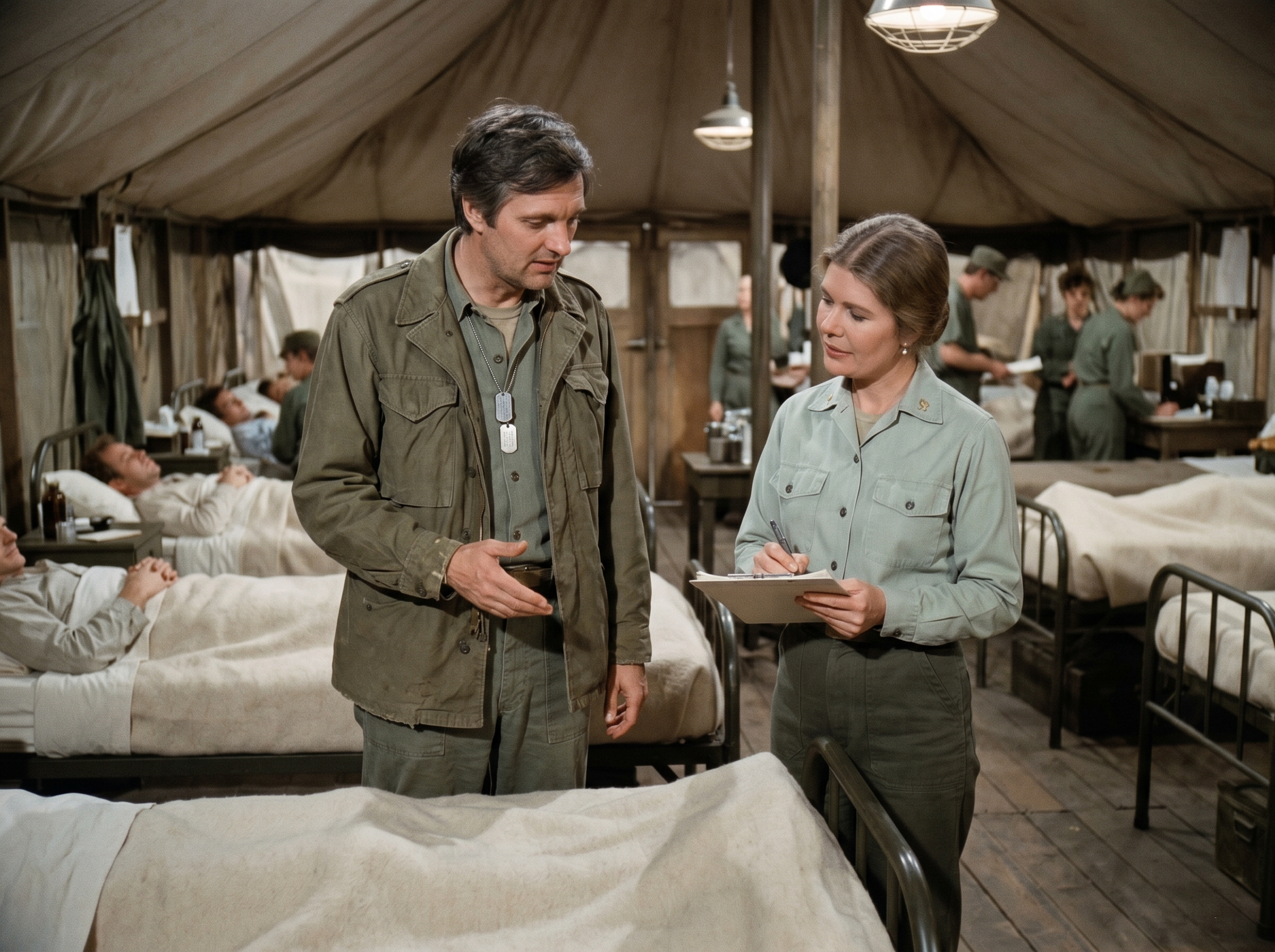
Post-Op at 0400 hours always possessed a very specific kind of quiet. It wasn’t the peaceful silence of a sleeping hometown, but the heavy, suspended stillness of a place holding its breath.
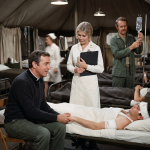
Outside the canvas walls of the 4077th, the Korean wind was biting, rattling the wooden tent frames and whistling through the camp. Inside, the ward was a cocoon of pale green canvas, muted white wool blankets, and the soft, dusty glow of overhead television lights.
The air smelled faintly of ether, iodine, and damp wool. Rows of metal cots stretched into the shadows, each holding a heavily bandaged kid who had somehow traded a muddy trench for a clean pair of sheets.
Hawkeye Pierce stood beside the third bed on the right. He looked like a man who had forgotten how to sleep.
His olive-drab fatigue jacket hung loosely over his scrubs, practically lived-in and unbuttoned to the chest. His dog tags rested heavily against his shirt, catching the dull overhead light. He had been standing in that exact spot for nearly three hours, anchored to the bedside of a nineteen-year-old private from Ohio who had arrived on a chopper looking more like a ghost than a soldier.
Beside him stood Major Margaret Houlihan.
Margaret carried her authority like armor, but in the quiet hours of Post-Op, the brass melted away. She wore her green fatigue shirt, her hair pinned back practically, a medical clipboard resting securely in her hands.
Usually, this was the hour when their personalities collided. This was the hour for Hawkeye to make an inappropriate wisecrack and for Margaret to threaten him with a court-martial.
But tonight, the exhaustion was too thick for their usual dance.
“I’m telling you, Margaret,” Hawkeye whispered, his hands moving in that expressive, familiar way, lifting in a half-shrug to deflect the heavy atmosphere. “The kid has a hollow leg. I pumped three pints of O-negative into him, and he’s still insisting on taking my shift at the mess tent.”
He offered a warm, attempting smile, but it didn’t quite reach his eyes. Beneath the joke, there was a quietly wounded look. A raw, ragged edge of concern that he couldn’t completely hide.
Margaret didn’t snap at him. She didn’t roll her eyes. Instead, she looked down at the medical chart in her hands.
Her eyes traced the jagged lines of the boy’s vitals from the past twelve hours. She saw the terrifying dip at midnight. She saw the frantic, barely legible notes Hawkeye had scribbled when the boy’s blood pressure had plummeted. She read the silent, desperate fight that had taken place in the dark while the rest of the camp slept.
Suddenly, the young private in the bed shifted.
A low, wet groan escaped the boy’s lips, and his chest hitched erratically. The steady rhythm of his breathing broke, turning shallow and rapid.
Hawkeye’s hands froze mid-gesture.
The tired joke died instantly in his throat. His shoulders went rigid, the masked bravado falling away completely. He leaned over the bed, his dark eyes locked on the boy’s pale face, terrified that the fragile thread keeping the kid tethered to the earth was about to snap.
Margaret gripped the clipboard tightly, her knuckles turning white. She looked up from the paper, the sharp presence of the Head Nurse suddenly entirely eclipsed by a sudden, suspended fear. She looked at the boy, and then she looked at Hawkeye, catching the absolute, unshielded desperation in his eyes.
The tent was dead silent, save for the faltering breath of a nineteen-year-old boy, as both doctors waited to see if the war had claimed one more.
For five agonizing seconds, nobody moved.
The distant hum of the camp generator seemed to grow deafening in the silence. Hawkeye didn’t reach for his stethoscope; he just stared, his hands hovering uselessly over the muted white blanket, waiting for a sign.
Then, the boy exhaled.
It was a long, shuddering sigh. He turned his head slightly on the thin pillow, his chest settling back into a slow, deep, rhythmic rise and fall. The crisis evaporated as quickly as it had arrived. The boy slipped back into a heavy, healing sleep.
Hawkeye let out a breath he seemed to have been holding since yesterday afternoon.
He slumped back slightly, the adrenaline suddenly draining from his veins, leaving behind a bone-deep, hollow exhaustion. He reached up, rubbing the back of his neck, his eyes dropping to the wooden floorboards.
Margaret stood perfectly still beside him.
She didn’t rush to check the boy’s pulse. Her practiced eyes told her exactly what she needed to know. The color was returning to the boy’s cheeks. He had rounded the corner. He was going to make it.
Slowly, Margaret looked back down at the medical chart resting against her arm.
She held her pen poised over the paper, but she didn’t write anything. Instead, a profound shift occurred in her posture. The rigid, military spine softened. The strict, demanding Head Nurse faded away, leaving behind a deeply exhausted, incredibly compassionate woman.
She looked at the frantic notes Hawkeye had written at two in the morning. She understood exactly what it had cost him to keep this kid alive.
When Margaret finally lifted her head to look at Hawkeye, her expression was entirely transformed.
The harsh lines of authority were gone, replaced by a quiet, moved expression of hidden warmth. Her eyes were incredibly tender, holding a profound vulnerability that she rarely allowed anyone in the 4077th to see.
“His pressure is stabilizing beautifully, Captain,” she said. Her voice was just above a whisper, gentle and incredibly kind.
Hawkeye looked up, surprised by the softness of her tone. He blinked, trying to assemble his usual armor of sarcasm. He waved his hand again, a weaker version of his previous gesture.
“Well, naturally,” Hawkeye replied, his voice a gravelly rasp. “I promised him if he made it to breakfast, I’d introduce him to a nurse from Toledo who owes me a favor. He’s highly motivated.”
It was a weak joke, fragile as glass.
Usually, Margaret would have bristled. She would have told him he was disgusting, turned on her heel, and marched out of the tent.
But tonight, she leaned in.
She didn’t step away. She stayed right beside him, standing shoulder-to-shoulder in the dim light of the Post-Op ward. She looked at his tired, unshaven face, seeing the tremendous weight he carried beneath the endless stream of martinis and wisecracks.
She understood him. They drove each other completely crazy, they fought over protocol and decorum, but in this specific, muddy circle of hell, they spoke the exact same language.
“You did good, Pierce,” Margaret said quietly, looking down at the chart again.
Hawkeye stopped moving. His hands fell to his sides. He looked at Margaret, really looked at her, and saw the genuine respect and affection shining beneath her professional exterior.
He didn’t make another joke. He didn’t deflect.
“We both did, Margaret,” he said softly.
They stood there together for a long time, bathed in the gentle, even television lighting of the surgical tent. They were just two exhausted people in practical, worn green fatigues, standing guard over a sleeping kid.
Around them, the 4077th continued to sleep. Tomorrow, the choppers would inevitably return. The sirens would wail, the loudspeakers would crackle, and the blood would flow again. They would go back to arguing over proper military procedure in the mess tent.
But in this singular, fragile moment, there was no war. There was no rank.
There was only a boy sleeping safely in a cot, and two friends sharing a quiet, hopeful pause in the dark, finding a brief moment of humanity before the sun came up to start the madness all over again.
In a place built on breaking hearts, it was the quiet moments of shared survival that somehow held them all together.