The Quiet Miracles of the 4077th
There was a specific kind of silence that fell over the Operating Room at the 4077th after a marathon session.
It wasn’t a peaceful silence. It was heavy, ringing with the phantom echoes of dropped clamps, hissed curses, and the endless, mechanical hum of the camp’s overworked generators.
It was the silence of a battle paused, not won.
For the last sixteen hours, the O.R. had been a meat grinder. The influx of wounded had rolled in like a dark tide, pushing every surgeon, nurse, and corpsman past the limits of ordinary human endurance.
Now, finally, the tide had briefly receded. The last patient—a frighteningly young corporal from Iowa—was stable. His chest rose and fell in a steady, miraculous rhythm beneath the modest green surgical drapes on the table behind them.
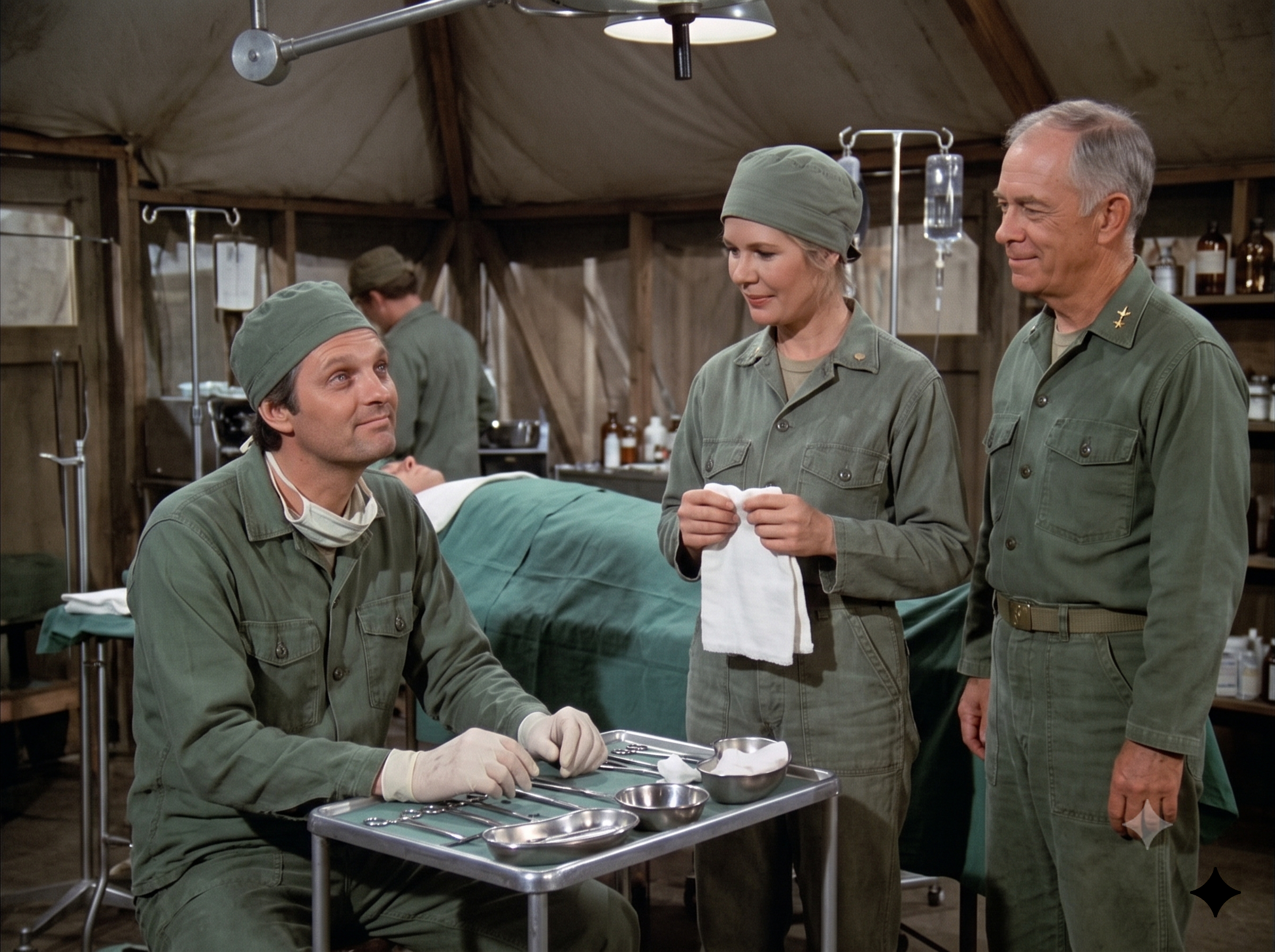
Hawkeye Pierce didn’t walk away from the table. He simply collapsed onto a small metal stool beside a stainless steel surgical tray.
His shoulders slumped beneath his faded, sweat-stained green scrubs. He didn’t even have the energy to peel off his rubber surgical gloves.
With a deep, shaky breath, Hawkeye reached up with a sterile wrist and hooked his surgical mask, pulling it down around his neck. The cool air of the tent hit his face, but it did little to wash away the bone-deep weariness etched into his features.
He sat there staring at the glint of the period instruments resting on the tray. Forceps. Scalpels. The simple tools they used to desperately patch together a broken world.
Footsteps approached softly against the wooden floorboards.
Hawkeye didn’t need to look up to know who it was. The sharp, precise cadence belonged to Major Margaret Houlihan.
Usually, this was the moment when the tension snapped. This was when exhaustion bred irritation, and a misplaced tool or an improper uniform would spark a fiery lecture from the Head Nurse.
Hawkeye prepared himself for the inevitable bark. He needed to deflect. He needed to build a shield of dry, stinging wit to protect his own frayed nerves.
Slowly, he tilted his head up. His expressive eyes, heavy with fatigue, locked onto hers. He opened his mouth, a clever, cynical remark already resting on the tip of his tongue, ready to break the fragile glass of the room’s silence.
But the words died in his throat.
Margaret wasn’t glaring. She wasn’t standing at attention.
She stood across from him, holding a simple, folded white cotton towel in both hands. And the expression on her face made Hawkeye forget how to breathe.
The rigid, professional pride that usually armored Margaret Houlihan had completely melted away.
In its place was a look of quiet, profound tenderness. Her eyes, framed by her green surgical cap, were remarkably soft, shimmering with an unspoken, moved gratitude.
She wasn’t looking at a subordinate, and she wasn’t looking at a cynical rebel. She was looking at a man who had just spent sixteen hours refusing to let the Reaper take another boy from her ward.
“You look like you lost a fight with a washing machine, Pierce,” she said softly. Her voice carried no bite, only a gentle, weary warmth.
Hawkeye blinked, the smart remark evaporating completely. His wry, exhausted features softened into a look of genuine, boyish relief. The tension in his jaw unclenched, and a small, dry smile tugged at the corner of his mouth.
“I’ll have you know,” Hawkeye replied, his voice a gravelly whisper, “I won that fight. The washing machine surrendered unconditionally at oh-four-hundred.”
Margaret let out a quiet, breathy chuckle. It was a beautiful, honest sound that rarely echoed in the sterile canvas room.
She took a step closer, her hands gently offering the white towel toward him. It was a simple, maternal gesture. A silent acknowledgment of the blood, sweat, and impossible burden he carried.
Hawkeye didn’t take the towel immediately. He just looked up at her, letting the warmth of her rare, unguarded affection wash over him. In a place defined by mud, fear, and fading olive-drab hospital tones, this quiet moment of pure humanity was a lifeline.
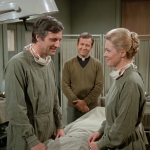
Standing just a few feet away, Colonel Sherman T. Potter watched them.
The seasoned commander wore his standard green fatigues, his silver eagles catching the bright, soft light of the overhead O.R. lamps. His hands rested casually near his belt, his posture relaxed but commanding.
Potter didn’t interrupt. He just observed, his lined face breaking into a look of seasoned presence and gentle pride.
He had commanded many units in his lifetime. He had seen soldiers of every stripe. But this chaotic, insubordinate, brilliant group of misfits at the 4077th was something entirely unique.
Potter knew that Pierce and Houlihan could fight like cats and dogs in the mess tent. But here, under the bright lights, in the darkest hours of the night, they were bound by a sacred, unspoken loyalty. They were a family forged in an absolute crucible.
“Fine work today, people,” Potter finally said, his gravelly voice keeping its volume low so as not to shatter the peace.
Hawkeye shifted his gaze to the Colonel, his smile widening just a fraction. “Just trying to keep the customer satisfaction high, Colonel. The food here is terrible, so we have to excel in customer service.”
“Well, you earned your pay today, Pierce,” Potter smiled warmly. “And yours too, Major. The both of you. Go get some rest. That’s an order.”
Margaret finally stepped forward and laid the white towel gently on the edge of Hawkeye’s Mayo stand.
“Wash your face, Hawkeye,” she murmured, using his first name—a rare and meaningful slip of protocol. “You’ve earned a clean slate for the night.”
“Thank you, Margaret,” Hawkeye said quietly. He meant it. For the towel, for the truce, and for the grace she was showing him.
Margaret nodded, her composed professional pride slowly returning, but the softness remained in her eyes. She turned and began the process of organizing the post-op cleanup, her movements deliberate and graceful in her worn scrubs.
Hawkeye stayed seated for another long moment. He looked at the white towel, then up at the fading canvas ceiling.
He was thousands of miles from home. He was exhausted down to his marrow. But as he listened to the quiet, reassuring footsteps of his commanding officer and the steady, capable movements of his head nurse, he felt an overwhelming, bittersweet comfort.
He wasn’t alone. They were all in this mud together. And for tonight, at least, that was enough.
In a war that took everything, the quiet moments of shared humanity were the only victories that truly mattered.