The Weight of a Single Sheet of Paper
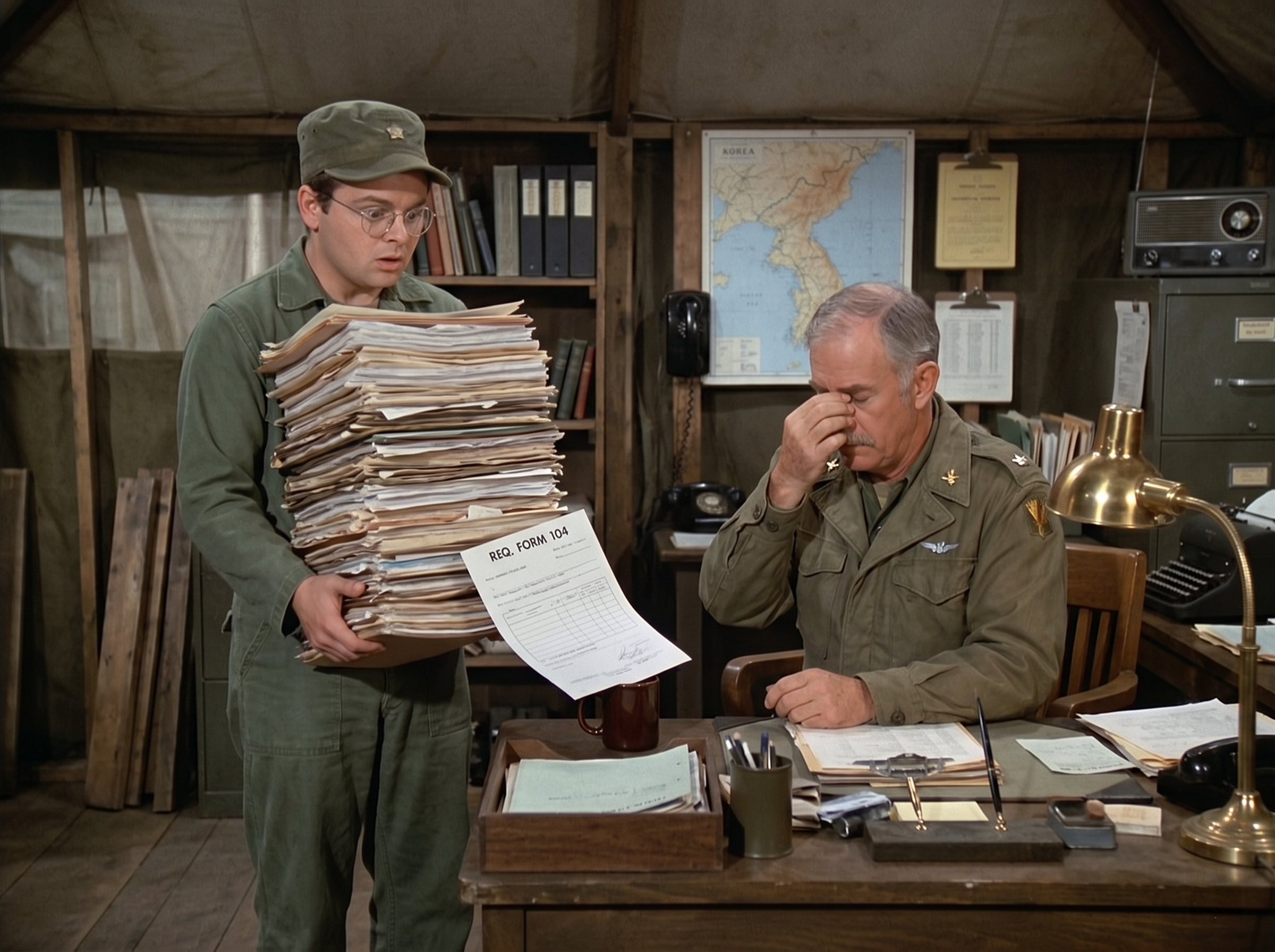
The stillness of Colonel Sherman Potter’s tent-office was a fragile thing.
Behind him, the map of Korea held its ground, a tangle of shifting front lines and colored pins, silent witness to a conflict that refused to follow logic.
But inside, the air was heavy with the smell of stale coffee and ink.
Potter sat at his desk, the lamp casting a low, warm light over an already impressive mountain of paperwork.
His hand was pressed against his eyes, his entire being radiating a bone-deep weariness that had nothing to do with the distant, thumping guns and everything to do with the relentless, grinding futility of bureaucracy.
He’d spent the last hour trying to decipher a directive from the brass in Seoul, a document so convoluted that even his beloved Mildred’s latest letter couldn’t soothe the administrative headache it had induced.
His index finger was dug into his temple, trying to rub away the throbbing that came with the job description.
A shadow fell across his cluttered desk.
It was a small shadow, a familiar shadow.
Radar O’Reilly had a way of appearing, not with a flourish, but with a quiet, earnest persistence.
He was a good kid, perhaps the finest clerk a colonel could ever hope to have, a master of finding the needle in a haystack of regulations.
But today, Radar wasn’t just bringing the paperwork; he seemed to be delivering a verdict.
He stood before the desk, not saying a word.
The stillness in the tent deepened.
Radar was carrying a stack.
It wasn’t just a pile of documents; it was a paper monument to military inefficiency.
The stack was nearly as tall as his entire torso, a teetering monolith of yellowed forms, carbon copies, and triple-duplicate requisition orders.
It appeared so heavy that Radar’s glasses were slipping down his nose, his brow furrowed with an intense effort to keep the balance.
One paper, taped right in the center, was the target of his gaze.
He held it like a sacred, terrible scroll.
The simple, clear text was visible: “REQ. FORM 104.”
Potter didn’t move. He hadn’t even taken his hand away from his eyes yet.
But he felt it.
He felt the weight of that incoming paper avalanche as if it were pressed directly against his chest.
The silence grew loud.
He finally began to lower his hand, his eyes opening slowly, already filled with a deep dread.
His gaze met Radar’s anxious eyes, then traveled to the stack.
And then his focus narrowed, zeroing in on that single, specific number.
Req. Form 104.
Potter’s face began to change.
The fatigue didn’t leave, but it was joined by a profound, incredulous realization.
He knew exactly what that form meant.
The moment stretched, suspended in the cool, ink-stained air of the tent.
And then, as the full weight of that single sheet of paper settled upon him, he closed his eyes again, not in a new headache, but in a quiet, devastating collapse of morale.
Potter’s hand remained over his eyes for a long, heavy minute.
He didn’t yell. He didn’t slam a fist on the desk.
He simply let out a long, slow exhale that sounded like a tire deflating.
Radar shifted his feet, a soft sound on the wooden plank floor.
The massive stack of paperwork didn’t wobble.
“Req. Form 104,” Potter murmured, his voice thick with a dry, tired resignation.
Radar took a small step forward, his voice a cautious whisper.
“The triple-duplicate, seven-page manifesto required to authorize the requisition of anything deemed ‘potentially non-essential,’ but actually crucial,” Radar supplied, quoting the reg manual with nervous fluency.
Potter finally opened his eyes, staring directly at the form, then back at Radar.
“Non-essential? That, Radar, is our entire surgical glove inventory. We operate with these.”
The dry humor was the only thing that kept the frustration manageable.
The image of administrative brass in Seoul, sipping gin and tonics while declaring surgical gloves “non-essential,” was a picture that did not sit well with the reality of a field hospital.
“They’ve rejected the previous 102 and 103, haven’t they?” Potter asked, though he already knew the answer.
Radar nodded, his shoulders slumping under the unseen weight.
“This is the third request this week, Colonel. They keep returning them as incomplete because the ‘reason for necessity’ wasn’t spelled out clearly enough on line 14B.”
“Reason for necessity?” Potter’s voice took on a sharper edge.
“Our reason is simple, Radar: we operate on people who don’t want to get infected. It’s a medical tent, not a glove-manufacturing facility.”
“Yes, sir. But they want it spelled out.”
“Put it down, Son.”
Potter gestured to the only available spot on his desk: a wobbly side table, barely large enough to hold a mug.
Radar approached, his movements meticulous.
He had to get the angle just right to avoid a catastrophic collapse.
He carefully eased the stack onto the small surface.
The table groaned, and the stack teetered for an agonizing second, but Radar’s delicate touch prevailed.
He stood back, adjusting his glasses, a quiet look of relief crossing his face.
The monument to bureaucracy now loomed large, a testament to the absurdity they faced daily.
Potter looked from the map, to his exhausted clerk, and then down at the specific paper with Req. Form 104 still visible.
He’d faced down enemy infantry, artillery barrages, and impossible supply lines in two wars.
But this? This was the true battlefield.
The constant battle against people who fought from behind a desk, whose weapon of choice was a rejection stamp.
“Get Hawkeye to sign the ‘official’ rejection form. Make it look like he spent four hours meticulously completing it. Then, have him write ‘This space intentionally left blank by order of Hawkeye’ right across the center.”
Radar nodded, a small smirk touching his lips.
It was a tactic they had used before.
Sometimes, the best way to fight absurdity was with an equal and opposite absurdity.
But the real solution lay elsewhere, and Potter knew it.
He looked at his small, industrious clerk, a kid from Iowa who had a better grasp of the human condition than half the officers in Seoul.
“And after that, Radar… go talk to that supply sergeant from the 8063rd.”
Potter knew that Radar, in his own quiet way, had ways of bypassing official channels.
“Tell him I need five boxes of surgical gloves. By Tuesday. And tell him… the 4077th is willing to trade two cases of scotch and Klinger’s favorite silk robe from when he tried to get sent home for being a ballerina.”
Radar’s eyes lit up. He knew the sergeant. He knew the value of Klinger’s collection.
“On it, Colonel. Consider it done.”
Potter watched him go, a small, genuine smile finally reaching his eyes.
Radar stopped at the tent opening, turning back.
“And about Req. Form 104, sir? Do you still want me to have Hawkeye sign it?”
Potter looked at the map, then back at the small, resilient figure.
“No, Son. Put that form in my ‘special file’ for the time being. The one I keep under my mattress.”
They both understood.
The paperwork was just a game.
The real win was found in looking after their people.
As Radar left, a quiet chuckle escaped Potter.
He reached for his coffee mug. It was cold.
But for the first time that day, the weight of the paper monument on the small table seemed just a little bit lighter.
In the heart of the storm, friendship and ingenuity always had a way of finding the only available desk space.