The Fabric of Home in the Mud of Korea
:Some days in the Korean mud don’t feel like days at all. They feel like a single, never-ending shift where the clock hands refuse to move, and the smell of rubbing alcohol and damp canvas settles so deep into your skin you think it’ll never wash out.
After a grueling thirty-six hours in the Operating Room, the world usually shrinks to the size of a canvas cot and a pillow that smells like stale feathers.
But when the supply truck finally groans its way into the 4077th after a three-week delay, nobody sleeps. A supply delivery is Christmas, a birthday, and a ticket home all wrapped into one splintered wooden crate.
Inside the supply tent, the air was thick with the scent of damp wool, cedar shavings, and the familiar, underlying musk of old canvas.
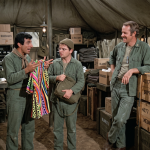
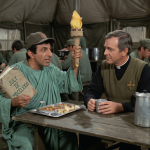
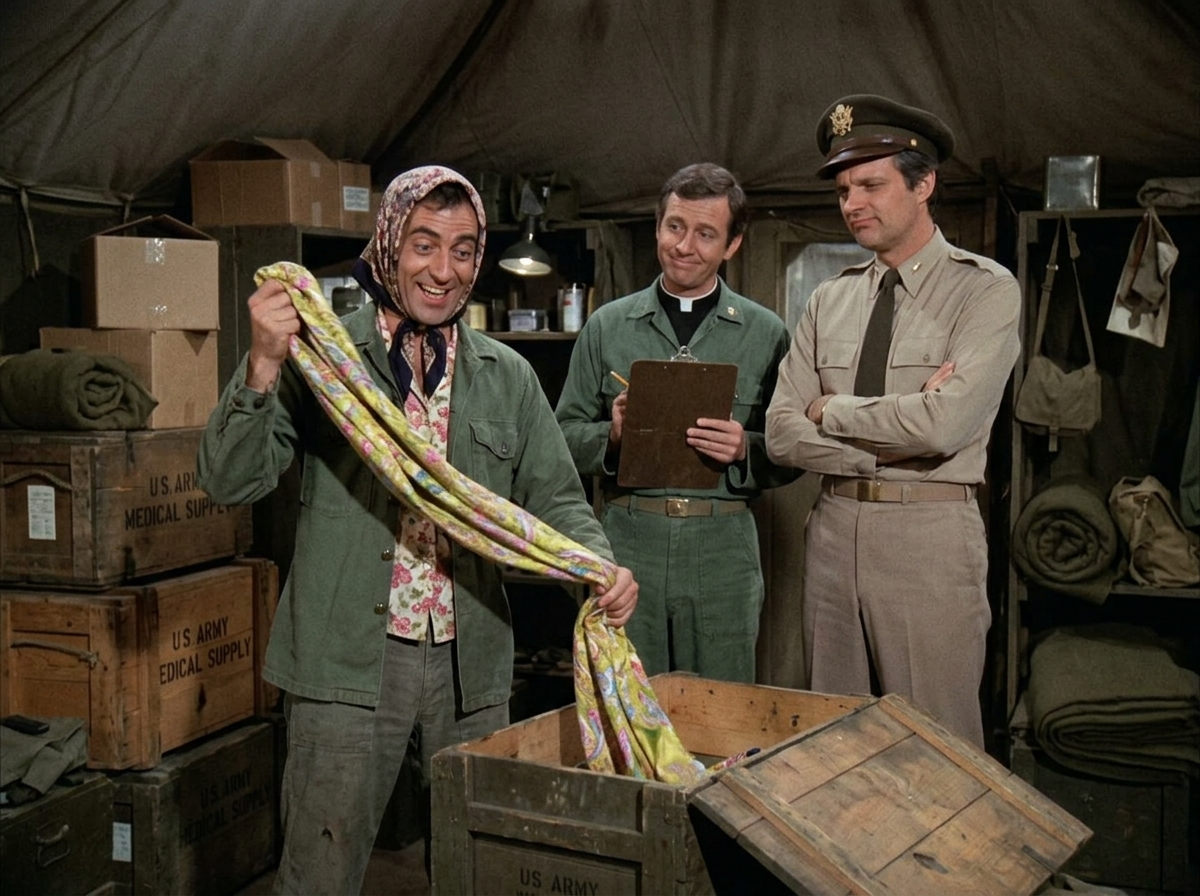
Corporal Klinger stood over a freshly pried-open crate, his eyes wide and shining with an absolute, unadulterated triumph that could light up the entire peninsula.
Wrapped tightly around his head was a mismatched, patterned scarf, but his hands held something far more precious—a long, flowing length of bright, floral fabric, patterned with vibrant pinks, yellows, and greens that seemed utterly defiant against the olive-drab world around them.
To Klinger, it wasn’t just a bolt of cloth; it was a masterpiece, a temporary passport back to Toledo, and perhaps the ultimate ticket out of the Army.
Standing just behind him, clipboard in hand and a pencil tucked neatly over his ear, Father Mulcahy watched with a gentle, bemused smile. He had come to log the incoming medical supplies—the gauze, the sulfa, the clean syringes—but as always, the chaotic humanity of the 4077th had taken center stage.
Beside the priest stood Captain Hawkeye Pierce, his arms crossed over his faded khakis, his officer’s cap tilted back just enough to look casual, though his posture carried the heavy, undeniable slouch of a man who had spent the last two days sewing human beings back together.
Hawkeye’s expression was a brilliant mix of skepticism, exhaustion, and fond amusement as he looked at the sheer joy radiating from the camp’s most notorious dressmaker.
“I’m telling you, Father, it’s a sign from above!” Klinger declared, his voice ringing out with theatrical grandeur as he lifted the floral fabric toward the swinging lightbulb of the tent. “Look at the stitching! Look at the drape! This isn’t just a dress, this is my ticket to freedom! One look at me in this, and the brass will be signing my Section Eight before sundown!”
Father Mulcahy offered a quiet, patient chuckle, adjusting his collar slightly. “It certainly is… vibrant, Klinger. Though I’m not entirely sure the Quartermaster Corps intended for floral prints to be included in a shipment marked ‘U.S. Army Medical Supply’.”
Hawkeye let out a dry, tired laugh, shifting his weight. “Come on, Father. You know the Army. They probably ran out of standard-issue olive drab and decided to raid a Sears and Roebuck curtain department. Besides, Klinger looks better in paisley than any man has a right to.”
Klinger didn’t care about the ribbing; he was already draping the fabric over his arm, his fingers moving with a practiced tenderness as he examined every inch of the material. “Joke all you want, Captain. But when I’m walking down peacetime streets in a custom-tailored tea gown, you’ll be wishing you had the eye for fashion.”
He began to pull more of the fabric from the crate, his smile widening, but as his hands dug deeper into the cedar shavings beneath the cloth, his expression suddenly shifted.
The theatrical flair instantly vanished from his face, replaced by a sudden, jarring stillness.
Hawkeye noticed the change immediately, his sharp eyes narrowing as the playful smirk died on his lips. “Klinger? What is it? Did you find a nest of Korean field mice, or did the Army accidentally ship us actual penicillin?”
Klinger didn’t answer right away. His hands were trembling slightly as he reached all the way to the bottom of the wooden crate, pulling out a small, separate bundle that had been hidden beneath the colorful fabric.
Father Mulcahy stepped forward, his gentle smile fading into a look of quiet concern as he saw the sudden paleness in the Corporal’s face.
The silence inside the tent grew heavy, swallowing the distant, comforting rumble of the camp’s generator, leaving only the sound of three men breathing in the dim light.
Klinger slowly lifted the object out of the crate, and the bright, floral fabric slid from his shoulder, pooling forgotten on the dirty wooden floor.
It wasn’t a piece of clothing, nor was it a supply for the hospital. It was a small, hand-knitted woolen blanket, colored a simple, faded blue, and tucked inside it was a piece of cardboard with a child’s handwriting scrawled in faded ink.
Hawkeye stepped closer, his arms unfolding as the cynical, joking doctor disappeared, leaving only the deeply empathetic man underneath. He gently reached out and took the piece of cardboard from Klinger’s unresisting fingers.
“What does it say, Pierce?” Father Mulcahy asked softly, his voice a calming anchor in the quiet tent.
Hawkeye looked down at the card, his throat tightening slightly as he read the words aloud. “‘To a brave soldier. Keep warm. Love, Clara. Grade 3, Ohio.'”
The words hung in the damp air of the tent, carrying the immense, crushing weight of a home that felt ten thousand miles away.
Klinger looked down at the small blue blanket in his hands, his thumbs tracing the uneven, clumsy stitches of a little girl from his own home state—a girl who had sat somewhere safe and warm, knitting a piece of comfort for a soldier she would never meet.
The theatrical defiance, the schemes for a Section Eight, the constant, desperate desire to escape—it all seemed to evaporate from Klinger in that single, quiet moment. He wasn’t a character in a comedy routine anymore; he was just a tired boy from Toledo, desperately homesick, holding a piece of yarn that smelled faintly of a far-away peace.
“Ohio,” Klinger whispered, his voice cracking just a bit as he stared at the blanket. “She’s from Ohio, Captain. Just across the river from me.”
Hawkeye placed a steady, heavy hand on Klinger’s shoulder, squeezing it with a quiet, fierce loyalty that defined the found-family of the 4077th. “It’s a good piece of work, Klinger. Keeps the chill out. And God knows this place could use a little less olive drab.”
Father Mulcahy smiled, a warm, deeply moving expression that carried all the quiet grace of his calling. He stepped up beside Klinger, looking at the clumsy stitches. “The Apostle Paul spoke of the hands that labor to bring comfort to others, Corporal. I think Clara’s stitches are just as beautiful as your floral print. Perhaps even more so.”
Klinger swallowed hard, a small, genuine, and incredibly vulnerable smile breaking through his tired features. He didn’t try to hide the tear that slipped down his cheek, nor did he make a joke to deflect the emotion. He simply nodded, carefully folding the small blue blanket with a reverence he usually reserved for his finest silk dresses.
“I think… I think I’ll keep this one in my tent,” Klinger said softly, looking up at Hawkeye and the Father. “Not for a dress. Just to look at when the mud gets too deep.”
Hawkeye smiled, his own eyes reflecting a mixture of deep fatigue and profound affection for the strange, beautiful mosaic of humanity he was surrounded by every day. “You do that, Klinger. And if the Colonel asks why it’s not logged in the medical inventory, we’ll tell him it’s specialized surgical equipment for the soul.”
Father Mulcahy nodded in agreement, writing a small, unreadable note on his clipboard with a wink. “An official medical necessity, indeed.”
Klinger carefully picked up the bright floral fabric from the floor, shaking off the dust, but the frantic, desperate energy of his earlier antics was gone, replaced by a quiet, grounded peace. He looked at his friends—the cynical doctor who cared too much, and the gentle priest who saw the good in everyone—and felt, for a fleeting moment, that the swampy camp in the middle of a war zone wasn’t entirely devoid of a home.
Outside, the distant thud of artillery echoed faintly against the hills, a stark reminder of the reality waiting just beyond the compound gates. But inside the supply tent, under the warm, yellow glow of a single lightbulb, three men stood together, bound by a small blue blanket and the enduring, unbreakable spirit of the 4077th.
Because in the heart of the 4077th, home wasn’t a place on a map, but the quiet moments of grace found in the most unexpected packages.