The Distance to Toledo
Silence at the 4077th was rarely a gift; it was usually a warning. On a slow Tuesday afternoon, Colonel Sherman T. Potter sat behind his heavy wooden desk, savoring a rare moment of peace. The morning’s casualties had been light, the paperwork was only mildly agonizing, and the sharp bite of the Korean wind was temporarily held at bay by the canvas and wood of his office.
Potter sighed, rubbing his tired eyes. He was just about to pour himself a cup of lukewarm, engine-oil-tasting coffee when the door swung open.
Corporal Maxwell Klinger stood in the doorway. For once, he wasn’t wearing a velvet evening gown, a fruit hat, or a feather boa. He was dressed in standard-issue olive drab fatigues, though they hung on his frame with his usual theatrical flair.
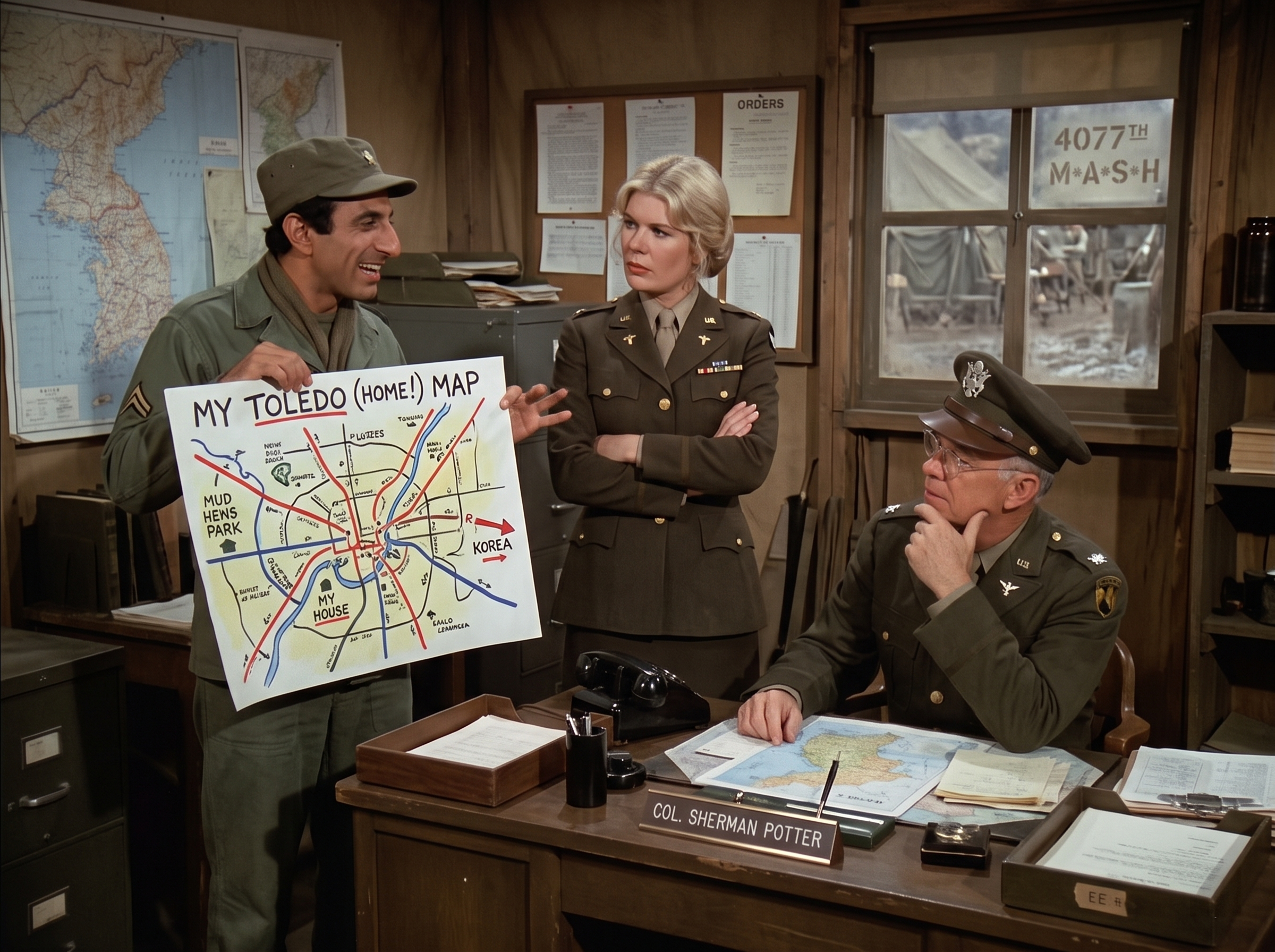
Standing right beside him, having just arrived to deliver the morning nursing report, was Major Margaret Houlihan. She immediately stiffened, her posture snapping into a perfect, rigid line of military professionalism. Her arms crossed instinctively over her chest, and her face settled into a composed, skeptical glare.
“Whatever it is, Klinger,” Margaret said, her voice sharp and clipped, “the Colonel is busy. Take your latest circus act back to the motor pool.”
Klinger ignored her entirely, his eyes fixed on Potter with a look of desperate, comic pride. “Colonel, sir,” he announced, his voice ringing with absolute earnestness. “I come before you today not as a man seeking a Section 8, but as a victim of a gross geographical tragedy.”
Potter didn’t reach for his coffee. He simply rested his elbow on the desk, placed his chin in his hand, and fixed Klinger with a look of dry, fatherly exasperation. “I have a feeling,” Potter rumbled, his voice gravelly and calm, “that I’m about to see a visual aid.”
“You are a perceptive man, sir!” Klinger grinned, stepping forward. With a grand, sweeping motion, he unrolled a massive sheet of stiff white poster board and held it up for both the Colonel and the Major to see.
It was a map. But it wasn’t a tactical grid of the 38th Parallel. It was a brightly colored, painstakingly hand-drawn diagram rendered in thick markers. Large block letters at the top proudly proclaimed: MY TOLEDO (HOME!) MAP.
Below the title was a chaotic, lovingly detailed web of red, blue, and green lines. There was a big green square labeled MUD HENS PARK. There was a winding blue squiggle representing the Maumee River. And right in the center, circled multiple times in heavy ink, was a tiny drawn building labeled MY HOUSE.
Most audaciously of all, on the far right side of the poster, Klinger had drawn a thick red arrow pointing off the edge of the cardboard. The arrow was simply labeled: KOREA.
Margaret let out a sharp scoff. “What is this nonsense? Are you trying to prove you’re crazy by drawing like a kindergartener, Corporal? Because it’s not working.”
“Major, please,” Klinger said, his expression wounded. “This is a precise cartographical document. I spent three nights in the supply tent getting the scale just right.”
He turned his pleading eyes back to Potter, who was still staring at the map with quiet, amused wisdom.
“Colonel,” Klinger continued, his voice dropping into a dramatic whisper. “Look closely at this map. Look at the distance from my house to Mud Hens Park. Then, look at the arrow pointing to Korea.”
Potter didn’t move. “I’m looking, son. What am I supposed to be seeing?”
“The error, sir! The massive, undeniable error!” Klinger tapped the poster board excitedly. “According to my calculations, the United States Army took a wrong turn at Albuquerque. You can see right here that Korea is clearly just three blocks past the Tony Packo’s hot dog stand! Therefore, I shouldn’t be deployed. I should just be commuting!”
Margaret uncrossed her arms, her face flushing with sudden anger. “Of all the ridiculous, time-wasting, infantile schemes—!”
“It’s not a scheme!” Klinger suddenly snapped, his voice cracking. The theatrical grin vanished from his face, replaced by a sudden, raw intensity. He clutched the edges of the poster board so tightly his knuckles turned white.
The silence that followed was heavy and sudden. Margaret stopped mid-sentence. Potter slowly lowered his hand from his chin, his eyes locking onto Klinger’s face.
“I didn’t draw it for a Section 8,” Klinger whispered, staring down at the little circled house on the cardboard. “I drew it because… I woke up this morning, and for five minutes, I couldn’t remember the way from my front porch to the corner store.”
The stillness in the small, worn office was absolute. Outside, the distant sound of a jeep engine sputtered and died, but inside, the air hung thick and heavy.
Margaret’s shoulders slowly dropped. The rigid, military indignation melted away from her face, leaving behind something much softer and entirely human. She looked at Klinger, really looked at him, and saw what they all tried so hard to hide. It wasn’t just Klinger the clown standing there; it was a terrified, homesick kid from Ohio who was terrified of forgetting the shape of his own life.
Margaret quietly crossed her arms again, but this time it wasn’t in anger. It was a protective gesture, a way to hold herself together against the sudden, sharp wave of empathy. She knew exactly what that fear felt like. She missed the crisp autumn air of her own hometown, the smell of her mother’s kitchen, the feeling of being somewhere safe.
Potter sat back in his chair. The dry amusement faded from his eyes, replaced by a deep, aching tenderness. He had commanded men in three wars. He had seen every trick, every lie, and every desperate attempt to escape the meat grinder. But he also knew a wounded soldier when he saw one, even if the wound wasn’t bleeding.
“Bring it here, son,” Potter said gently, gesturing toward the desk.
Klinger hesitated, blinking back the sudden moisture in his dark eyes. He slowly stepped forward and laid the oversized map flat across the Colonel’s scattered paperwork and military forms.
Potter leaned over the desk, resting his forearms on the edge. He didn’t look at Klinger; he looked closely and respectfully at the hand-drawn lines of Toledo. The faded paper tones of the military documents beneath the map seemed to vanish, overshadowed by the bright, desperate colors of home.
“Now, let me get my bearings,” Potter murmured, his voice calm and steady. He raised a finger and pointed to a blue line. “This is the Maumee River, you say?”
Klinger swallowed hard. “Yes, sir. It ain’t the Mississippi, but it’s ours.”
“And this Tony Packo’s place,” Potter continued, tracing a red line with his weathered finger. “Is it really just three blocks from where you live?”
“Two and a half, sir,” Klinger said, his voice trembling slightly before growing a little stronger. “If the wind is blowing right on a summer evening, you can smell the chili sauce right from my front porch. It’s… it’s the best smell in the world, Colonel.”
Margaret took a slow step closer to the desk, her eyes scanning the messy, beautiful drawing. “What’s this green area, Corporal?” she asked, her voice entirely stripped of its usual bark. It was quiet, gentle, and genuinely curious.
Klinger looked at her, surprised by the softness in her tone. “That’s Mud Hens Park, Major. Where the minor league team plays. My uncle used to take me there on Sundays. We’d sit in the bleachers and eat peanuts until our stomachs hurt.”
Margaret smiled, a small, sad, beautiful smile. “It sounds lovely, Max.”
It was the use of his first name that did it. Klinger let out a long, shaky breath, the last of his theatrical tension leaving his body. He wasn’t on stage anymore. He was just a boy showing his commanding officers the map of his heart.
Potter tapped the drawing of Klinger’s house. “It’s a good map, Klinger. A fine piece of cartography. You got the scale all wrong, of course. Korea is a hell of a lot further than three blocks away.”
“I know, sir,” Klinger whispered.
“But,” Potter said, looking up and meeting Klinger’s eyes with a look of profound, fatherly reassurance. “It’s good to have it down on paper. Because as long as you know where it is on the map, you can always find your way back. You haven’t forgotten a damn thing, son. It’s right here.”
Klinger stared at the older man, a deep, silent gratitude washing over his face. He nodded slowly. “Yes, sir. It is.”
“Now,” Potter said, leaning back and returning to his usual gruff, practical tone. “I can’t grant you leave based on a navigational error. The Army relies on its own maps, sadly. But I am going to order you to take this document back to your tent and pin it up somewhere safe. A soldier needs to know his topography.”
“Yes, Colonel,” Klinger said, a small, genuine smile returning to his face. He carefully rolled up the poster board, treating it with the reverence of a holy relic.
He offered a crisp, perfectly executed salute—not to butter them up, but out of genuine respect. Potter returned it. Margaret nodded warmly.
When Klinger turned and walked out of the office, his step was a little lighter. He carried the map tucked under his arm, holding his little piece of Toledo close to his chest against the Korean wind.
Inside the office, the silence returned, but it wasn’t heavy anymore. It felt warm, like the lingering heat of a fire.
Margaret looked at the door for a long moment before turning back to the desk. “He’s a good boy, Colonel.”
“The best, Margaret,” Potter sighed, finally reaching for his cold coffee. He took a sip, grimaced, and smiled softly at the empty doorway. “We all are. Just trying to find our way home.”
Some days, the bravest thing a soldier can do is remember exactly what he’s fighting to get back to.