THE SACRAMENT OF ROSIE’S BAR
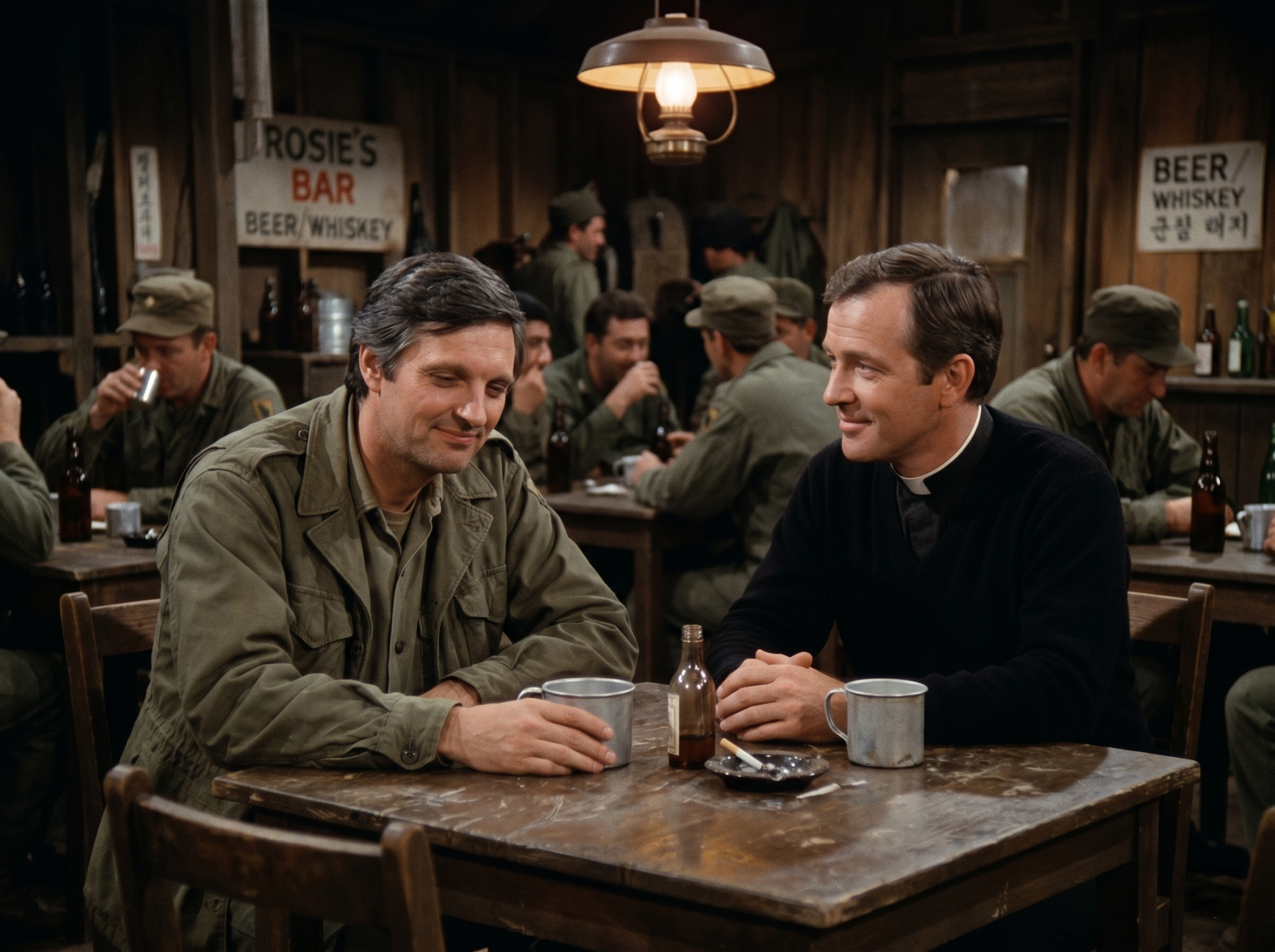
The war stopped at the swinging doors of Rosie’s Bar.
It didn’t retreat, of course. But it checked its weapons at the threshold, leaving the doctors and nurses of the 4077th just enough room to breathe.
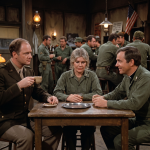
Inside, the air was thick with the smell of stale beer, cheap cigars, and whatever mysterious meat Rosie was currently passing off as ribs. The only light came from dim, amber practical lamps scattered across the small, rustic room, casting warm shadows over the wooden tables and simple chairs.
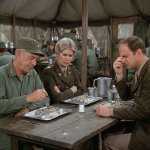
At a corner table, far from the noisy center of the room, sat Captain Benjamin Franklin Pierce.
Hawkeye leaned forward, his shoulders heavy with the invisible weight of a thirty-hour shift in the operating room. One hand rested casually on a simple ceramic cup, his long fingers drumming a slow, restless rhythm against the side. He wore his standard-issue olive drabs, the fabric worn, lived-in, and bearing the modest, dusty fatigue of a mobile army hospital.
Across from him sat Father John Patrick Mulcahy.
The chaplain’s hands were gently folded near his own drink, his posture relaxed but entirely attentive.
Hawkeye stared into his cup, offering a weary smirk to the dark liquid inside.
“I have to hand it to Rosie, Father,” Hawkeye said, his voice raspy from too much coffee and too little sleep. “Just when you think she’s hit rock bottom with her brewing techniques, she breaks out the heavy machinery and starts drilling.”
He took a small sip and winced theatrically. “I think this batch was aged in an old combat boot. A left one, specifically. You can really taste the laces.”
Father Mulcahy offered a soft smile of hopeful warmth.
He didn’t laugh out loud, but his eyes crinkled with quiet amusement. The priest knew Hawkeye too well. He knew the rapid-fire jokes were just a fence the surgeon built to keep the rest of the world from seeing how badly his hands wanted to shake.
“It’s an acquired taste, to be sure, Hawkeye,” Mulcahy replied gently. “Though I suspect the true value of Rosie’s establishment isn’t found in the glass.”
Hawkeye’s smile faded just a fraction.
The playful deflection remained on his face, but it was a thin veil tonight, barely covering a deep, welling sadness and a sharp emotional intelligence that refused to turn off. They had lost three boys on the table that afternoon. Young kids who should have been worrying about prom dates back in Ohio, not shrapnel in Korea.
Hawkeye shifted in his chair, the wooden joints creaking in the quiet corner.
He looked up, meeting the chaplain’s gaze, and for a split second, the wisecracking doctor vanished entirely. The mask simply slipped away.
“Padre,” Hawkeye asked, his voice dropping to a near-whisper. “How long before we’re all just ghosts wearing dog tags?”
Father Mulcahy didn’t flinch at the question.
He didn’t offer a quick prayer, and he didn’t pull out a rehearsed, empty sermon. He knew that Hawkeye Pierce didn’t need theology right now; he needed an anchor.
Mulcahy’s hands remained folded on the table, his demeanor radiating emotional attentiveness. He looked at the weary surgeon, the dim amber light softening the harsh lines of exhaustion etched into Hawkeye’s face.
“We are not ghosts, Hawkeye,” Mulcahy said quietly. “Not yet. And certainly not you.”
Hawkeye let out a hollow, humorless chuckle, looking back down at his cup.
“Could have fooled me, Father. I spent all day sewing up boys who looked transparent before they even reached pre-op. Sometimes I think if I close my eyes, I’ll just fade away into the canvas of the mess tent.”
He dragged his hand through his uncombed hair.
“It’s like trying to empty the ocean with a slotted spoon. You scoop, and you scoop, and the bloody water just keeps rushing back in.”
Mulcahy leaned forward slightly, closing the physical distance between them over the wooden table.
“But you keep scooping,” the priest noted softly.
“Because I’m an idiot,” Hawkeye shot back, though there was no real bite to his words. “Because I have this ridiculous, misguided notion that human bodies are supposed to have all their parts on the inside.”
Mulcahy’s soft smile returned, steady and full of quiet grace.
“I don’t think it’s ridiculous at all. I think it is the most profoundly sacred work a person can do.”
Hawkeye shook his head, a playful deflection rising to the surface once more. It was his survival instinct kicking in.
“Don’t go pinning wings on me, Padre. I’m no angel. I drink too much, I chase nurses, and I have absolutely zero respect for the glorious, star-spangled traditions of the United States Army.”
“Perhaps,” Mulcahy conceded, his eyes twinkling in the warm light. “But when those choppers land, you are always the first one out the door. You fight for those boys with a ferocity that I can only describe as divine stubbornness.”
The chaplain reached out and gently tapped the wooden table near Hawkeye’s cup.
“You feel the weight of this war so heavily, Hawkeye, because you refuse to stop caring. You refuse to let your heart grow cold to the suffering. That pain you feel? That means you are still wonderfully, miraculously alive.”
Hawkeye stared at the table.
The silence between them stretched out, but it wasn’t uncomfortable. It was the silence of two men who understood the exact same nightmare, even if they processed it in completely different ways.
The bar around them hummed with low conversations, the clinking of glasses, and the faint, scratchy sound of an old record playing on Rosie’s battered phonograph. It was a small, fragile pocket of humanity in the middle of absolute madness.
Hawkeye took a deep, shuddering breath, letting the tension slowly drain from his shoulders.
The sadness was still there—it would always be there—but the crushing, suffocating weight of it had eased just a little. He picked up his cup, holding it up in a mock toast toward the priest.
“Well, if I’m doing sacred work, Father, I think I deserve better communion wine than this.”
Mulcahy laughed gently. It was a genuine, warm sound that seemed to make the amber lamps glow a little brighter.
“I will see if I can have a word with the higher authorities about Rosie’s inventory,” the chaplain smiled. “Though I make no promises.”
Hawkeye took a drink, his face twisting into a familiar, exaggerated grimace.
“Maybe just ask Him to turn it into water. It would be a vast culinary improvement.”
The heavy emotional tide had broken, leaving behind a comfortable, shared exhaustion. Hawkeye wasn’t magically healed, and the war wasn’t over, but the ghosts had been kept at bay for one more night.
He looked across the table at the gentle priest, feeling a deep, quiet surge of gratitude for the man’s presence.
“Thanks, Father,” Hawkeye said softly, dropping the jokes entirely for just a second. “For the ear. And the company.”
Mulcahy simply nodded, his hands resting on the table, offering that same steady, fatherly warmth.
“Anytime, Hawkeye. My door is always open.”
They sat together as the evening wore on, two tired men sharing a quiet corner, finding strength in the simple, profound comfort of friendship. Tomorrow, the choppers would come again. Tomorrow, the blood and the noise and the chaos would return.
But tonight, in the warm, dim light of Rosie’s Bar, they were just two men holding onto their humanity, one awful cup of beer at a time.
In a world gone mad, sometimes the greatest medicine of all is just someone who sits with you in the dark and refuses to let you fade away.